


Hungarians are voting in parliamentary elections on April 12 as war continues to rage in neighboring Ukraine and their government’s relationship with Russia is under intense scrutiny.
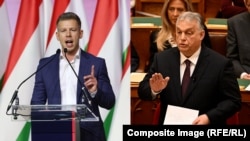
Opinion polls suggest that after 16 years in office, Prime Minister Viktor Orban may be about to lose power to opposition leader Peter Magyar. But Orban has defied the polls in the past.
The outcome of the elections will not only be closely watched in Kyiv and Moscow. Hungary’s troubled relationship with many countries in the European Union means that EU nations are also keenly interested in the outcome of the vote, while Washington has expressed strong support for Orban.

Why It Matters
Orban has created a pivotal role for Hungary.
As an EU member, it has managed to block or water down many EU decisions on sanctions against Russia following its full-scale invasion of Ukraine in 2022. It has also prevented some EU support for Ukraine.
Recently, he stopped a 90-billion-euro ($105 billion) loan for Kyiv for 2026 and 2027, initially agreed by EU leaders in December 2025. Last month, Hungarian police seized two vans carrying more than $80 million in cash and 9 kilograms of gold bars, along with seven Ukrainian citizens, who were en route from Austria to their home country in what was considered the regular transportation of monetary instruments.
These steps came after Orban accused Ukraine of stopping deliveries of Russian oil via the Druzhba pipeline. Ukraine says the pipeline was damaged by Russian strikes and repairs would take time.
All of these issues have fed into the election campaign, as have leaked telephone calls in which Hungarian Foreign Minister Peter Szijjarto appeared to be briefing his Russian counterpart, Sergei Lavrov, on high-level EU meetings.
After first denying it, Hungary's foreign minister then confirmed that he not only speaks to Russian colleagues before and after EU meetings, but also to counterparts from Israel, Serbia, Turkey, and the United States.
Scenario 1: Orban Wins
Ahead of the elections, US President Donald Trump wrote on social media that Orban “has my complete and total endorsement.” The two leaders have close ties based on ideological proximity and personal chemistry.
If Orban wins, this close relationship can be expected to continue.

EU officials have told RFE/RL they would expect Orban to “mellow somewhat” and allow some vetoes to be lifted if he manages to remain in office.
But they also expect, broadly speaking, continuity -- as do political analysts that RFE/RL spoke to.
“The only change here now is that he didn't really account for the dependence on Ukraine [for Russian oil] and that gives some strong cards to the Ukrainians,” said Zsuzsanna Vegh, program officer at the German Marshall Fund in Berlin.
“Transit through the Druzhba pipeline is essential at the moment for Hungarian energy supply and, if there is no quick resolution to [Iran’s blockade of the] Strait of Hormuz, then this may really be a point where Ukraine can put some pressure on Hungary as well,” she added.
Botond Feledy, head of Brussels-based Red Snow Consulting, said an Orban victory would see an entrenchment of Hungary’s existing foreign policy trends.
He foresaw “relationship deterioration with the EU and hence potentially some political support from Trump…seeing Hungary as the good pupil of the [Make America Great Again] ideology on the continent. And the Russians will just use it as they have used it before, without any emotional attachment and as long as it is useful.”

However, he added, he did expect movement on some issues once polling day is past, such as the seized Ukrainian gold.
“I understand Orban saying something along the lines that he will incrementally unblock Ukrainian funds once he is back in government,” he said. “It will be up for negotiation.”
The Hungarian government did not respond to RFE/RL’s request for comment on future foreign policy steps.
Scenario 2: Magyar Wins
Magyar’s primary focus in the election campaign has been on domestic issues, particularly an anti-corruption campaign.
In an interview with RFE/RL in October 2025, he indicated that his foreign policy instincts would be cautious.
In particular, he said that there would be no quick end to Russian fossil fuel imports, despite EU pressure for Hungary -- and neighboring Slovakia -- to fall into line with steps taken by other member states to fully cut energy ties with Moscow by 2027.
Hungary currently imports around 95 percent of its natural gas supplies from Russia, while during the first half of 2025 some 92 percent of its oil imports came from Russia.
“I understand him not being willing to take early risks by declaring potential objectives that he cannot fulfill,” Fedely said.
“The main issue is that those contracts are still confidential, and any incoming government or Peter Magyar cannot really estimate what actually those contracts with Russia contain,” he added.

The currently fluid situation on international energy markets caused by the Iran war only adds to the uncertainty here.
Magyar has made broad statements about shifting Hungary’s foreign policy away from Moscow and towards the EU and NATO.
He has avoided being too specific on Ukraine beyond indicating that he does not support moves to grant Ukraine accelerated EU membership. But analysts did expect a change of tone from Magyar if he wins.
“His campaign rhetoric on Ukraine has been muted, has been very restrained. He does not dare to just openly confront Viktor Orban on this question,” Dalibor Rohac, senior fellow at the American Enterprise Institute, told RFE/RL.
“But the postelection reality in which Peter Magyar will have to repair Hungary's relationship with the EU and Hungary's allies and restore Hungary's place in Europe...will make it inevitable that Hungary will become a more constructive partner, including for Ukraine,” he added.
Vegh voiced a similar view.
“The attitude and the approach generally would be different. I think there would be an attempt for partnership towards the EU's policies regarding Ukraine,” she said.
In his RFE/RL interview, Magyar also praised Trump for his Gaza peace initiative and for putting pressure on Russia to agree to “peace, or at least a cease-fire” in Ukraine.
When JD Vance visited Budapest on April 7, the vice president also stated the White House’s support for Orban, but added that the United States would "work with whoever wins this election."