



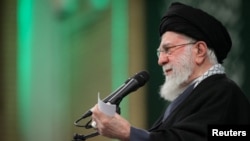
Iran's clerical rulers resorted to unprecedented brute force to put down weekslong antiestablishment protests that posed the biggest threat to their rule in decades.
Even though the clerical establishment appears to have survived the latest round of mass protests, many observers say its days are numbered.
US President Donald Trump, who has threatened military action against Iran over the deadly crackdown on protesters, has called for new leadership in the Islamic republic.
RFE/RL interviewed Alex Vatanka, director of the Iran Program at the Middle East Institute in Washington, about possible US action against Tehran and the likelihood of change in Iran.
RFE/RL: For the first time in nearly four decades, it feels like things might finally change in Iran. It increasingly looks like a make-or-break moment. Protests have happened before. How is this one different?
Alex Vatanka: Obviously, Iran has experienced a number of protests in the last decade, and even before. What has happened during the last decade is the frequency of the protests. They happen more often, and they have become more radical. Ten years ago, protesters would ask for policy change, and they would chant slogans about how miserable life is.
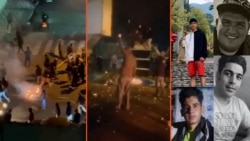
Today, they are shouting for the toppling of the regime. They are shouting for the death of the dictator, by which they mean Supreme Leader [Ayatollah] Ali Khamenei. Previously, they would be in the streets and maybe burn some garbage cans in the city of Tehran. Now what we are seeing is attacks on mosques. Some of the protesters have been willing to fight the security forces. We have seen thousands of people killed. The fact is this is on a different scale, and each time we have seen the trend continue, the protesters are becoming angrier. Their demands are more fundamental. They want fundamental change, and the security forces are acting more ruthlessly.
The external context matters here because the regime genuinely seems to believe that even if these protesters are homegrown, external powers are going to try to exploit the moment for their benefit. They accuse the United States and Israel of somehow being involved. That just makes this cocktail much more dangerous than what we have seen in previous rounds of protests.
RFE/RL: Speaking of external powers, let's talk about possible US intervention. Based on Trump's initial tweets -- "help is on its way" -- it seemed likely. But now the threat appears to have petered out. So how likely is it, and have the Iranian authorities at least received a reprieve?
Vatanka: President Trump does not seem to have a clear strategy in mind. He stepped in and talked about being on the side of the protesters when the protests were gaining momentum. For a moment, it looked like the regime was on the brink. But as soon as the protests died down, the president backtracked, saying they are not killing people and they are not executing people.
Therefore, he does not see a need for the United States to intervene. That takes us to his basic philosophy. He intervenes when he thinks he is going to be on the winning side. He is certainly not interested in getting the United States involved in another open-ended conflict in the Middle East that looks like nation building, which is exactly what he has always argued against. He is not a man who is interested in building other people's nations for them.
He wants to, as he says, Make America Great Again. In that sense, he was never going to intellectually commit himself to a long campaign to help the protesters, to help them organize, or to give them whatever they need to empower them in a prolonged struggle against the regime. That was never on the cards. For a second, he thought maybe they were going to win in Iran and that he should side with them. When it turned out they were not that close to victory, he stepped out.
RFE/RL: Could Trump be tempted into doing something akin to what he did in Venezuela, where US forces captured President Nicolas Maduro and flew him out of the country, as opposed to a protracted involvement?
[Khameini] is not the father figure he claims to be. When you order mass killings of the country's youth, including children, you cannot credibly claim that role."Alex Vatanka
Vatanka: The Maduro scenario requires a couple of things. The most important one is whether there are people inside the Iranian regime that US intelligence agencies are in touch with, people who are willing to accept a change of power. You cannot have the Islamic republic under Ali Khamenei and call it change. He has to go.
The question is whether the US has that kind of influence, sway, and access to people in the regime to bring about a transition to a post Ali Khamenei Iran. If that can happen, a lot of people will be happy if it actually means things are going to be different going forward.
If you just take Ali Khamenei out and everything stays the same, for example if the Islamic Revolutionary Guards Corps (IRGC) become more open, that is not a change that is going to please people in Iran. That is certainly not going to please the opposition.
Change has to be meaningful. You can see a scenario where people in the regime come to the realization that things cannot continue like this anymore, that time is up, and that this is an opportunity to jump ship, particularly if the United States can give them an off-ramp, an alternative, a way to get off this sinking ship. If it does not sink tomorrow or next week, it is bound to sink in the near future.
RFE/RL: How long are we talking about? The authorities seem to have received a temporary reprieve. How long can they last
Vatanka: There is no sign to suggest that the regime can last another 10 to 15 years, because for the first time we are seeing that the economy has really exhausted itself after more than a decade of sanctions. Previously, the authorities were able to maneuver, coming up with flexible policies to deal with sanctions, but now they are running out of options.
On top of that, there is the corruption issue and the governance issue where the ruling elite have lost their way. They do not appeal to or inspire the youth. All sorts of things are coming together to create conditions that are very unique. The idea that the regime could last much longer is questionable. Killing your way out of a problem can solve the issue once or twice, but it is not guaranteed to work every time.
RFE/RL: Can the clerical establishment make concessions or promise reform, or would that show weakness that could invigorate the protests?
We see mosques being openly attacked, which shows religion is under massive pressure. Many Iranians are giving up on Islam, particularly the version represented by Khamenei."Alex Vatanka
Vatanka: Ali Khamenei has been shaped by two events more than anything else in his determination not to give in to protesters when they are angry in the streets and challenging him. One was how the shah [of Iran] tackled the protests and the revolution he faced in 1978 and 1979. Khamenei was there. He saw the shah come on national television and say, "I have heard the voice of your revolution." That was the end of him.
Khamenei is not going to do that. He is not going to say anything like that. In fact, he is doing the opposite. He has green-lighted the crackdown because he thinks intimidation and fear are the way forward. The second event that shaped him was what [the last Soviet leader] Mikhail Gorbachev did.
RFE/RL: Could we see an Iranian glasnost or openness policy
Vatanka: Khamenei was a young supreme leader when he saw the Soviet Union collapse from within. He does not want to do anything major in terms of reform. What he has to do instead, without publicly accepting change or agreeing to major reform, is take certain steps that suggest some willingness to change. For example, for months now, the authorities have stopped enforcing the mandatory hijab [Islamic head scarf]. It is a policy of the regime, but they realized it was making people angry.
Another thing is that they are talking to the Americans. Even after being attacked by the Americans, they are still saying they talked. There are also reports that they are willing to sit down for talks of sorts with the Israelis through the Russians, with [Russian President Vladimir] Putin mediating between [Israeli Prime Minister Benjamin] Netanyahu and the Iranian leadership. All of this suggests a regime in a very awkward place that knows it has to compromise. It has to bend and be flexible for the sake of survival. It does not announce this loudly or say it is capitulating, but in practice it is taking steps that suggest it knows there is no other way out than compromise at this point.

The regime is stubborn, and that stubbornness is embodied in its supreme leader, but it is not suicidal. It is more flexible when it comes to the outside world than the inside. It gives small concessions because it is scared of the slippery slope that reform could trigger, but there has been some willingness to change, not enough to please the public, but enough to suggest flexibility.
RFE/RL: Speaking of stubbornness or inflexibility, how strong is Islamic ideology in Iran right now compared to the 1980s?
Vatanka: Forty-seven years into this regime, whatever ideology once drove it is largely gone. It mattered in the 1980s, but today the vast majority of people in the system are there because that is where they get their salaries. They do not have alternatives, and nobody has shown them a different political system in which they could still have a role. They fear that major change would mean losing their jobs, their money, or potentially their lives. That is why so many people are hanging on to what is essentially a sinking ship.
RFE/RL: Let's explore the issue of leadership. With Khamenei being 86 years old, who can succeed him without the legitimacy of the Islamic system being questioned?
Vatanka: This is the big question. He has never pointed to a successor, which would be against his nature. He does not want to share the limelight with anyone, so he has never had a deputy. Constitutionally, it is up to the Assembly of Experts to choose his successor. But there could be a situation where there is no supreme leader after him. Since 1979, this role has been held by only two men, [the founder of the Islamic republic, Ayatollah Ruhollah] Khomeini and Khamenei. There is no deeper precedent for it in Iranian history. Getting rid of the Office of the Supreme Leader and restructuring political power is not as far-fetched as it might seem.
RFE/RL: Could that mean the IRGC reinventing itself?
Vatanka: This is a theocracy, and by nature a theocracy is meant to be run by senior religious authority, not uniformed men. One scenario is a token cleric as supreme leader with little real power, while the Revolutionary Guards run the country. In many ways, the IRGC already runs the show. Khamenei is much more powerful than anyone who could replace him. After 37 years in power, no one can really fill his shoes. But for at least the last two decades, the IRGC has been the state machinery people associate with Iran.

RFE/RL: Could we see Iran's theocracy transformed into a military junta?
Vatanka: It could happen. That is one scenario people speculate about. But Iran has no history of military rulers. This is not Latin America in the 1970s. Historically, Iran was ruled by kings and then, from 1979, by clerics. An openly ruling IRGC would be a new reality. Even then, the regime's problems would not go away. The IRGC has effectively been running Iran for decades, both domestically and abroad. Simply moving from Khamenei to open IRGC rule does not solve anything.
RFE/RL: Would that give society a false sense of reprieve -- the feeling that Khamenei is gone, and now everything is for the greater glory of the nation?
Vatanka: No. The IRGC are not seen as nationalist heroes. They may have been viewed that way in the 1980s during the war with Iraq, but for decades they have mostly fought Iranians at home or pursued adventurous policies in places like Lebanon or Gaza. Very few Iranians see the IRGC as nationalist heroes. In that sense, Khamenei and the IRGC are indistinguishable. Their takeover would make no real difference to the fate of the regime.
RFE/RL: Much like Putin in Russia, entire generations in Iran have grown up seeing this man as the sole leader of the nation. What does that do to the national psyche, and how does that complicate things for whoever comes after him?
Vatanka: The end of Ali Khamenei would be an opportunity for the nation to return to where it left off. For decades, Iran has been frozen in the ideological bubble he is committed to. His departure opens space. Yes, there are followers of Khamenei in society, but we are talking about maybe 5-10 percent. He is not the hero of a nation of 90 million. He is seen as the problem. He is not the father figure he claims to be. When you order mass killings of the country's youth, including children, you cannot credibly claim that role.
RFE/RL: If the protests succeed now or in the near future, what will happen to religion as an institution?
Vatanka: We see mosques being openly attacked, which shows religion is under massive pressure. Many Iranians are giving up on Islam, particularly the version represented by Khamenei. Iran is arguably the most secular country in the broader Middle East, more secular than Turkey or the Gulf states. This is not because Islam itself has done something wrong, but because of how it has been practiced by the regime.
RFE/RL: How does one explain the shah's popularity among some of the protesters? Is it simply because he was not as bad as the regime that replaced him, or are people looking for a strongman without a turban?
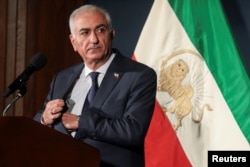
Vatanka: This goes back to the question of who inspires. monarchists who look up to [exiled former Crown Prince] Reza Pahlavi, his father the shah, and his grandfather Reza Khan argue that those leaders achieved a great deal during their time in power. They developed Iran. In contrast, the Islamic republic has brought isolation, sanctions, and dependence on Russia and China. Many Iranians judge leadership by who made the country stronger and more respected.
RFE/RL: Make Iran Great Again?
Vatanka: Yes. There is a lot of nostalgia, but that nostalgia is not born out of a vacuum. It exists because the regime has done such a poor job of connecting with and inspiring people.
RFE/RL: If a strongman were to emerge, who could make the country matter again, are people looking for their own Putin
Vatanka: To some extent, yes. Anyone who can save them from Khamenei gains appeal. Reza Pahlavi has history, name recognition, and some access to foreign powers. But this is a deeply contested issue inside Iran and in the diaspora. The idea that Iranians can only be ruled by a strongman is simplistic. There is hope that the opposition can organize itself and move toward a democratic, pluralistic system similar to Europe. Concentrating too much power in one individual always carries risks.
RFE/RL: China and Russia are clearly paying attention. What realistic options do they have and what would it cost them if Iran's clerical rulers were to fall?
Vatanka: China has very limited appetite for defending the Islamic republic. Beijing treats Iran as a transactional partner, useful mainly as a source of discounted oil, and did very little during the protests or during the 12-day [war with] Israel [last year]. China will not confront Washington or invest political capital to save Tehran. If the regime were to fall, China's main cost would be losing a cheap, sanctions-hit energy source, not a true strategic ally.
Russia, meanwhile, sees Iran as a strategic buffer and a useful partner in regional confrontations, but not an ideological ally. Moscow's support is real and important but bound by pragmatism. A collapse of the regime would cost Russia a regional partner that helps absorb Western pressure, but Moscow does not stake its own security on Iran's internal survival.