




This live blog is now closed. Thank you for following our live coverage.
You can read our continuous live coverage on Iran, along with comprehensive reports and analysis, at this link.
Thank you for your time.
CENTCOM Insists Iran 'Does Not Control' Strait Of Hormuz
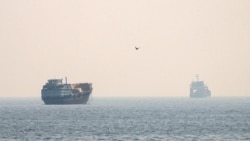
US Central Command, which is responsible for American forces in the Middle East, sent out a "fact check" on July 9, reiterating the US stance that the crucial Strait of Hormuz is an international waterway and that Tehran has no right to control it.
"CLAIM: Iranian state media claims that transit through the Strait of Hormuz is only permitted through routes designated by Iran," CENTCOM posted on X.
"TRUTH: Iran does not control the Strait of Hormuz. Since early May, U.S. forces have helped facilitate the successful transit of more than 800 commercial vessels and 380 million barrels of crude oil through the vital international trade corridor," it added.
Tehran has said it will charge fees for ships transiting the waterway -- a suggestion rejected by most countries in the world. Some 20 percent of the world's crude oil and gas supplies transit the strait, which has become the source of high tensions between the US and Iran.
Iran Says Military HQ Hit, But US Denies Its Forces Conducting Strike
Iranian state media reported that a "US-Israeli projectile" hit a military headquarters on the outskirts of Bushehr amid renewed tit-for-tat strikes by the US and Iran, but American officials denied that US forces were carrying out attacks at the time.
"Moments ago, a military headquarters on the outskirts of Bushehr was attacked and hit by a projectile of the American-Zionist enemy," Iranian state news agency IRNA quoted the deputy governor of Bushehr, Ehsan Jahanian, as saying.
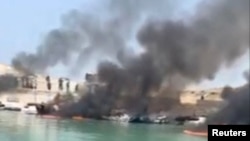
Bushehr is the site of Iran's lone nuclear power plant. Authorities reported that a projectile had hit the perimeter of the plant, although US officials have not acknowledged striking the site.
Iran's Mehr news agency also reported explosions in the port city of Bandar Abbas, but Iranian state TV later denied that report.
Amid the uncertainty, two US officials said the American military is "not currently conducting strikes," although it was not clear if the possibility existed for strikes later in the night or early on July 10.
On July 9, Israeli Defense Minister Israel Katz said his country was prepared to resume its military campaign against Iran if necessary and "with even greater force" than previous strikes.
"The army is ready and on alert for a resumption of fighting, in order to regain air superiority and strike again...in Iran, to eliminate threats, including a third time if necessary," Katz said at a military ceremony.
"If we have to go back, we will go back, with even greater force," he added.
Separately, Israeli Prime Minister Benjamin Netanyahu's office said he and US President Donald Trump spoke by phone on July 9 and that Trump updated Netanyahu on "American moves in the Gulf."
Netanyahu also told a ceremony that said Iran had been weakened by the two previous military campaigns Israel had launched against it, but he also acknowledged that the conflict was not yet over.
"The Iranian axis is weaker than ever before, while Israel is stronger than ever before," he said.
"We proved that the long arm of the Israeli Air Force can reach anywhere, from Yemen to Iran. Yet we must also acknowledge that the campaign is not over."
With reporting by RFE/RL's Radio Farda, Reuters, and AFP
Iran FM Discusses Latest Strikes, Hormuz In Calls With Oman, Turkey, Pakistan
Iranian Foreign Minister Abbas Araqchi has stepped up efforts to build up support internationally, speaking separately by phone with counterparts and officials from Pakistan, Turkey, and Oman, the Foreign Ministry in Tehran said on July 9.
In the call with Pakistan, Araqchi warned against any further US military "adventurism" and condemned US strikes on Iran as a violation of the Islamabad memorandum of understanding in a phone call with Pakistan's powerful army chief, Field Marshal Asim Munir, the ministry said.
Iran's Foreign Ministry said that in separate calls with his Omani and Turkish counterparts, Araqchi discussed the latest developments in the region, particularly in the Strait of Hormuz.
Pakistan and Oman have been acting as mediators in negotiations between Washington and Tehran in recent weeks, although talks appear to have stalled with the latest exchange of strikes between the US and Iran.
With reporting by RFE/RL's Radio Farda and Reuters
Iran Targets Base Housing US Forces In Jordan
Iran's hard-line Islamic Revolutionary Guards Corps (IRGC) said it targeted a base in Jordan that houses US forces after the Jordanian military said it intercepted eight missiles fired from Iran on July 9 as the latest flareup of violence continued in the Middle East.
The IRGC said its forces struck a US "command-and-control center in West Asia and the enemy air base in Al-Azraq, Jordan, with 10 ballistic missiles."
Jordan's Azraq area hosts a Jordanian air base utilized by US, German, Belgian, and French forces as part of a previous campaign against the Islamic State extremist group in the region.

Jordan insists it does not host foreign military bases, although it acknowledges that limited forces from a number of countries are deployed at some Jordanian bases as part of cooperation and training arrangements.
The IRGC added that "if the terrorist US military repeats its aggression, the other US bases in the region will not be safe from our heavy fire."
Jordan's military said its "air defense systems intercepted and shot down, today, Thursday, eight missiles that were launched from Iran toward Jordanian territory."
The intercepts "resulted in the fall of a number of fragments, without any human casualties or material damage." The military added that it will "not allow any violation of Jordanian airspace by any party."
Although it has been targeted in the past by Iranian missiles, Jordan -- a strong US ally -- has not suffered as many attacks as many Gulf Arab states.
The July 9 attacks marked the first time Jordan has disclosed the interception of Iranian projectiles since June 11, when it said its forces downed 20 missiles when the IRGC targeted a US command center in response to US strikes on Iran.
Earlier on July 9, Iran's military said it had launched one-way attack drones against sites in Kuwait, Qatar, and Bahrain in retaliation for US strikes earlier the same day, according to state media.
The Iranian army said it had targeted a Patriot missile interceptor system in Kuwait, an early warning system in Qatar, and fuel tanks in Bahrain with "a large number of various types of army kamikaze drones."
With reporting by RFE/RL's Radio Farda and AFP
Here's a map showing where the US strikes hit Iran last night.
Iranian Media Report Fresh Explosions In Port City
Iran's semiofficial Fars and Mehr news agencies reported on July 9 that fresh explosions had been heard in the city of Bushehr.
Fars said two explosions were heard in the southern port city, while Mehr reported several explosions. No further details about the blasts were immediately available.
Mehr also reported that several explosions were heard in the town of Choqadak in Bushehr Province.
Meanwhile, the deputy governor of Bushehr Province for political, security, and social affairs told the official IRNA news agency that the perimeter surrounding the Bushehr nuclear power plant had also been "hit by US projectiles."
He also said that "following the US attack on a fishing pier in the village of Bonood in Asaluyeh County, local residents' fishing boats caught fire."
The official added that no fatalities have been reported so far from the attacks and that emergency response teams were present in the affected areas.
With reporting by RFE/RL's Radio Farda
Iran Says It Targeted Kuwait, Qatar, Bahrain In Drone Attacks
Iran's military said on July 9 that it had launched one-way attack drones against sites in Kuwait, Qatar, and Bahrain in retaliation for US strikes earlier the same day, according to state media.
The Iranian army said that it had targeted a Patriot missile interceptor system in Kuwait, an early warning system in Qatar, and fuel tanks in Bahrain with "a large number of various types of army kamikaze drones."
This is the first time since the recent cease-fire that Tehran has officially acknowledged targeting Qatar. Qatari authorities have not commented.
Kuwait's Defense Ministry said at least one person was injured in the attacks and that the individual's condition was "stable." It said three ballistic missiles, one cruise missile, and 10 drones launched from Iran were "successfully intercepted and neutralized," but that damage was caused to several locations during the interceptions.
With reporting by RFE/RL's Radio Farda and AFP
Iran Says 14 Killed In Two Days Of US Attacks
The Iranian Health Ministry said on July 9 that 14 people have been killed in the past two days as a result of US attacks on Iran.
According ministry spokesman Hossein Kermanpur, the United States has so far targeted five Iranian provinces in its attacks, leaving 14 people dead and injured 78.
Kermanpur added that 47 of the injured remain hospitalized, while the others have been discharged after receiving medical treatment.
It is not clear whether the casualty figures provided by the Health Ministry include military personnel.
On July 8, the Iranian Army announced that eight of its personnel had been killed in the first night of US attacks, while the Islamic Revolutionary Guards Corps reported that one of its members had also been killed.
With reporting by RFE/RL's Radio Farda
Fresh US Strikes Hit Iran As Tehran Issues Retaliation Warning
US Central Command (CENTCOM) said its forces struck approximately 90 Iranian military targets in a fresh round of attacks on Iran.
In a statement released on July 9, CENTCOM said US forces conducted an additional round of strikes aimed at further degrading Iran's ability to attack commercial shipping and civilian mariners in the Strait of Hormuz.
The latest strikes followed a US attack the previous night, when CENTCOM reported that it had hit about 80 Iranian military targets, including more than 60 boats belonging to Iran's Islamic Revolutionary Guards Corps (IRGC).
The US military said the operation was intended to impose heavy costs on Iran for violating the cease-fire by attacking three commercial vessels in the Strait of Hormuz.
Mohammad Bagher Qalibaf, Iranian parliamentary speaker and chief negotiator with the United States, said that "America still hasn't learned that bullying and breaking promises are no longer cost-free."
"Let me put it plainly: if you strike, you'll get hit," he wrote in a post on X, adding that the Strait of Hormuz would only remain open under Iranian arrangements, not "American threats."