


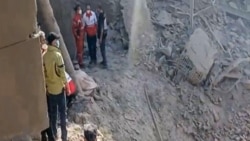
Images obtained by RFE/RL's Radio Farda show the widespread presence of protesters on the streets of the southern port city of Bandar Abbas on the evening of January 8.
Some of the footage shows protesters gathered in front of the city’s state radio and television building.
Iran Says Nuclear Talks With US Should Resume Soon After Oman Meeting
- By RFE/RL
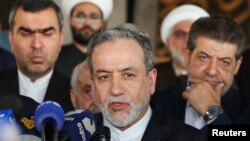
Iran’s foreign minister said Tehran and Washington believe nuclear talks should resume soon following indirect negotiations in Oman, even as Tehran ruled out discussions on its missile program and uranium enrichment.
Abbas Araqchi told Qatar’s Al-Jazeera television on February 7 that both sides agreed the discussions should resume soon, adding that there was no agreed timeline for the next meeting.
While he said that Tehran was open to reaching a deal, Araqchi added that issues over Iran's missile program and uranium enrichment were nonstarters for future negotiations.
“Neither now nor in the future can negotiations be held over missiles because this is a defensive issue," he said. “The issue of banning enrichment is not negotiable from Iran’s point of view."
Araqchi added that Iran would respond to any potential US attack: "If Iran is attacked, we will target US bases in the region."
The comments from Araqchi came a day after delegations from Tehran and Washington held talks mediated by Oman, and after US President Donald Trump said the discussions were “very good.”
While neither side announced concrete outcomes, both suggested that negotiations over Iran’s nuclear program could continue in the near term.
“Iran looks like it wants to make a deal very badly. We have to see what that deal is,” Trump told reporters aboard Air Force One.
"The fact that the talks didn't fail and the two sides did not leave the negotiating table shows that maybe they felt enough common ground or that both sides put some concessions on the table that were attractive enough for both sides to continue the talks," Ali Vaez, Iran project director at the International Crisis Group, told RFE/RL's Radio Farda.
Read more here.
More Than 250 Slain Kurdish Protesters Identified
Hengaw, a human rights group which covers news from the Kurdish regions of Iran, announced in a report on February 7 that it has so far identified more than 250 Kurdish victims of the violent clampdown on demonstrators.
It has so far identified 257 Kurdish citizens who were killed by the Islamic republic's security forces during the nationwide protests in January, including 19 women and 20 children under the age of 18.
According to Hengaw, the dead came from 67 cities, including 10 students, five doctors and nurses, at least two engineers, and one teacher.
Good morning.
We'll start the blog today with the latest casualty figures from the Hrana group, which has been identifying and counting victims of the brutal crackdown on recent protests in Iran.
According to the human rights organization, the total number of deaths so far amounts to 6,955, including 6,905 protesters. Hrana says "the number of injured civilians stands at 11,021" while "total arrests have reached 51,251 cases."
In its daily report on the unrest in Iran, it also highlighted "continued arrests, growing pressure to extract forced confessions, and the emergence of cases signaling an intensification of judicial and security measures."
We are now closing the live blog for today, but we'll be back again tomorrow morning at 9:30am Central European time to follow all the latest developments in Iran.
Trump Threatens Tariffs On Countries Importing From Iran
US President Donald Trump signed an executive order that may impose secondary tariffs on countries that import goods from Iran, a statement released by the White House said on February 6.
The order described the move as "necessary and appropriate" after receiving additional information from senior officials regarding the "actions and policies" of the Iranian government.
The development occurred hours after The Wall Street Journal and Reuters reported that Iran has rejected US calls to halt the enrichment of nuclear fuel during talks in Oman with the United States.
Earlier in the day, the US State Department announced new sanctions on Iran's oil exports, targeting 15 entities and 14 shadow fleet vessels.
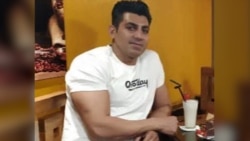
Iranian Bodybuilder Gunned Down From Behind Amid Protests, Says Family
The family of Iranian bodybuilder Mehdi Chooghadi says he was shot by security forces on January 9 in the city of Shahreza amid a crackdown on nationwide protests.
Chooghadi's wounds indicated he was shot from behind after a large crowd had gathered in the streets -- many others were also killed while trying to flee snipers, according to witnesses who spoke to RFE/RL's Radio Farda.

BREAKING: Citing sources familiar with the discussions in Oman, The Wall Street Journal and Reuters separately reported that Iran has rejected US calls to halt enrichment of nuclear fuel.
Reza Pahlavi: Only 'Acceptable Deal' Is Where Iran 'Surrenders To The People'
Before Iran-US talks began in Oman, Iran’s former Crown Prince Reza Pahlavi posted on X: "The only acceptable deal is one in which the Islamic Republic surrenders to the people of Iran."
He added that "we are ready for such a deal and it will bring peace to the region and the world."
Along with Iranian political activists, several US political figures have warned that negotiations should not be limited to Iran's nuclear program.
The United States says Iran's missile program, its handling of protesters, and the regime's regional proxies are also focal points of the talks.
Tehran insists it will negotiate only on the nuclear issue.
Sunni Imam Says 'Vast Majority' Of Iranians Are Dissatisfied
Molavi Abdolhamid, the imam of Sunni Friday Prayers in Zahedan, the capital of the Sistan and Baluchestan Province in southeastern Iran near the borders with Afghanistan and Pakistan, says the "vast majority" of Iranians are dissatisfied and that "no scholar who is on the path of moderation" would consider the January "massacre" of protesters permissible.
The province is home to Iran's largest Sunni Muslim community in the predominantly Shi'a country.
In his Friday Prayer sermon on February 7, he described the recent regime crackdown on protesters as "very heartbreaking and shocking."
Abdolhamid said that the "root of Iran's problems" were in the country's constitution, adding that after the 1979 Islamic revolution, "religious and ethnic views" became dominant in the country.
The imam, citing the “narrow-mindedness” and “tough decisions” behind parliamentary and governmental constraints, noted that even reforms in Iran ultimately lead nowhere.
He noted that the country’s atmosphere has gradually shifted toward “security” and “militarization,” stressing that even “religion” in the Islamic Republic has become securitized.