



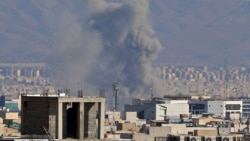
In Bunkers And On Streets, Israelis Celebrate Purim Amid Repeated Missile Strikes
JERUSALEM -- Crowds of civilians in costumes were literally dancing in the streets as they marked the Purim holiday here when air-raid sirens rang out. Immediately, people streamed toward the shelters -- some clutching babies, others drinks.
On this occasion, the shelter was a nearby underground parking lot where revelers continued the party, spinning around with arms linked and singing vigorously. One man was attached to an inflatable horse. A child was dressed as a chick, a parent as a penguin.
It was a jarring moment where a high-spirited party collided with war.
To read the full report by RFE/RL Senior International Correspondent Ray Furlong, click here.

Pentagon Investigating Attack On Girls' School In Iran
US Defense Secretary Pete Hegseth announced the launch of an investigation after reports emerged of an air strike on a girls' school in the southern Iranian city of Minab on February 28 that Iranian media said killed more than 160 people.
"All I can say is that we're investigating that," he told reporters at a Pentagon news conference on March 4. "We, of course, never target civilian targets, but we’re taking a look and investigating that."
The girls' school was located near a base of the Islamic Revolutionary Guards Corps. Hegseth did not provide further details about who may have been responsible for the attack or the type of ammunition used, only saying the Department of Defense was investigating the attack.
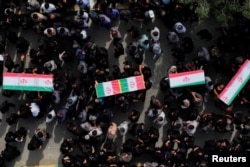
Qatari PM To Iran: Stop Attacking Regional Countries
Sheikh Muhammad bin Abdulrahman al-Thani, Qatar's prime minister and foreign minister, has called on Iran to immediately stop attacks on Gulf countries, saying such attacks do not reflect Iran's goodwill toward its neighbors.
On March 4, the Qatari Foreign Ministry wrote in a post on X Iranian Foreign Minister Abbas Araqchi told al-Thani in a phone call that "Iran's missile attacks were aimed at American interests and did not target the Qatari government."
According to the report, al-Thani rejected the claim and said objective evidence shows that areas targeted by Iranian attacks included residential areas inside Qatari territory, critical infrastructure, and industrial areas where liquefied natural gas production facilities are located.
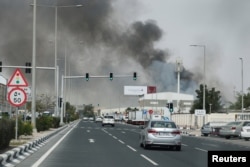
Strait Of Hormuz Oil Tanker Traffic Down 90 Percent, Says Kpler

Energy market analysis firm Kpler announced on March 4 that tanker traffic in the Strait of Hormuz has decreased by 90 percent since the start of the US-Israeli attacks on Iran.
Spokespeople for the Iranian Armed Forces have said they have completely stopped traffic on the waterway.
“Unlike some other shipping sectors that have largely ground to a halt, some ships are still sailing east and west through the Strait of Hormuz, and some are sailing with their tracking systems off,” said Matt Wright, senior shipping analyst at Kepler, referring to the maritime traffic tracking system.
Meanwhile, Chinese Foreign Minister Wang Yi told his UAE counterpart in a phone call that the security of shipping lanes must be protected.
According to the Chinese Foreign Ministry, Wang said the "red line" of protecting civilians in conflicts must not be violated and civilian targets, including energy-related facilities, must not be attacked.
Wang told his counterparts in Saudi Arabia and the United Arab Emirates on March 4 that China would send a special envoy to the Middle East to mediate.
China sources most of its oil from the Middle East.
Turkey Summons Iranian Ambassador Over Missile
Turkey summoned the Iranian ambassador to Ankara to the Foreign Ministry on March 4 to express concern over a ballistic missile that was fired from Iran and headed toward Turkish airspace.
The Turkish Defense Ministry announced the interception and destruction of the missile hours earlier, saying parts of the defense system used to intercept the missile fell in the country's Hatay Province, but there were no casualties in the incident.
Turkish Foreign Minister Hakan Fidan also contacted his Iranian counterpart, Abbas Araqchi, and called for avoiding any action that would lead to the spread of war.
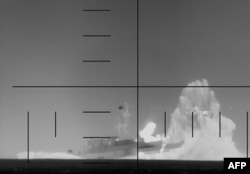
US Confirms Sinking Iranian Ship, Says Tehran Firing Fewer Missiles
Defense Secretary Pete Hegseth has confirmed that a US submarine sank an Iranian warship off the coast of Sri Lanka as military officials said Iran is firing fewer missiles at targets around the Gulf region due to its decimated capabilities to wage war.
Speaking at a briefing on March 4, Hegseth called the attack -- which left at least 87 seamen dead with dozens of others injured or missing -- "quiet death." Sri Lankan authorities said 32 Iranian sailors were rescued.
"An American submarine sunk an Iranian warship that thought it was safe in international waters. Instead, it was sunk by a torpedo," Hegseth said.
To read the full report, click here.
The Administrator, The Wild Card, The Heir: The Clerics Vying For Iran's Top Job
For the first time in 36 years, Iran finds itself having to pick a new supreme leader.
It has happened only once before, in 1989, after the death of the founder of the Islamic republic, Ayatollah Ruhollah Khomeini, paved the way for Ayatollah Ali Khamenei to take over.
While Khomeini died of natural causes, Khamenei was killed on the first day of a joint US-Israeli military campaign against Iran on February 28. Now the 88-seat Assembly of Experts must convene in secret to select his successor.
Alex Vatanka, director of the Iran Program at the Washington-based Middle East Institute, told RFE/RL that whoever emerges will be chosen on a single criterion: political expediency. The Assembly of Experts is today a "rubber-stamp body" and the process will be driven by circumstance rather than grooming, Vatanka argued.
Many names over the years have been thrown around as potential successors to Khamenei, but currently three candidates are widely considered to be frontrunners: Mojtaba Khamenei, Alireza Arafi, and Hassan Khomeini.
To read the full report, click here.
Taliban Profiting From Global Air Traffic Chaos Amid Iran War
The ongoing war in Iran and airspace closures in the region have forced airlines to reroute, creating congestion across alternative paths connecting Europe and Asia. In particular, the Afghan Taliban have been experiencing a windfall in transit fees amid a surge in flights over its territory.
Despite recent clashes and air strikes between Pakistan and Taliban‑controlled areas of Afghanistan, the airspace over both countries, known as the Afghan‑Pakistan Corridor, is now one of the few alternatives to the southern routes.
Live FlightRadar data shows the number of daily flights over Afghanistan has jumped from about 50 to over 280 per day -- representing a fivefold increase -- since February 28. Pilots must fly high and follow strict paths because most of Afghanistan lacks formal air-traffic control.
Transit flights generate revenue for the Taliban, who charge $700 per aircraft without providing any air-traffic control services. The surge in flights is already bringing the Taliban a sudden windfall, with an estimated $196,000 daily in transit fees.
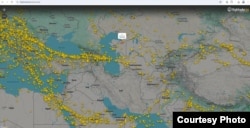
Another crucial route is the Caucasus. Armenia, Azerbaijan, and Georgia have emerged as a major alternative for Europe‑Asia flights. Pilots must navigate close to restricted airspace over both Russia and Iran. As of March 4, the Caucasus air corridor is experiencing a massive surge in traffic, with volume roughly tripling following the start of military operations in Iran on February 28.
Major carriers such as Lufthansa, Singapore Airlines, and British Airways, as well as regional airlines like Uzbekistan Airways and Air Astana, are using both corridors to keep routes open.
FlightRadar24 has noted long lines of planes in the Afghan airspace, which airlines had until recently almost completely avoided. The last time a dramatic increase of flights over Taliban‑controlled airspace was recorded was during June 2025 war on Iran.
Kallas Says Iranian Capacity To Target Gulf States 'Unsustainable'
WARSAW -- EU foreign policy chief Kaja Kallas says she doubts Iran's capacity to sustain its pace of attacks on countries across the Middle East given its decimated military following the 12-day war last year with Israel and the current US-Israeli campaign launched against it over the weekend.
"We have to understand that the Iranian capacities are not endless, especially if also the big friends are not supporting them," she told RFE/RL in an interview conducted in Warsaw on March 4.
"Americans have also said that their target is the missile launchers and missile factories, then their capacity to cause harm is also and maybe more limited than they want to show. So this is always also a fight for narratives."
To read the full report, click here.

Iran War Sends Economic Ripples Through Central Asia, Turkmenistan Most Exposed
Balkan, in western Turkmenistan along the Iranian border, is one of the first regions to feel any disruption in trade from Iran. Residents there are reliant on imported goods arriving daily from nearby crossings, so even minor delays or price changes in Iranian shipments are immediately noticeable in local markets.

As one Balkan resident put it: "We are almost entirely dependent on Iran for both food and household items. Without these imports, our markets would be nearly empty."
Another resident, reporting on current market shortages, said there are already apparent shortages due to cargo from Iran being held up. "Five liters of Iranian cooking oil used to be 150 manats ($29), and today it's 200. Prices for cleaning and chemical products have gone up by 5 manats across the board. Some shops that normally sell Iranian food in bulk are now selling only in small quantities."
Ashgabat, Turkmenistan's capital, located just 25 kilometers north of the Iranian border and roughly 350 kilometers northeast of the main Sarakhs crossing, sees supply fluctuations and price increases with a slight lag after border regions. But residents there are feeling the pressure on daily staples.
To read the full report, click here.