


Iranian Attacks On Israel Reportedly Leave 2 Dead
Local Israeli media reported on March 18 that at least two people were killed in an Iranian missile attack on the country.
According to the Haaretz and Times of Israel newspapers, citing aid organizations, the victims were seriously injured in an attack on the city of Ramat Gan, near Tel Aviv, and later died from their injuries.
The reports said that two others were also wounded in the cities of Bnei Brak and Petah Tikva, east of Tel Aviv.
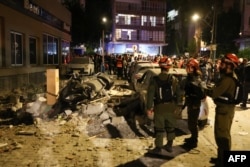
The Israeli Army announced that strikes were reported in several locations in the central part of the country and urged people to avoid the affected areas.
Following the killing of Ali Larijani, the secretary of the Supreme National Security Council, the Islamic republic announced it had targeted Tel Aviv with missiles equipped with cluster warheads in retaliation, Iranian state television reported on March 18.
The nighttime attack on a neighborhood near densely populated areas of Tel Aviv, which also houses important military installations, brought the death toll in the war in Israel to at least 14.
A statement read by the Islamic Revolutionary Guards Corps on state television said that the attacks used Khoramshahr-4 and Qadr missiles, both of which carry multiple warheads.
Israel has accused Iran of repeatedly using cluster munitions, which split into several smaller bombs midflight and spread over a wide area, making them difficult to intercept.
Meanwhile, several explosions were heard in Jerusalem on March 18, following the Israeli military's announcement that it had detected a new wave of missiles fired from Iran.
AFP said that its reporters saw bright lights in the sky and hearing several explosions. The Israeli Army announced that air defense systems were operating to counter the threat.
As sirens sounded in various parts of the city, the Home Front Command called on residents to go to shelters.
Israeli police also announced on March 17 that fragments of missiles and interceptor systems had been found in holy sites in the Old City of Jerusalem, including around Al-Aqsa Mosque and the Church of the Holy Sepulchre.
We are now closing the live blog for the day. We'll be back tomorrow at 7:30 a.m. Central European time to cover the latest events across the Middle East.
Trump: We Are Ahead Of Schedule In Iran
In a meeting with Irish Prime Minister Michael Martin at the White House, US President Donald Trump spoke of his administration's military operation against Iran and reiterated it is not going to take much longer. "We had to do a short mission to deal with nuclear weapons that were in the hands of a few crazy people; but other than that, it will be over in a week or two and it won't take long," Trump said on March 17. He stopped short of providing a more specific timeframe, adding that “everything is moving very quickly” and that “we are well ahead of schedule.” March 17 marked day 18 of the US and Israeli military operations against Iran, which the Pentagon calls Operation Epic Fury and Israel calls Operation Roaring Lion.
Wall Street Journal: Russia Expands Support For Iran In Targeting US Forces
Russia is “providing satellite imagery and improved drone technology” to help Iran target US forces in the Middle East, The Wall Street Journal reported on March 17, citing people it did not name but said were familiar with the matter.
The technology Russia is providing includes components that are intended improve communication, navigation, and targeting of modified Shahed drones, the newspaper reported.
Ukrainian President Volodymyr Zelenskyy told British lawmakers on March 17 that Kyiv has “clear evidence that Iranian Shaheds used in the Middle East contain Russian components.”
The Wall Street Journal also said that based on its experience deploying drones in its war against Ukraine, Russia has been offering tactical guidance on how many drones should be used in operations and what altitudes they should strike from.
Additionally, it said Russia has recently provided satellite imagery directly to Iran.
The reported cooperation goes beyond the support first described by The Washington Post, which said Moscow passed along the locations of US military assets in the Middle East and Persian Gulf region.
The Wall Street Journal reported that its sources, who included a senior European intelligence officer and a Middle Eastern diplomat, said the Russian support is believed to have helped Iran carry out recent strikes on US radar systems in the Middle East.
Ali Larijani Confirmed Killed
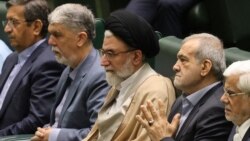
Ali Larijani, one of Iran’s most powerful figures and a close confidant of the late Supreme Leader Ayatollah Ali Khamenei, has been confirmed dead.
Read our obituary here.
Ukraine’s Zelenskyy Calls Russia And Iran 'Brothers In Hatred'
Ukrainian President Volodymyr Zelenskyy lashed out at Russia and Iran in a speech to the British Parliament, calling their governments “brothers in hatred” and “terrorist regimes” that are helping each other fight wars.
Russia has used Iranian-supplied Shahed drones in its full-scale invasion of Ukraine and has also used Iranian technology to manufacture its own drones. Zelenskyy said that Russia has also provided components for drones Iran has been using as it strikes targets in the region in response to the US-Israeli attacks that began on February 28.
“Iran taught Russia how to launch [Shaheds] and gave [Russia] the technology to produce them. Russia then upgraded them, and now we have clear evidence that Iranian Shaheds used in the Middle East contain Russian components,” Zelenskyy said. “So what is happening today around Iran is not a faraway war for us.”
“The regimes in Russia and Iran are brothers in hatred and that is why they are brothers in weapons, and we want regimes built on hatred to never win in anything,” said Zelenskyy, who also met on March 17 with British Prime Minister Keir Starmer and King Charles.
He said he had sent military experts to the Middle East “at the request of our partners, including the United States," in part to help them defend against drone attacks.
Zelenskyy visited Paris last week and heads to Madrid on March 18 as Kyiv and its European supporters seek to keep a spotlight on Russia’s war against Ukraine at a time when the US is focused on Iran and the conflict there threatens to deprive Ukraine of weapons for its defense against Russia.
Trump Says NATO Allies Reject Participating In Iran Operation
President Donald Trump says the United States has been informed by most of its NATO allies that they don't want to get involved with the country's military operation in Iran.
Trump said in a social media post on March 17 that "we have had such Military Success [against Iran], we no longer 'need,' or desire, the NATO Countries’ assistance."
Trump had called for help securing shipping through the Strait of Hormuz, which Tehran has effectively shut down with attacks on vessels and threats of more.
Some countries had said they'd consider such a move but many others rejected getting involved.
US Counterterrorism Chief Kent Quits Citing Iran Conflict, White House Rejects Claims
Joseph Kent, the head of the United States' National Counterterrorism Center, said he is resigning over the Iran military operation.
Kent said in a letter to President Donald Trump, which he posted on X on March 17, that the United States was deceived into "believing that Iran was an imminent threat" by Israeli officials and "influential members of the American media. He added that while he supported the values and foreign policy Trump talked about during all three of his presidential campaigns, he could not continue given the current situation with Iran.
"I cannot in good conscience support the ongoing war in Iran," said Kent, a combat veteran whose navy cryptologist wife died in Syria in 2019.
Kent added that he hoped Trump would reverse course and "chart a new path for our nation."
White House spokeswoman Karoline Leavitt said in a statement on X that Kent made "many false claims" in his letter, including that Iran posed no imminent threat to the United States.
She also called the assertion that Trump was influenced by others "absurd."
"President Trump has been remarkably consistent and has said for DECADES that Iran can NEVER possess a nuclear weapon," she said.
Kent, who was nominated by Trump and confirmed to the post by the Senate, is the highest ranking official in the administration to have stepped down specifically because of the Iran war.
In Photos: Iranian Kurds Watch And Wait As Tehran's Air Strikes Hit Region
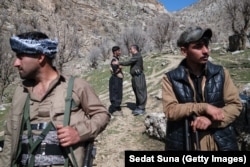
After initially voicing support, US President Donald Trump says he doesn't want Iran's Kurds to enter the military operation against Tehran -- at least for now. Still, one group of exiled Kurds is "preparing for war" just in case, according to a photographer who visited one stronghold of Iranian Kurds.
Photojournalist Sedat Suna gained access on March 12 to a mountain base of the Komala -- Reform Faction, an armed political entity of Iranian Kurds based in the northeastern region of Iraq that has recently been targeted by Iranian drone strikes.
To see the full photo story, click here.
Explosions Rock Baghdad As Drone Strikes Target US Embassy
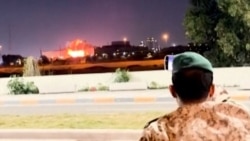
Witnesses recorded explosions in Baghdad on March 17 as drone strikes targeted the US Embassy compound in the heavily fortified Green Zone in Iraq's capital city.
Footage recorded on mobile phones showed smoke and fire as air defenses intercepted several drones.