



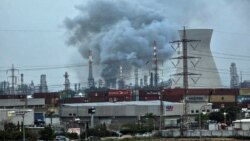
Qatar Slams Iranian Attacks On Regional Energy Facilities
Qatar has strongly condemned Iran's recent attacks on energy facilities in Saudi Arabia and the United Arab Emirates, calling them a serious violation of international law and a threat to global energy security, navigation, and the environment.
"Iran's brutal attacks on countries in the region have crossed all red lines by targeting civilians, civilian objects, and vital facilities," Qatar's Foreign Ministry said in a statement on March 19.
It also emphasized "the need to spare the region the consequences of these unjustified attacks and to work towards de-escalation to restore regional and international security and stability." Qata
'Brief Restoration' Of Internet Reported In Iran, Says Monitor
The Internet monitoring group NetBlocks reports that network data showed a "brief restoration" of Internet connectivity in Iran during the 444th hour of the country's second-longest digital blackout.
"Some users report coming momentarily back online after an apparent filtering system glitch. However, the restoration is not sustained," NetBlocks said in a post on X late on March 18.
The Islamic republic cut Internet access across Iran in the early hours of February 28, shortly after the start of US and Israeli attacks. Connectivity from inside the country has dropped to around 1 percent since the conflict started.
Experts and rights groups say Internet shutdowns in Iran can limit information leaving the country and help authorities control the narrative during unrest or conflict.
EU Leaders To Convene, With Iran, Ukraine Wars On Agenda
The wars in Iran and Ukraine will be on the agenda as European Union leaders meet in Brussels on March 19. Fuel prices in the EU have surged since the United States and Israel began an air campaign against Iran nearly three weeks ago, and member states are struggling to find ways to ease the burden on consumers. The matter of high energy prices has been an issue for EU leaders even before the Iran war and have only been exacerbated with the disruptions to the sector as the conflict has spilled over into the greater Gulf region.
Vessel Hit Off Gulf Of Oman As Shipping Remains Perilous
A vessel has been struck by an unknown projectile while in the Gulf of Oman near the Strait of Hormuz, a British naval security agency said on March 19. The UK Maritime Trade Operations (UKMTO) said it received a report at 2300 GMT on March 18 "that a vessel has been hit by an unknown projectile, which has resulted in a fire on board" about 20 kilometers off United Arab Emirates port of Khor Fakkan. Further details were not immediately available. Ships have repeatedly been hit by projectiles in the Persian Gullf, the Strait of Hormuz, and the Gulf of Oman since the US-Israeli attacks on Iran began on February 28. Threat of attack as brought a severely disrupted shipping in the region, hitting the oil sector especially hard.
Trump Warns Of Dire Consequences As Iran Hits Qatari Gas Hub For Second Time
US President Donald Trump on social media late on March 18 warned Tehran with dire consequences if it again retaliated for an Israeli attack on Iran's massive South Pars gas field, an important part of the country's Gulf energy infrastructure.
As Trump's comments were posted on Truth Social, Iran, in fact, did retaliate again, targeting Qatar's main gas hub, Ras Laffan, for a second time in 24 hours, causing fires and "extensive damage" both times.
It was not immediately clear if Trump knew about Iran's second strike on the Qatari site when his comments were posted to social media or the exact timing of the two events.
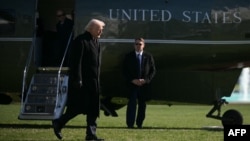
Trump vowed that there would be no further Israeli attacks on South Pars, unless "Iran unwisely decides to attack a very innocent, in this case, Qatar."
"In which instance the United States of America, with or without the help or consent of Israel, will massively blow up the entirety of the South Pars Gas Field at an amount of strength and power that Iran has never seen or witnessed before."
"I do not want to authorize this level of violence and destruction because of the long term implications that it will have on the future of Iran, but if Qatar’s LNG is again attacked, I will not hesitate to do so," he said.
Trump also said that Washington did not know in advance about the Israeli strike on South Pars after Israeli media reported the attack was conducted by Israeli forces with US consent.
"Israel, out of anger for what has taken place in the Middle East, has violently lashed out at a major facility known as South Pars Gas Field in Iran," Trump said. "The United States knew nothing about this particular attack. ..."
Saudis 'Reserve Right' To Take Military Action Against Iran, Top Diplomat Says
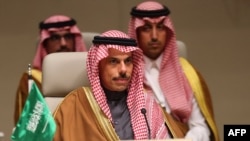
Saudi Arabia's foreign minister on March 19 said the kingdom "reserves the right" to act militarily against Iran after Riyadh was targeted by Iranian ballistic missiles.
Prince Faisal bin Farhan told a news conference that any trust with Tehran has been shattered and that pressure from Iran will "backfire" as the Islamic republic continues to retaliate for the US-Israeli air strikes with missile and drone launches against Gulf Arab states.
Tehran accused Israel of striking its facilities in the huge South Pars gas field on March 18 in a major escalation in the war. Iran has vowed to attack oil and gas targets throughout the Gulf, immediately firing missiles at Qatar and Saudi Arabia.
In the harshest comments to come out of the Saudis since the start of thte war, the foreign minister accused Iran of hostile actions against its neighbors -- directly and through its many regional proxies.
He said the most recent attacks had been long planned by Tehran and were not in reaction to the South Pars attack.
"This pressure from Iran will backfire politically and morally and certainly we reserve the right to take military actions if deemed necessary," Farhan told reporters following a meeting of the region's top diplomats in Riyadh.
Interceptors were fired from near the Riyadh hotel where the conference was held around the time foreign ministers from about a dozen countries -- including Turkey, the UAE, Jordan, Qatar, and Syria -- gathered for a meeting on the Iran war.
With reporting by Reuters
Macron Calls For Suspension Of Attacks Oil, Gas Sites In Middle East
French President Emmanuel Macron called for a suspension of attacks on oil and gas facilities in the Middle East, following talks with US President Donald Trump and the Qatari emir, Tamim bin Hamad Al Thani. "It is in our common interest to implement, without delay, a moratorium on strikes targeting civilian infrastructure, particularly energy and water supply facilities," Macron said on X. "Civilian populations and their essential needs, as well as the security of energy supplies, must be protected from military escalation," he added. The French president said he had spoken with Al Thani and Trump "following the strikes that hit gas production facilities in Iran and Qatar" on March 18. US and Israeli air strikes have hit Iranian targets, while Tehran has retaliated with launches against energy infrastructure in the region.
Israeli Media Report IDF Attacks Iranian Navy In Caspian Sea
Israeli media are reporting that the country's air force has targeted Iranian naval vessels in the Caspian Sea for the first time.
The TV channel N12 on March 19 described an "unusual attack" in the northern Iranian port city of Bandar, citing Israeli security sources.
The news website ynet and broadcaster Kan 11 also are reporting an attack by the Israel Defense Forces (IDF) on Iranian naval targets.
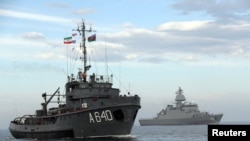
Israel's military did not immediately comment on the reports, although the IDF said it had struck sites in northern Iran for the first time.
US President Donald Trump recently said the US military had destroyed Iran's entire navy.
Iran's Northern Fleet is based in Bandar Anzali.
N12 quoted a security source as saying, "We attacked an Iranian naval vessel, this is a dramatic event."
This is the first time the Israeli military has attacked the Iranian navy on such a distant site -- some 1,300 kilometers from Israel -- the report cited officials as saying.
Iran Condemned By EU After Executing Swedish Citizen Charged With Spying For Israel
Iran has executed a Swedish citizen, the Foreign Ministry in Stockholm said on March 18, prompting condemnation from Sweden and EU foreign policy chief Kaja Kallas.
Swedish officials did not name the person, who had been arrested in June of 2025.
But earlier, the Mizan Online news agency, which is run by Iran's judiciary, said a man named Kouroush Keyvani was executed for spying for Israel. It said he was arrested during Iran's 12-day war with Israel in June 2025.
Keyvani, an Iranian national, had also obtained Swedish citizenship in 2019.
Sweden had repeatedly raised his case with Tehran, Foreign Minister Maria Malmer Stenergard said.
Since his arrest, "we have done everything in our power to try to change this situation. We have been in contact at various levels, both in Stockholm and in Tehran," Stenergard said.
"The death penalty is an inhumane, cruel, and irreversible punishment. Sweden, together with the rest of the EU, condemns its application in all circumstances," she said.
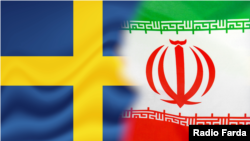
She added that legal proceedings leading up to the execution did not meet the standards of due process.
Kallas said: "The appalling human rights situation in Iran and the alarming increase in executions are intolerable and show the regime's true colors."
Keyvani was the third person executed by Iran on espionage charges this year. The Norway-based Iran Human Rights monitoring group said at least 13 people were executed last year on spying-related charges.
Western governments and rights groups of soundly condemned Tehran for executions carried out after questionable legal proceedings.
Iran executed more than 2,500 people in 2025 for various crimes in what the UN human rights watchdog called a "dramatic escalation" and Amnesty International called a "horrifying assault" on the right to life.
Save The Children Says War Delaying Deliveries Of Life-Saving Medicines
The Save the Children aid organization said the war in Iran has disrupted transport of crucial medical supplies for more than 400,000 children.
"The conflict in the Middle East and wider region is obstructing key delivery routes for humanitarian supplies, delaying life-saving medical shipments for at least 410,000 children in three countries" and "the global impact will only grow," it said in a statement.
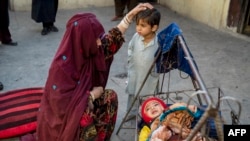
"The escalating conflict is having dire ripple effects on global aid supplies due to disruptions to key air, sea, and land routes, with shipping costs estimated by Save the Children to skyrocket about 10-50 percent to reroute aid in some cases," it added.
Aid deliveries hit by the delays were set for delivery to families in Sudan, Yemen, and Afghanistan, the organization added.
It said that a consignment for Sudan is currently stuck in the United Arab Emirates because the crucial Strait of Hormuz is almost completely blocked to shipping.
A separate shipment destined for Yemen is stuck in Dubai and now will have to be transported by land.
"Lifesaving aid is being delayed around the world, costs are soaring as a result of the fuel price increases at a time when governments are cutting vital foreign aid budgets, and families in some of the world’s most fragile places risk losing the support they depend on," said Willem Zuidema, the organization's global supply chain director.