




Iran Says It Executed 2 Men Linked To Opposition Group
Iran has executed two men convicted of links to the exiled Iranian opposition group, Mujahedin-e Khalq (MEK), and of plotting attacks in Tehran with improvised launcher devices, the Iranian judiciary’s news outlet said on March 30.
The two men, identified as Akbar Daneshvar-Kar and Mohammad Taqavi Sangdehi, were executed in the early hours of March 30. Iranian media said they were accused of carrying out “multiple terrorist acts,” and that explosive devices and related equipment were found in safe houses linked to them.
The MEK is an Iranian opposition group dating to the 1960s that has opposed both the Shah and the Islamic republic. It was previously designated by the United States as a foreign terrorist organization before being delisted in 2012.
In November 2025, Mai Sato, the UN special rapporteur on human rights in Iran, warned that the cases of the two men and four others were marked by serious due process concerns, including delayed access to lawyers and allegations of torture, and said imposing the death penalty in such cases would violate international law.
With reporting by Reuters
US Special Forces Arrive In Middle East, Giving Trump More Options: NY Times
The New York Times late on March 29 reports that several hundred US special operations troops have arrived in the Middle East to give President Donald Trump and the military additional options in the war with Iran.
The report, citing two unnamed US officials, said the commandos have not yet been assigned specific roles in the conflict. They will join the thousands of marines and elite paratroopers being sent to the region to join the 50,000 troops already there.
The commando forces include Army Rangers and Navy SEALs, the Times cited the officials as saying.
US leaders, including Trump and Secretary of State Marco Rubio, have said the deployment of any additional troops would be designed to give the president further options in dealing with Iran.
Among the possibilities is a potential seizing of Iran's Kharg Island, a key oil terminal and a major cog in the country's economic machine. The US military could also seek ways to safeguard shipping in the Strait of Hormuz, which has been largely closed by Iran.
Another potential use of special forces, the Times reported, would be a mission to capture Iran’s highly enriched uranium supplies at the Isfahan nuclear site.
The reported noted that military experts caution that even 50,000 troops are a small number for a major land operation. The US-led coalition that invaded Iraq in 2003 was close to 250,000 at the beginning, the Times said.
Trump Says He Wants Iran's Oil, Insists Peace Talks Going 'Extremely Well'
US President Donald Trump said he wants to “take the oil in Iran” and perhaps seize Kharg Island, while at the same time insisting that Washington is doing “extremely well” in negotiations with Iran and said he is "pretty sure" a peace deal will be reached.
The mixing of threats and the possibility of peace deal with Tehran came in an interview published late on March 29 in the Financial Times and remarks an hour later to reporters aboardAir Force One.
To reporters, Trump hailed progress in talks with Iran, saying they were being held directly and indirectly and asserted that Tehran was partially opening the crucial Strait of Hormuz, the waterway through which some 20 percent of the world's oil and natural gas supplies pass.

He didn't elaborate on what he called direct talks with Iran, whose leaders deny negotiations are taking place. Tehran has said it received a 15-point US peace plan, which it said it would not accept.
"We are doing extremely well in that negotiation. But you never know with Iran because we negotiate with them and then we always have to blow them up...whether it's with B52 bombers" or by having torn up the 2015 landmark nuclear deal that Tehran signed with world powers, including the United States, Russia, and China.
"I think we will make a deal with them. Pretty sure. But it's possible we won't," he told reporters. "But we've had regime change already. [The Iranian] regime was decimated, destroyed. They're all dead."
He said, without being specific, that the current leaders have been "very reasonable."
In the FT interview, Trump said that “my preference would be to take the oil," likening the situation to that of Venezuela, where the said the intends to take control of the oil industry “indefinitely” after US forces captured strongman leader Nicolas Maduro in January.
“To be honest with you, my favorite thing is to take the oil in Iran, but some stupid people back in the US say: ‘Why are you doing that?’ But they’re stupid people,” Trump was quoted by the FT as saying.
“Maybe we take Kharg Island, maybe we don’t. We have a lot of options,” Trump said, referring to the hub where most of Iran's oil is exported.
“It would also mean we had to be there [in Kharg Island] for a while,” he said “I don’t think they have any defense. We could take it very easily.”
Despite the threats, Trump insisted that indirect talks between the US and Iran via Pakistani “emissaries” were progressing well. Trump has imposed an April 6 deadline for Iran to accept a deal ending the war or face US strikes on its power plants.
Foremost on the administration's demand list is the reopening of the crucial Strait of Hormuz, which Iran has largely blocked, creating a bottleneck of oil and natural gas shipments.
Tehran has said it would allow "nonhostile" nations' ships to pass safely, which Trump hailed as progress.
Read more here.
Iranian VP Suggests New Restrictions On Hormuz Passage
Iran’s vice president on March 29 said Tehran plans to revamp governance of the crucial Strait of Hormuz to secure long-term economic and security gains.
"The Strait of Hormuz regime will no longer be as it was in the past," Mohammad Reza Aref wrote on social media.
He added that the government plans to "transform the battlefield achievements into sustainable economic and security benefits for the country."
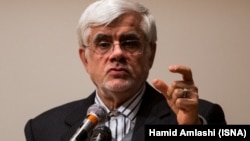
He said efforts by Iran's enemies to bring about political change in Iran had merely led to "regime change in Hormuz."
Iranian sources told the dpa that the Iranian parliament is also planning legislation to introduce a toll system for the waterway, through which some 20 percent of the world’s oil and natural gas supplies transit.
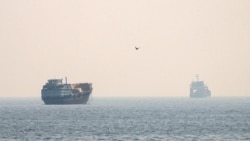
Tehran has repeatedly attacked vessels in the strait, effectively closing down the shipping route.
The narrow passage -- located between Iran and Oman -- is the only link between the Gulf and the world's oceans.
With reporting by dpa
IAEA Confirms Iran Heavy-Water Reactor Knocked Out Of Commission
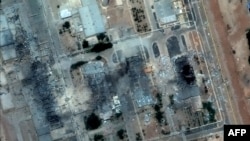
The International Atomic Energy Agency (IAEA) on March 29 aid Iran's heavy-water reactor at Khondab, near the city of Arak, which Tehran reported had been attacked on March 27, has suffered severe damage and is no longer operational.
The Israeli military had said it struck the facility, officially known as the Khondab Heavy Water Research Reactor -- at least the second time the site had been hit following an Israeli air strike during the 12-day war in June 2025.
"STRUCK: Arak Heavy Water Plant in Central Iran—A Key Plutonium Production Site for Nuclear Weapons. The IDF will not allow the Iranian regime to continue advancing its nuclear weapons program, which poses an existential threat to Israel and the entire world," the Israeli Defense Forces wrote on X on March 27.
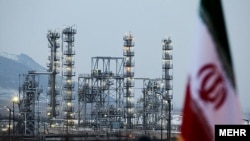
The IAEA said: "Based on independent analysis of satellite imagery and knowledge of the installation, the IAEA has confirmed the heavy water production plant at Khondab...has sustained severe damaged and is no longer operational. The installation contains no declared nuclear material,"
The reactor is part of a sprawling nuclear complex in central Iran that includes heavy-water production facilities, which allow Iran to use natural uranium as fuel without the need for high-level enrichment.
Pakistan Says Ready To Host Talks To End Iran War, But No Word Yet From US Or Iran
Pakistan's foreign minister on March 29 said Islamabad was preparing to host "meaningful talks" in the coming days to end the Middle East war, even though there has been no letup in the violence or harsh rhetoric between Washington and Tehran.
Ishaq Dar, speaking after talks between regional foreign ministers, said the top diplomats from Pakistan, Saudi Arabia, Egypt, and Turkey had discussed possible ways to bring a permanent end to the war as well as potential US-Iran talks in the Pakistani capital.
"Pakistan will be honored to host and facilitate meaningful talks between the two sides in coming days, for a comprehensive and lasting settlement of the ongoing conflict," he said, although it was not clear if Washington and Tehran had agreed to such talks.
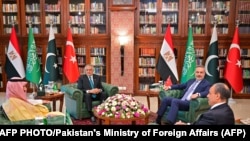
The Pakistani government has been acting as a mediator between Iran and the United States and has conveyed the US peace plan to Tehran.
A day earlier, Dar said Iran had agreed to allow an additional 20 Pakistani-flagged ships to pass through the Strait of Hormuz, with two vessels permitted to transit daily. Iran's effective blocking of the key waterway has created a bottleneck of oil and natural gas tankers seeking to deliver products to the world markets.
Iran has said it will allow ships from "nonhostile" nations to safely pass through the strait.
Sources told Reuters that the initial discussions between Pakistan, Saudi Arabia, Turkey, and Egypt had focused on proposals to reopen the strait to help relieve the widening economic pain around the world.
With reporting by Reuters and dpa
Iran, Israel Report New Exchanges Of Air Strikes
The Israeli military announced on Sunday, March 29, evening it had launched new strikes on targets across Tehran after it had detected seven new incoming missile salvoes fired from Iran during the day. "The IDF is currently striking Iranian terror regime targets across Tehran," the military said.
Iran said the barrage followed earlier strikes that knocked out power across parts of Tehran, neighboring Karaj, and elsewhere. State news agencies (FARS) reported several hours after the blackout that power had been restored in most of Tehran.
Earlier today, Iranian ballistic missiles struck open areas and residential outskirts in Beersheba, Israel. The Times of Israel reports that at least 11 people were lightly injured by shrapnel and falling debris. A significant blaze broke out at a chemical plant in the Ne'ot Hovav industrial zone near Beersheba. While the IDF initially stated it was caused by "interception fragments," or debris from an intercepted missile, newer reports from The Jerusalem Post suggest a direct hit or a very close proximity impact from an Iranian missile that appears to have pierced extensive Israeli air defense systems.
A Second Strike on Isfahan University
Iranian state media outlets (WANA and IRINN) are reporting that the Isfahan University of Technology was hit on March 29 for the second time in a week.
According to Akbar Salehi, the deputy for security in Isfahan, the attack primarily targeted one of the university’s research institutes. While the buildings are said to have suffered significant structural damage, there have only been reports of minor injuries affecting four staff members.
This follows a previous strike on the same campus on March 26. Iranian officials are calling it a "brutal aerial assault" and a violation of international law regarding academic institutions.
An Israeli statement released shortly after confirmed a "wave of extensive strikes in Isfahan targeting mobile command centers and weapons production facilities." An IDF spokesperson, in a response to The Times of Israel, suggested that any strikes near academic sites were targeting Revolutionary Guard (IRGC) research labs embedded within the facilities, specifically those linked to drone navigation and "advanced explosive devices."
The Pentagon and US CENTCOM have not explicitly confirmed the Isfahan University strike but have stated that "precision operations" are ongoing against "strategic assets" used to facilitate Iranian proxy attacks in the region.
Iran’s New Supreme Leader Thanks Iraq For Support
In a written message read out on Iran’s state media on March 29, Mojtaba Khamenei thanked Iraqi religious authorities and the Iraqi people for their “clear stance against the aggression against Iran and their support for our country.”
Iraq’s Grand Ayatollah Ali al-Sistani had earlier condemned the US and Israeli war with Iran. He also issued an appeal for humanitarian aid for Iran. An Iraqi aid convoy is reported to be on the way to Iran.
Mojtaba Khamenei was selected on March 9 to replace his father, Ayatollah Ali Khamenei, who was killed on the first day of the US-Israeli bombardment. The younger Khamenei, 56, has not appeared in public since his election as Iran’s third supreme leader. US defense chief Pete Hegseth has suggested that he was believed to have been wounded in the strikes.
Zelenskyy In Jordan As Ukraine Pitches Drone, Missile Expertise On Gulf Tour
Ukraine’s president arrived in Jordan, the latest stop in a whirlwind tour of the Gulf region and the Middle East where he’s touted Ukrainian prowess in building -- and defending against -- drones and missiles.
In a Telegram post, Volodymyr Zelenskyy did not detail any specifics of his scheduled talks in Amman.
"Today in Jordan. Security is the top priority, and it is important that all partners make the necessary efforts toward it. Ukraine is doing its part. Important meetings ahead," Zelensky said.
A day earlier, Zelenskyy traveled to the United Arab Emirates and Qatar, where he signed new, unspecified defense contracts. He was in Saudi Arabia a few days earlier.
Iran has launched hundreds of drones, as well as missiles, at US military facilities and other targets around the Gulf region.
Ukrainian officials have spotted what they hope will be lucrative new contracts with oil-rich Gulf States not only for drone technology, but also for the expertise and experience the country has built up over more than four years of all-out war with Russia.
Long-range Ukrainian drones have hit key Russian oil export terminals on the Baltic Sea over the past week, flying more than 900 kilometers from the Ukrainian border.