


Ukraine Restores Train Service To Recaptured Southern City As Fierce Fighting Continues In East
People take selfies in front of the first train to travel to liberated Kherson in Kyiv on November 18.
Ukraine has restored train service to the newly recaptured southern city of Kherson, and Ukrainian forces face fierce fighting in eastern Donbas, where Russian troops have intensified their push on several fronts.
Also on November 19, Britain's prime minister paid an unannounced visit to Kyiv for talks with President Volodymyr Zelenskiy and announced a new weapons and security assistance package.
The arrival of the train from Kyiv, announced by Ukraine's national railway authority, was a small but highly symbolic achievement, coming barely a week after Russian forces pulled out of Kherson, and Ukrainian forces returned to a jubilant reception from locals.
It's the first train to travel from Kyiv to Kherson since before Russia's February 24 invasion. Officials said it marked the resumption of regular service.
Russia continued to pound energy infrastructure across Ukraine with missiles and drones, the Ukrainian military's General Staff said. Zaporizhzhya, about 300 kilometers northeast of Kherson, was hit 42 times since November 18, leaving thousands without heat, the General Staff said in its daily update.
"Rocket explosions damaged the central heating pipelines and stopped the supply of coolant to 123 high-rise buildings, in which more than 17,000 people live," Zaporizhzhya regional Governor Oleksandr Starukh wrote on Telegram.
The Zaporizhzhya region is home to Europe's largest nuclear plant, which has been under Russian control since the invasion in February.
Many parts of Ukraine, including Kyiv, are suffering sporadic, sometime prolonged power and heating disruptions, a problem that has worsened as winter weather set in this week. Nearly 50 percent of the country's energy infrastructure has been disabled by Russian strikes, Prime Minister Denys Shmyhal said this week.
Officials have said stretched repair teams are working at maximum capacity to try to return power but that land mines, further attacks, and other obstacles are slowing their progress.
Russia's surge in missile strikes also appears partly designed to exhaust Kyiv's air defenses, Colin Kahl, a top U.S. Defense Department official, told reporters. He said Moscow hoped to deplete Ukrainian defenses to allow Russia's air force to operate more freely.
Ukrainian troops battled for weeks to push Russian forces out of Kherson city and the region west of the Dnieper River. Its forces appear to have paused for the moment; the Dnieper itself presents a formidable military obstacle, and Russian troops are digging trenches and fortifications on the river's east bank.
Russian Forces Digging Trenches, Fortifications On Banks Of Dnieper River, Satellite Imagery Shows
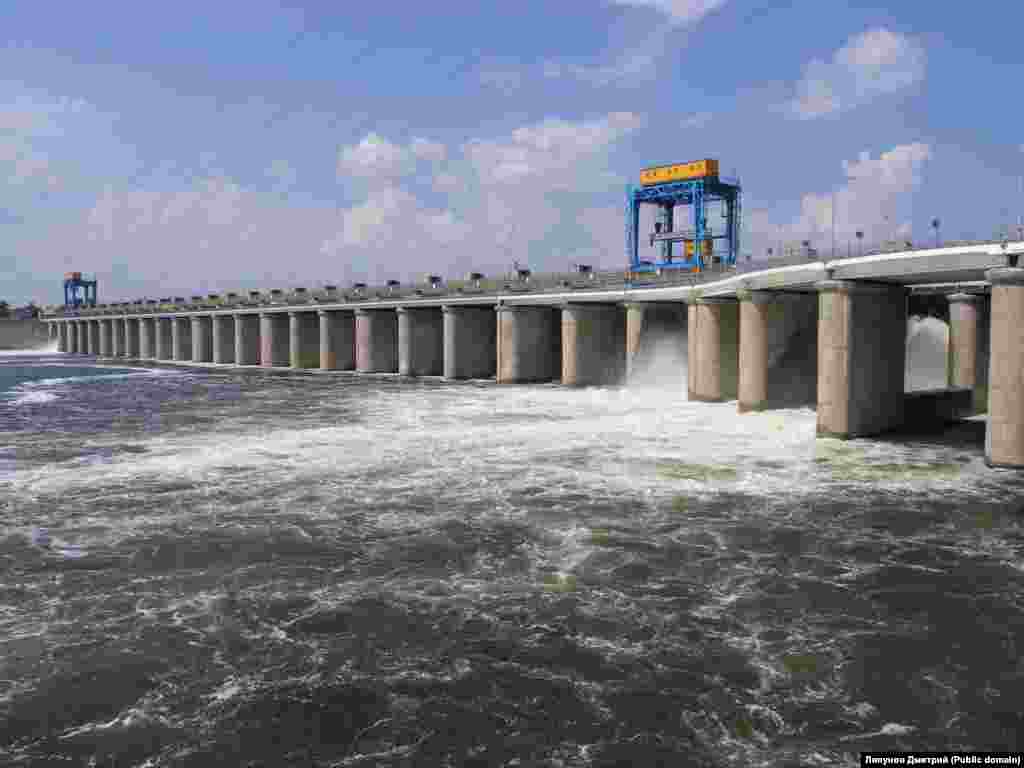
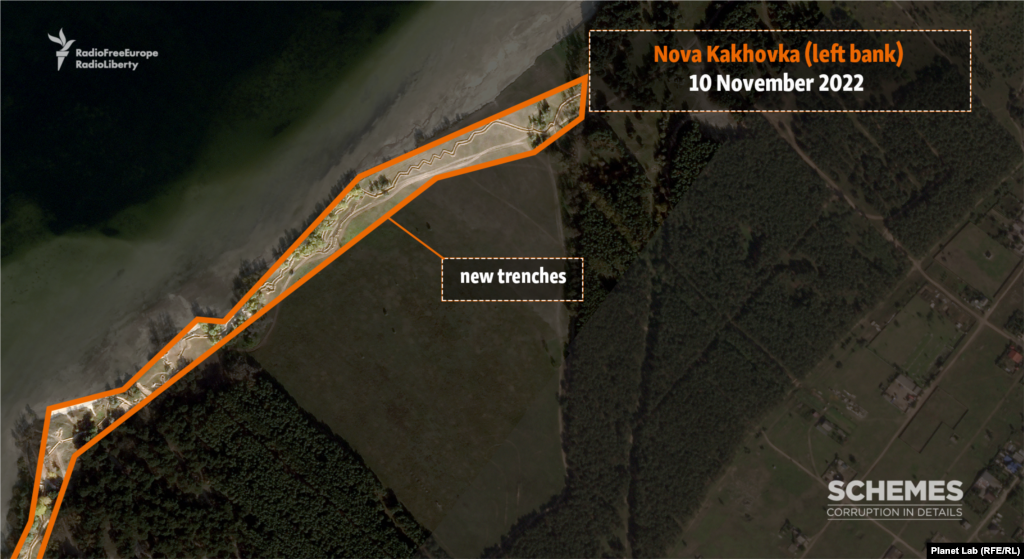
1/13Satellite images taken on November 10 by Planet Labs and obtained by RFE/RL show a network of trenches dug into the riverbanks upriver -- to the north -- of the town of Nova Kakhovka, the site of a major hydroelectric dam and the only remaining permanent crossing across the Dnieper.
Russian forces have dug extensive trenches and other fortifications on the east bank of Ukraine’s Dnieper River, new satellite imagery shows, as Russia stages a major retreat from the opposite bank and braces for further Ukrainian offensives.
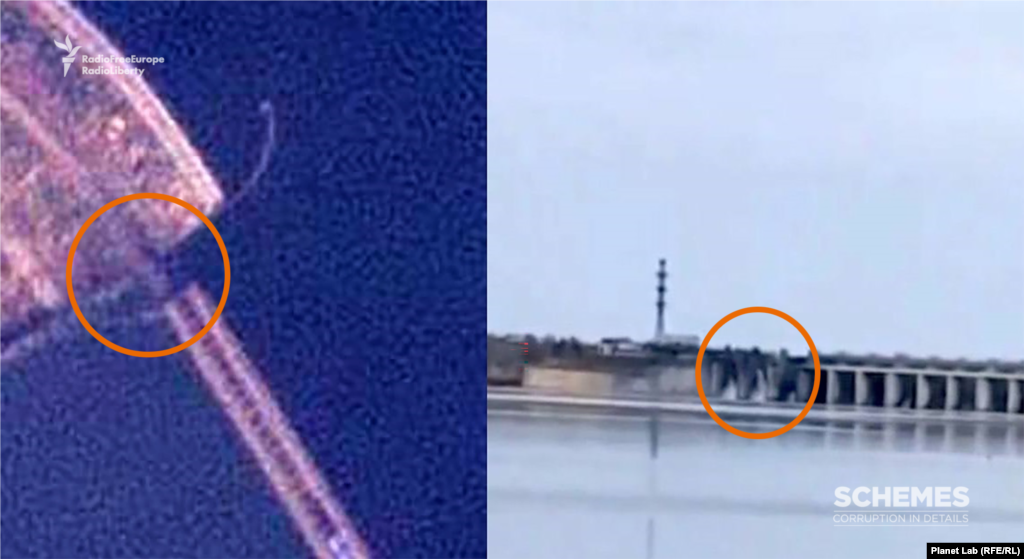
2/13Satellite photos also confirm that Russian troops blew up several spans of the bridge leading to the dam’s hydroelectric station. Ukrainian forces have pummeled the river crossings for weeks now, limiting Russia’s ability to resupply its forces on the west -- or right -- bank of the Dnieper.
That effort has also severely hindered Russia’s ability to withdraw its forces from the west bank amid an accelerating Ukrainian offensive toward the city of Kherson. On November 11, however, Ukrainian forces were reported in the city, and photographs and videos circulating on social media showed people waving Ukrainian flags, dancing, and chanting in the city’s main square.
Russian forces have dug extensive trenches and other fortifications on the east bank of Ukraine’s Dnieper River, new satellite imagery shows, as Russia stages a major retreat from the opposite bank and braces for further Ukrainian offensives.
3/13The images obtained by RFE/RL include ones taken more than a month ago, when Russian forces still controlled much of the west bank in Kherson Oblast and most of the riverfront and river crossings.
Since that time, Ukrainian forces have slowly pushed south and east, squeezing Russian forces.
Russian forces have dug extensive trenches and other fortifications on the east bank of Ukraine’s Dnieper River, new satellite imagery shows, as Russia stages a major retreat from the opposite bank and braces for further Ukrainian offensives.
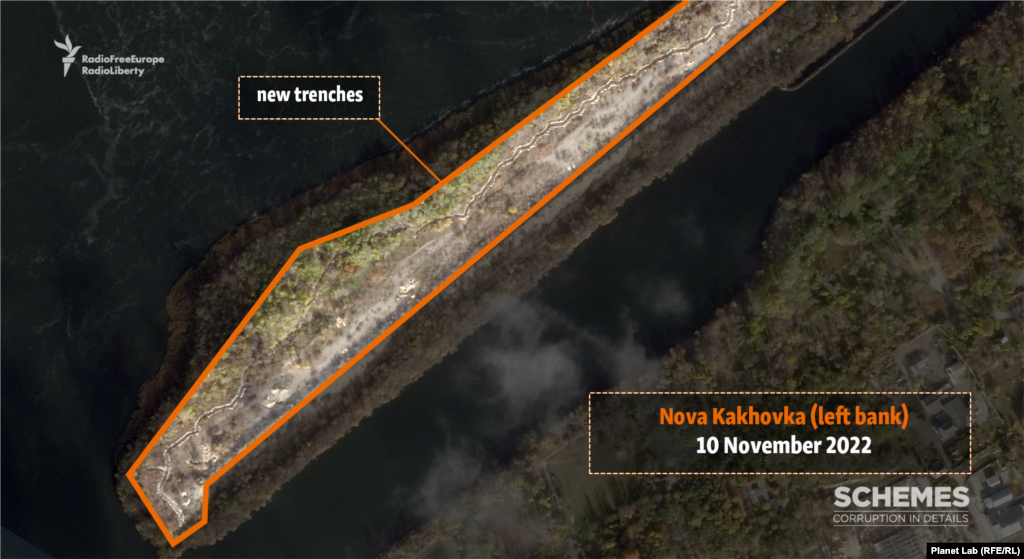
4/13At Nova Kakhovka, the images show a snaking line of trenches immediately downriver from the concrete dam itself, on an island known as Kos.
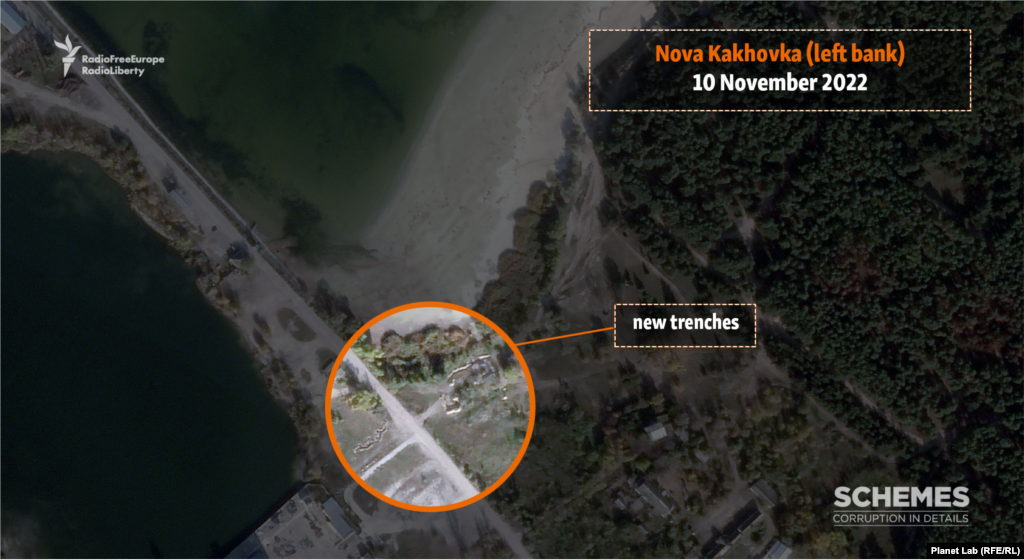
The trenches, estimated at about 2 kilometers in total, appear to have been dug sometime between October 9, when the most recent previous images were taken, and November 10.
Russian forces have dug extensive trenches and other fortifications on the east bank of Ukraine’s Dnieper River, new satellite imagery shows, as Russia stages a major retreat from the opposite bank and braces for further Ukrainian offensives.
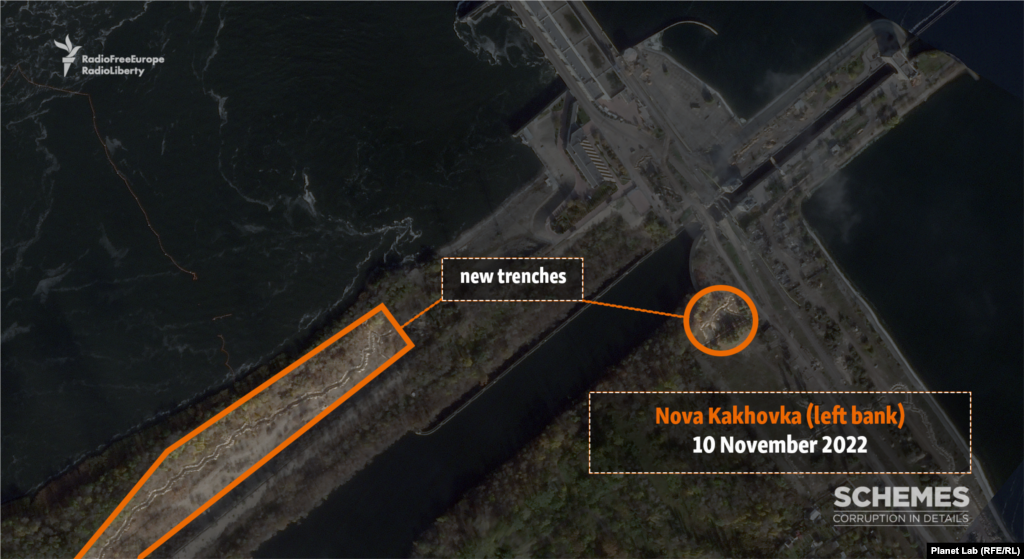
5/13A satellite image taken on November 10 showing the Nova Kakhovka hydroelectric plant, after Russian forces dug defensive trenches.
Russian forces have dug extensive trenches and other fortifications on the east bank of Ukraine’s Dnieper River, new satellite imagery shows, as Russia stages a major retreat from the opposite bank and braces for further Ukrainian offensives.
6/13Another image of a riverfront beach upriver from the dam also shows a snaking line of trenches that appear to stretch for hundreds of meters, paralleling the water.
Russian forces have dug extensive trenches and other fortifications on the east bank of Ukraine’s Dnieper River, new satellite imagery shows, as Russia stages a major retreat from the opposite bank and braces for further Ukrainian offensives.
7/13The defensive trenches do not appear in imagery taken last month.
Russian forces have dug extensive trenches and other fortifications on the east bank of Ukraine’s Dnieper River, new satellite imagery shows, as Russia stages a major retreat from the opposite bank and braces for further Ukrainian offensives.
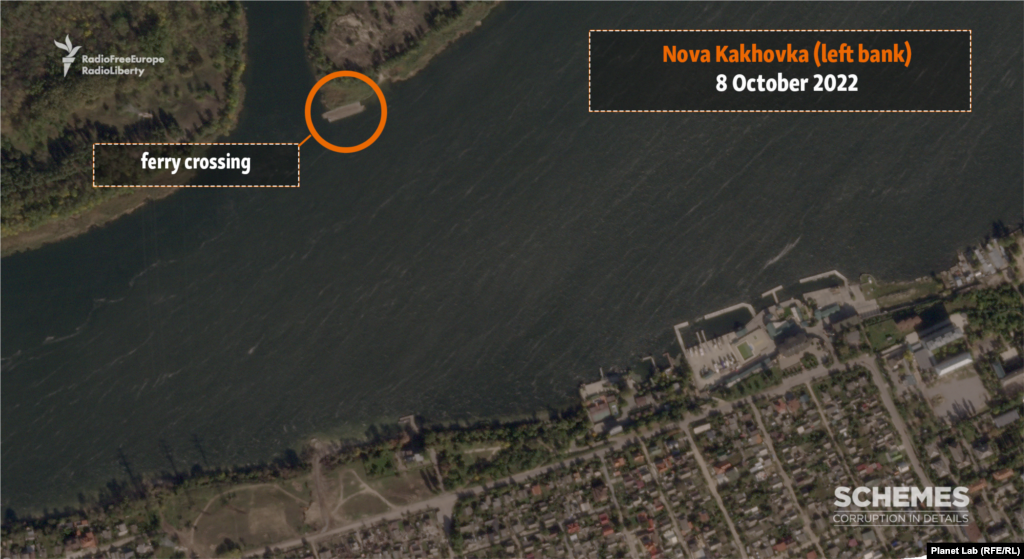
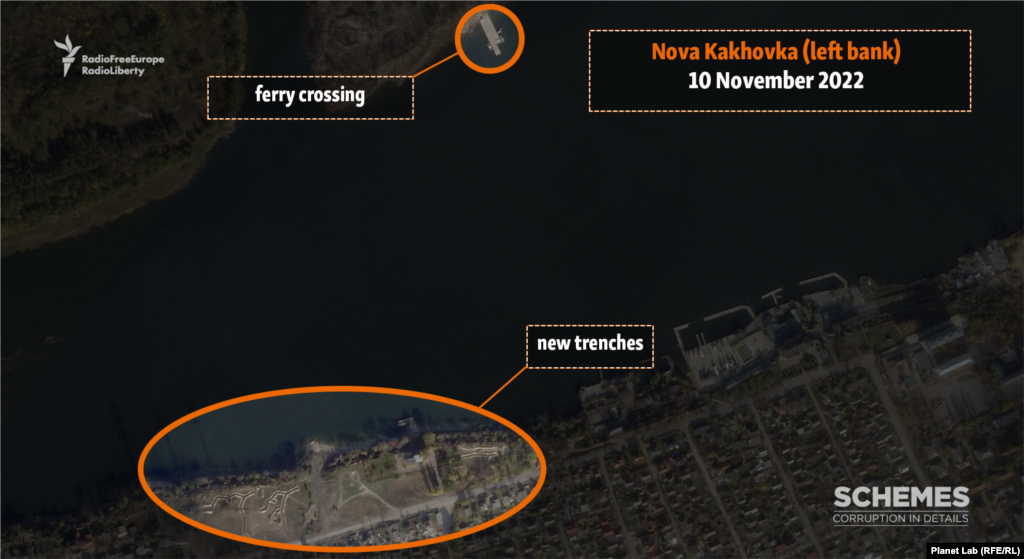
8/13About 6 kilometers downriver from the dam, more trenches can be seen on the riverbank, along with a pontoon ferry on the opposite bank to the north, beached on a sizable island close to the west bank.
Russian forces have dug extensive trenches and other fortifications on the east bank of Ukraine’s Dnieper River, new satellite imagery shows, as Russia stages a major retreat from the opposite bank and braces for further Ukrainian offensives.
9/13The ferry appears to be similar to one discovered by RFE/RL last month, based on social media videos and photographs posted by retreating Russian soldiers.
Russian forces have dug extensive trenches and other fortifications on the east bank of Ukraine’s Dnieper River, new satellite imagery shows, as Russia stages a major retreat from the opposite bank and braces for further Ukrainian offensives.
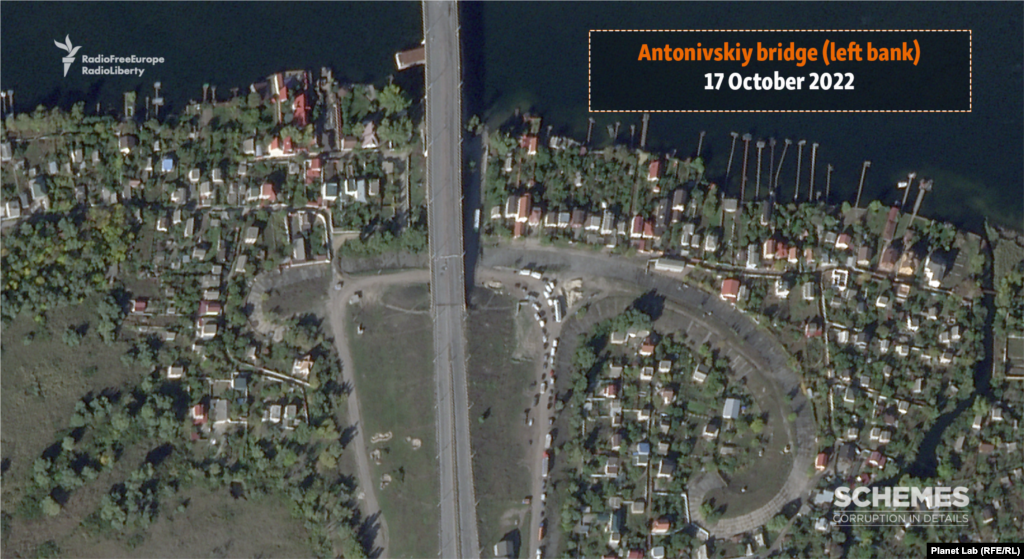
10/13Aside from the dam at Nova Kakhovka, the other major crossing linking the two banks of the Dnieper is the Antonivskiy Bridgeon the eastern outskirts of the city of Kherson.
The bridge has been repeatedly blasted by Ukrainian forces seeking to limit Russia’s ability to resupply its forces; the bridge surface spans have been heavily damaged and impassable for vehicles but have been intact until November 11.
Russian forces have dug extensive trenches and other fortifications on the east bank of Ukraine’s Dnieper River, new satellite imagery shows, as Russia stages a major retreat from the opposite bank and braces for further Ukrainian offensives.
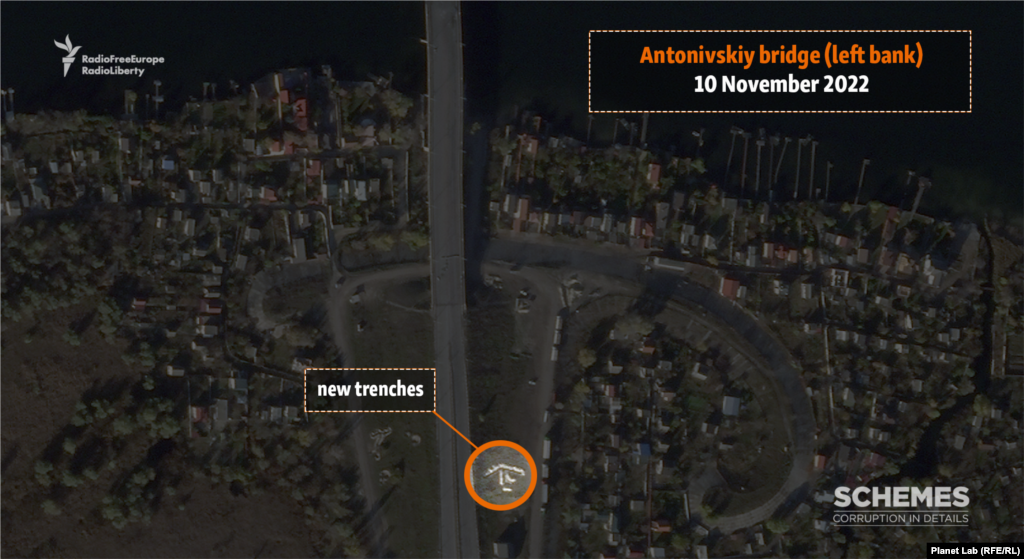
11/13Another satellite image taken on November 10 shows the new Russian trench fortifications on the southern approach to the bridge, on the opposite side of the river from the city of Kherson itself.
Russian forces have dug extensive trenches and other fortifications on the east bank of Ukraine’s Dnieper River, new satellite imagery shows, as Russia stages a major retreat from the opposite bank and braces for further Ukrainian offensives.
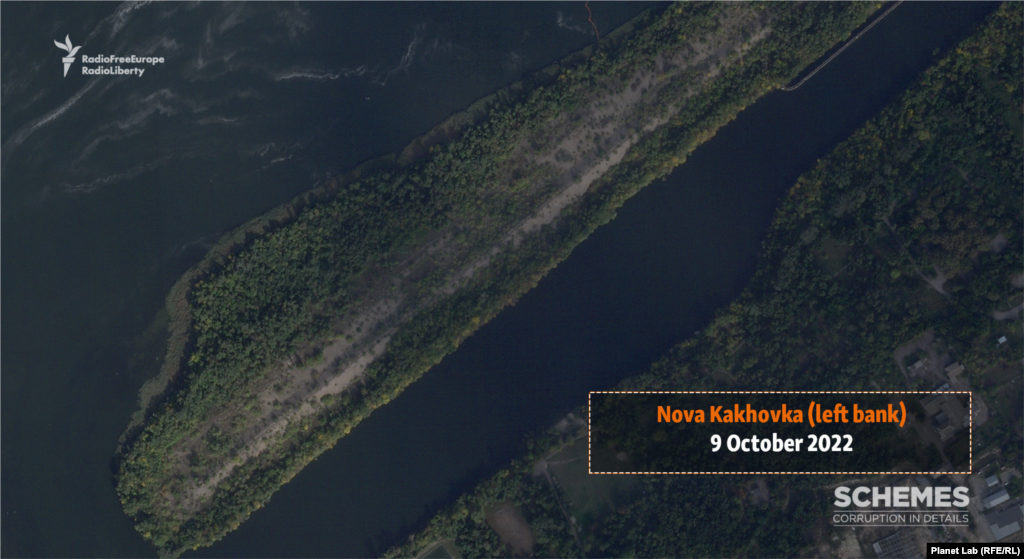
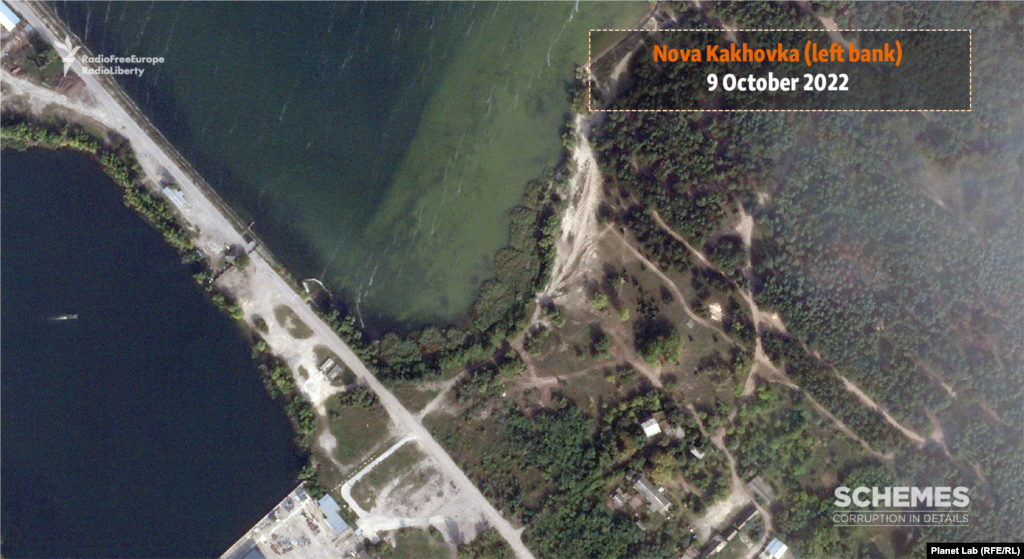
12/13A satellite image taken on October 9 immediately upriver from the Nova Kakhovka dam, before Russian forces dug defensive fortifications.
Russian forces have dug extensive trenches and other fortifications on the east bank of Ukraine’s Dnieper River, new satellite imagery shows, as Russia stages a major retreat from the opposite bank and braces for further Ukrainian offensives.
13/13A satellite image taken on November 10 from the same location adjacent to the Nova Kakhovka dam, after Russian forces dug defensive fortifications.
A day earlier, Russian Defense Minister Sergei Shoigu and the top Russian commander in charge of the Ukraine war, General Sergei Surovikin, announced a wholesale retreat from the west bank. On November 11, the Russian Defense Ministry announced that the withdrawal was completed, though that could not be immediately verified by RFE/RL.
Between 20,000 and 30,000 Russian troops were estimated to have been on the west bank in recent weeks, U.S. General Mark Milley, the chairman of the U.S. Joint Chiefs of Staff, said this week.
Russian forces have dug extensive trenches and other fortifications on the east bank of Ukraine’s Dnieper River, new satellite imagery shows, as Russia stages a major retreat from the opposite bank and braces for further Ukrainian offensives.
Previous slide
Next slide
Still, Ukrainian forces have used longer-range rockets and artillery to target Russian positions across the Dnieper. The General Staff claimed that its troops destroyed a military base on the Kinburn Spit, a strip of land southwest of Kherson that juts into the Black Sea.
Russia is also reportedly repositioning some of its forces elsewhere: further to the east, bolstering the defense around Zaporizhzhya and Melitopol, as well as increasing the intensity of fighting in the Donbas.
The Russians "are conducting offensive actions in the Bakhmut, Avdiyivka, and Novopavliv directions," the military said in its daily update. It also said Ukrainian forces repelled attacks near the towns of Bilohoryivka, Zelenopil, and Klishchiyivka.
Russia's Defense Ministry confirmed intense fighting in several locations in the Donbas.
RFE/RL cannot verify reports of battlefield success in areas of intense fighting.
In videos and statement released by his office, British Prime Minister Rishi Sunak said London was providing a $59.4 million package of weapons for Ukraine, including anti-aircraft guns and anti-drone technology.
"I am here today to say that the U.K. will continue to stand with you...until Ukraine has won the peace and security it needs and deserves," Sunak said during a Kyiv news conference with Zelenskiy.
Sunak's visit comes amid growing public and private discussions in Western capitals about whether Ukraine and Russia should open peace negotiations to halt the war, which is nearing its ninth month.
Ukrainian officials have pushed back on the calls, though Zelenskiy has made some small shifts in rhetoric.
"There will be peace when we destroy the Russian Army in Ukraine and reach the borders of 1991," Andriy Yermak, one of Zelenskiy’s top aides, wrote on Telegram on November 19.
The deputy defense minister, meanwhile, predicted Ukrainian forces could be back in the Russian-occupied peninsula of Crimea by year's end and the entire war could be over by the spring. Volodymyr Havrylov suggested Russia could face an unforeseen "black swan" event that would disrupt internal politics.
"I think Russia can face a black swan in their country, inside Russia and it can contribute to the success of us with Crimea," Havrylov said in an interview with Sky News.
Zelenskiy said in his nightly video address on November 18 that "brutal fighting" continues in the east, but suggested that in some areas they expect "future successes."
He said that "everywhere we are holding [our] positions."
RFE/RL cannot verify reports of battlefield success in areas of intense fighting.
"Very fierce fighting is continuing in Donetsk region," Zelenskiy said, adding that "there is no letup in the fighting. There has been no lull."
He didn't elaborate on his reference to expected "future successes" in some areas of the battlefield.

With reporting by Reuters, AFP, AP, dpa, and Newsweek
RFE/RL's Ukrainian Service has seen its audience grow significantly since Russia's full-scale invasion in February 2022 and is among the most cited media outlets in the country. Its bold, in-depth reporting from the front lines has won many accolades and awards. Its comprehensive coverage also includes award-winning reporting by the Donbas.Realities and Crimea.Realities projects and the Schemes investigative unit.