





That concludes our live-blogging of the Ukraine crisis for February 26, 2019. Check back here tomorrow for more of our continuing coverage. Thanks for reading and take care.
From 'Not Us' To 'Why Hide It?': How Russia Denied Its Crimea Invasion, Then Admitted It
By Carl Schreck
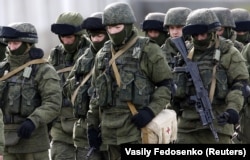
In the darkness of the morning on February 27, 2014, heavily armed men wearing green uniforms with no identifying insignia stormed the regional parliament in Simferopol, the capital of Ukraine’s Crimean Peninsula, and raised the Russian flag atop the building.
The seizure came a day after pro- and anti-Russian protesters had clashed outside the building over the future of the peninsula following the ouster of Kremlin-friendly Ukrainian President Viktor Yanukovych, who had fled Kyiv days earlier. And it was just the beginning.
As masked commandos in similar garb fanned out across the peninsula over the next two weeks, surrounding Ukrainian military bases and taking control of other strategic facilities, it was clear to many on the ground that they were Russian military. One of the soldiers said as much on camera.
But despite clear indications that Moscow had dispatched these forces -- or "little green men," as they came to be widely known -- Russia embarked on a campaign of denials and obfuscations about their provenance and role in helping cement Moscow's annexation of Crimea in March 2014.
Russia described them as "self-defense units" created by locals concerned about alleged threats against Crimea's Russian-speaking population from Ukrainian ultranationalists.
Only later did the story begin to change.
Nothing To See Here
A day after the seizure of the Crimean parliament and the regional government headquarters, masked Russian soldiers took control of the Simferopol airport. One woman in the crowd appeared certain about their nationality, yelling "Russia, Russia!" as a group of commandos loaded their weapons and equipment into a military truck.
But the same day, Russia's ambassador to the European Union told Euronews that the troops at the airport were not Russian. "There are no troops whatsoever, no Russian troops at least," Vladimir Chizhov said.
Days later, during his first public comments on the events in Crimea, Russian President Vladimir Putin was asked directly whether Russian troops were blockading Ukrainian soldiers inside their bases on the peninsula.
Despite the clear evidence of Russian soldiers' role in these blockades over the previous days, Putin replied: "Those were local self-defense units."
The Bloomberg reporter who asked the question noted that the armed men wore "uniforms strongly resembling Russian Army uniforms."
Putin responded: "Take a look at the post-Soviet states. There are many uniforms there that are similar. You can go to a store and buy any kind of uniform."
The same day, Ukrainian journalists published a video on YouTube in which one of several commandos deployed in Crimea said of himself and his colleagues: "We're Russians."
Asked about videos in which the armed men in Crimea say they are Russian, Putin's defense minister, Sergei Shoigu, said: "It's complete nonsense," Russia's state-run news agency RIA Novosti reported at the time. Asked whether the men in unmarked uniforms in Crimea were Russian, Shoigu added, "Absolutely [not], are you kidding?" Russia’s state-run TASS news agency reported.
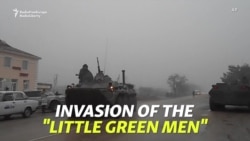
Russian Foreign Minister Sergei Lavrov, meanwhile, told a news conference in Madrid alongside his Spanish counterpart that “pro-Russian forces” in Crimea were not taking orders from Moscow and that military personnel at Russia’s naval base in the Crimean port city of Sevastopol were staying put.
"With regard to the servicemen of Russia's Black Sea Fleet, they are staying at the sites of permanent deployment. Yes, there were additional special measures of elevated alert for ensuring the security of the Black Sea Fleet," Lavrov said.