





Russian authorities promise to remove accusatory pages from Crimean history textbook:
By the Crimean Desk of RFE/RL's Ukrainian Service
The Russian authorities who control Ukraine's Crimean Peninsula have promised to remove a section of a high-school history textbook that claims many Crimean Tatars collaborated with Nazi Germany during World War II.
The senior education official in the Russian-imposed government of Crimea, Natalya Goncharova, said on May 6 that the pages in question would be removed from the 10th-grade textbook History Of Crimea by the end of the month.
Educators and lawyers -- some of them members of the indigenous, mainly Muslim Crimean Tatar minority -- have urged the authorities to remove the book from the curriculum, saying that it threatens to incite ethnic and religious hatred among teenagers.
The pages that are to be removed include a claim that the majority of Crimean Tatars "were loyal to" the Nazis, and that "many actively helped them."
The claim echoes the pretext that Soviet dictator Josef Stalin's government used when it deported Crimean Tatars en masse from the Black Sea peninsula in 1944, asserting that they were collaborators.
Many died on the journey or in exile in Central Asia and the steppes of southern Russia.
Crimean Tatars were allowed to begin returning to their homeland in the late 1980s, and make up some 12 percent of its population.
Russia seized control of the peninsula in March 2014, sending in troops without insignia, securing key facilities, and staging a referendum deemed illegitimate by Ukraine and most other world countries.
Rights groups and Western governments say Russia has conducted a persistent campaign of oppression targeting Crimean Tatars and other citizens who opposed Moscow's takeover of the peninsula. (w/TASS and Interfax)
That concludes our live-blogging of the Ukraine crisis for May 6, 2019. Check back here tomorrow for more of our continuing coverage. Thanks for reading and take care.
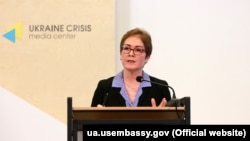
U.S. Ambassador To Ukraine, Openly Criticized By Top Ukrainian Prosecutor, Departing Early
By Christopher Miller
KYIV -- The U.S. ambassador to Ukraine is departing her position by the middle of May, two months ahead of schedule, according to four people familiar with the decision.
The four people, which include embassy employees and others, told RFE/RL on May 6 that Marie Yovanovitch was leaving but gave no indication exactly why she was departing.
The individuals spoke on condition of anonymity, ahead of an expected formal announcement by the U.S. State Department.
Sections of an e-mail shared with RFE/RL but not yet made public said Yovanovitch’s last day would be May 20, and a charge d’affairs -- basically an embassy's chief operating officer -- would then be appointed long-term until a new ambassador is nominated and confirmed.
The State Department referred questions to the Kyiv embassy, which didn’t immediately respond to queries.
Sworn in as ambassador to Kyiv in August 2016, Yovanovitch has been at the forefront of U.S. efforts to help stabilize Ukraine’s shaky economy and push reforms to root out endemic corruption.
She’s also been at the forefront of U.S. backing for Ukraine in its ongoing fight with Moscow over Russia-backed fighters battling Ukrainian government forces in eastern regions since 2014.
Yovanovitch drew attention in early March when, just weeks before Ukraine’s presidential election, she called on Kyiv to fire the country’s special anti-corruption prosecutor. The speech was notable not only for its timing but also its bluntness, from a foreign diplomat.
President Petro Poroshenko, who has been accused of not doing enough to tackle corruption, went on to lose reelection in the April 21 vote to Volodymyr Zelenskiy.
Yovanovitch was also the target of an explosive claim, in March, by Prosecutor-General Yuriy Lutsenko, who alleged she had given him "a list of people whom we should not prosecute" during their first in-person meeting.
The claim, made in an interview broadcast by the Washington-based newspaper The Hill, prompted an unusual rebuke by the State Department, which said: "The allegations by the Ukrainian prosecutor-general are not true and are intended to tarnish the reputation of Ambassador Yovanovitch."
Lutsenko's claim got further attention later when a tweet about the story was re-tweeted by President Donald Trump’s son.