



Czech soldier gets suspended sentence for joining separatists in Donetsk:
A court in the Czech Republic has handed a suspended three-year prison sentence to a soldier after finding him guilty of joining Russia-backed separatists in eastern Ukraine.
The court in the city of Pardubice also ruled on May 17 to demote Corporal Erik Estu to the rank of private and expel him from the Czech armed forces.
Estu, 35, was found guilty of joining in April-May 2015 an organized criminal group established to conduct terrorist activities.
The soldier was charged after he shared pictures of himself carrying firearms and wearing a uniform of the separatists in the eastern Ukrainian region of Donetsk.
Estu pleaded not guilty to the charges against him, and insisted he had travelled to Donetsk to visit relatives of his wife, a native of Ukraine.
He said he bought the uniform in a local store because he collects military items.
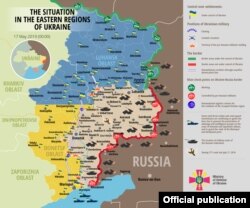
Fighting between Ukrainian government forces and separatists controlling parts of the Donetsk and Luhansk regions has killed some 13,000 people since April 2014. (Dnes and Cesky Rozhlas)
Here is today's map of the latest situation in the Donbas conflict zone according to the Ukrainian Defense Ministry. (CLICK TO ENLARGE,)
An interesting take on Vyshyvanka Day. Compare and contrast with this photo gallery from Crimea that we posted earlier.
The Kyiv Post asks a question that's been on a lot of people's lips:
Three out of every four registered foreigners in Poland are Ukrainian according to this.
This earlier story from RFE/RL's news desk gives some background to the Council of Europe decision (see previous entry):
Council Of Europe Marks 70th Anniversary With Russia's Membership In Spotlight
The Council of Europe's relations with Russia are in the spotlight as the continent’s key human rights body celebrates its 70th anniversary at a gathering in Finland.
More than 30 European foreign ministers are in Helsinki for the two-day meeting that began on May 16 at the historic Finlandia Hall, where the 1975 Helsinki Accords were signed as part of efforts to ease Cold War tensions.
Russia has been a member since 1996, but relations have deteriorated since the Council suspended Moscow's voting rights following its seizure of Ukraine’s Crimean Peninsula in 2014.
In response, Russia froze its annual payment of $37 million to the council, about 7 percent of the Strasbourg, France-based body's budget.
The nonpayment could lead to Russia’s suspension from the body as of June this year.
But Moscow has shown signs of seeking to improve relations in recent days, suggesting it has no immediate plans to quit the rights watchdog.
A Foreign Ministry statement said Council membership had helped improve Russia's justice and penitentiary systems and even its sports practices since joining.
"Russia is interested in preserving and strengthening the Council of Europe as one of the most authoritative and respectable international organizations on the European continent," the ministry said.
Finnish Foreign Minister Timo Soini said his country has tried to find a solution to differences with Moscow during its chairmanship to help relieve tensions, but added that "the origin of the crisis" was due to Russia's actions.
"It was the illegal annexation of Crimea in 2014," Soini said. "And that cannot be forgotten."
Meanwhile, Ukraine said Foreign Minister Pavlo Klimkin would not attend the meeting, but other representatives are due to participate.
Kyiv has expressed concerns the meeting could lead to member states adopting a final declaration that could ease pressure on Moscow, which has also supported separatists fighting in the eastern part of Ukraine.
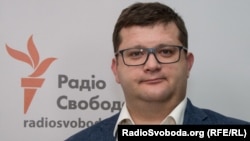
Ukrainian lawmaker Volodymyr Ariev, who heads his country's delegation to the body’s Parliamentary Assembly of the Council of Europe (PACE), told the AFP news agency that, if pressure on Russia is eased, Ukraine is "ready to take very serious steps."
"We are ready to seriously reconsider our involvement with the Council of Europe."
The Council was founded in 1949 by Belgium, Britain, Denmark, France, Ireland, Italy, Luxembourg, the Netherlands, Norway, and Sweden as a watchdog for democracy, human rights, and the rule of law.
The 47-member body includes the European Court of Human Rights (ECHR), which enforces the European Convention on Human Rights
With reporting by AFP, AP, and dpa
Hmm...