



UN Tribunal To Issue Ruling On Ukrainian Ships Seized By Russia
By RFE/RL
A United Nations tribunal is set to issue a ruling in the dispute over Russia's detention of two dozen Ukrainian sailors and the seizure of three Ukrainian ships near Crimea last year.
The May 25 ruling by the International Tribunal for the Law of the Sea is unlikely to definitively end the question of allowing Ukrainian ships full access to the Sea of Azov, which Russia has been restricting since a bridge across the Kerch Strait was completed.
But Ukraine is hoping a victory will provide legal weight in its fight against Russia, which has boycotted the proceedings, saying the court has no jurisdiction.
Russia seized the ships in November near the Kerch Strait bridge, which connects the Russian mainland to the Black Sea peninsula of Crimea. Moscow annexed the Ukrainian peninsula in 2014.
Ukraine has denied Russia's charge that the Ukrainian ships had entered Russian territorial waters illegally.
The European Union, NATO, and other international bodies have called on Moscow to release the ships and the detained sailors.
After Two Years, Journalist Stanislav Aseyev Remains Captive In Donbas
In the spring of 2017, RFE/RL contributor Stanislav Aseyev was allegedly abducted by Russia-backed separatists while reporting from the conflict zone in eastern Ukraine. Two years later, he is still being held. His only opportunity to communicate with the outside world was when he appeared in handcuffs on Russian state-run TV and said he had been accused of espionage.

That concludes our live-blogging of the Ukraine crisis for May 24, 2019. Check back here tomorrow for more of our continuing coverage. Thanks for reading and take care.
Latest from our news desk:
Ukraine's new President Volodymyr Zelenskiy and German Chancellor Angela Merkel spoke by phone on May 24, discussing efforts to resolve the conflict in eastern Ukraine, both offices said.
According to Zelenskiy’s office, both leaders agreed on the need to restart peace efforts, including the so-called Normandy format, which brings together Ukraine, Russia, Germany, and France.
The statement also said that Zelenskiy plans to hold talks with French President Emmanuel Macron in the nearest future.
In Berlin, German government spokesman Steffen Seibert said on May 24 that Merkel and Zelenskiy agreed on a need for a "full implementation" of the current peace agreements.
In Moscow, the Kremlin said Russia would support a meeting within the Normandy format in case if there would be potential for a significant result.
"No one wants it to be a meeting for the sake of a meeting," Kremlin spokesman Dmitry Peskov was quoted as saying by TASS on May 24.
Since April 2014, some 13,000 people have been killed in fighting between Kyiv's forces and the Russia-backed separatists who control parts of the Donetsk and Luhansk regions.
Cease-fire deals announced as part of the Minsk accords -- September 2014 and February 2015 pacts aimed at resolving the conflict -- have contributed to a decrease in fighting but have failed to hold.
A new cease-fire agreement was reached on March 8, but both sides have accused each other of repeated violations since then.
The conflict in the region known as the Donbas is one of the challenges facing Zelenskiy, who was inaugurated on May 20.
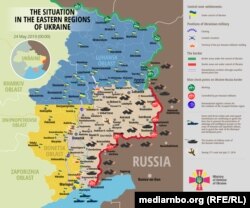
Here is today's map of the security situation in eastern Ukraine, according to the National Security and Defense Council (click to enlarge):