





Poll Shows Fewer Russians See Ukraine, U.S. As Enemies
Fewer Russians consider Ukraine and the United States to be enemy states as they shift their attention toward growing domestic problems, according to a new poll.
The number of Russians who consider the United States a hostile country dropped to 67 percent from 78 percent a year ago, a May survey conducted by the independent Levada Center showed on June 14.
Those who consider Ukraine a hostile country dropped from 49 percent to 40 percent.
Russia's relations with Ukraine and the United States deteriorated after Moscow annexed Crimea in 2014 and then began supporting separatist fighters in eastern Ukraine.
The United States later imposed sanctions on Russia to punish it for its actions.
Those sanctions -- along with a drop in oil prices -- have hurt Russia’s economic growth over the past five years as private investment stalls.
Several protests have taken place in Russia in recent months over bread-and-butter issues like wages and pensions.
Russians’ negative attitude toward the United States and Ukraine dropped because citizens are less interested in geopolitics and more concerned about prices and wages, political analyst Aleksei Makarkin told Vedomosti.
Some Russians may also be hopeful that a new leader in Ukraine will lead to better relations between the two nations, Levada Center Director Lev Gudkov told the paper.
Ukraine in April elected actor Volodymyr Zelenskiy to a five-year term as president.
Based on reporting by Vedomosti
That concludes our live-blogging of the Ukraine crisis for June 13, 2019. Check back here tomorrow for more of our continuing coverage. Thanks for reading and take care.
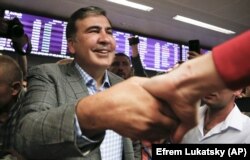
Saakashvili, Party Colleagues To Run In Ukraine’s Parliamentary Elections
By RFE/RL
The party of Mikheil Saakashvili, the former Georgian president who served as governor of Ukraine's Odesa region in 2015-16, has presented its list of top 10 candidates for Ukraine’s July 21 parliamentary elections.
Saakashvili tops the list of his Movement of New Forces party, which he announced in a June 13 news conference in Kyiv.
He said the list has brought together people with experience in fighting "injustice and corruption."
The former Georgian leader returned to Ukraine on May 29, a day after his Ukrainian citizenship was reinstated by new Ukrainian President Volodymyr Zelenskiy.
Saakashvili was president of Georgia from January 2004 until 2013, a year after his party was dislodged by an opposition force in parliamentary elections.
In a May 28 interview with RFE/RL’s Ukrainian Service, Saakashvili hinted that he wants to play a substantial role in public life, without specifying what it might be.
Saakashvili was granted Ukrainian citizenship and appointed to the Odesa governor's post in 2015 by former Ukrainian President Petro Poroshenko, an acquaintance from his student days in Soviet-era Kyiv. Authorities in Tbilisi stripped Saakashvili of his Georgian citizenship in December 2015 on grounds that Georgia does not allow dual citizenship.
Then, when relations with Saakashvili soured over reform efforts and the fight against corruption, Poroshenko sacked him from the Odesa governor's post in November 2016.
In July 2017, after Saakashvili created his party, Poroshenko issued a decree that stripped Saakashvili of his Ukrainian citizenship.