





Update from the Crimea Desk of RFE/RL's Ukrainian Service:
Russian Court Jails Five Crimean Tatars On Extremism Charges

ROSTOV-ON-DON, Russia -- A court in Russia has sentenced five Crimean Tatars to lengthy prison terms on extremism charges that they say are politically motivated.
The North Caucasus Regional Military court in the city of Rostov-on-Don on June 18 found the five men guilty of organizing and/or participating in the activities of the Hizb ut-Tahrir Islamic group that is banned in Russia but legal in Ukraine.
Teymur Abdullayev was sentenced to 17 years, Rustem Ismaiylov received 14 years, and Uzeiyr Abdullayev 13 years, while Ayder Saledinov and Emil Dzhemadenov were sentenced to 12 years in prison each.
The men were arrested in October 2016 after Russia-controlled authorities in Ukraine's Crimea searched their homes.
Two months later, they were transferred to a detention center in the Russian city of Rostov-on Don.
Last week, eight other Crimean Tatars were arrested in Crimea and charged with belonging to Hizb ut-Tahrir.
Since Russia seized the peninsula in 2014, Russian authorities have prosecuted dozens of Crimean Tatars for allegedly belonging to Hizb ut-Tahrir.
Earlier, in March-April, Russia's Federal Security Service detained 24 Crimean Tatars, also on suspicion of being members of the group, following house-to-house searches in Crimea.
Rights groups and Western governments have denounced what they describe as a campaign of repression by the Russian-imposed authorities in Crimea who are targeting members of the Turkic-speaking Crimean Tatar community and others who have spoken out against Moscow's takeover of the peninsula.
In its annual report on religious freedom worldwide, released on April 29, the U.S. Commission on International Religious Freedom (USCIRF) said that "[in] Russian-occupied Crimea, the Russian authorities continued to kidnap, torture, and imprison Crimean Tatar Muslims at will."
Russia took control of Crimea from Ukraine in March 2014 after sending in troops, seizing key facilities, and staging a referendum dismissed as illegal by at least 100 countries. Moscow also backs separatists in a war against government forces that has killed some 13,000 people in eastern Ukraine since April 2014.
Here's an item from RFE/RL's news desk:
Ukrainian Deputy Foreign Minister Says Dutch Investigators To Name First MH17 Suspects On June 19
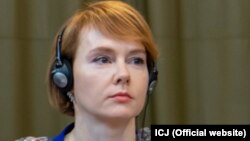
Ukrainian Deputy Foreign Minister Olena Zerkal says Dutch authorities plan to name suspects in the downing of flight MH17 five years ago, in which all 298 people aboard the passenger jet were killed.
In a June 18 interview with Interfax-Ukraine, Zerkal said the Dutch-led Joint Investigation Team (JIT) in charge of investigating the disaster will name the first four suspects in the case on June 19.
"The names will be announced. Charges will be brought. After that, the Criminal Court of Schiphol (the Netherlands) will start working on considering this case,” Zerkal was quoted as saying.
Dutch media, including the NL Times and RTL Nieuws, have reported that relatives of the victims will be first be briefed, after which a news conference will be held at 1 p.m. local time.
On June 14, the JIT noted "new developments" in the investigation in an email sent to the victims' relatives, RTL Nieuws reported.
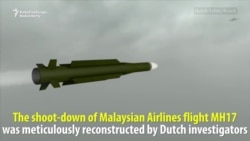
JIT initially announced in 2016 that the sophisticated Buk missile system, which was used to shoot down the Malaysia Airlines Boeing 777, came from Russia.
Russia's 53rd Antiaircraft Missile Brigade had transported the Buk in 2014 to and from Ukraine, JIT additionally concluded in May 2018.
Moscow seized control of the Crimean Peninsula in March 2014 and has supported the separatists who control parts of the eastern Ukrainian regions of Donetsk and Luhansk in a war that has killed some 13,000 people since April of that year.
The passenger flight was downed in the conflict zone over non-government-controlled territory.
Using open-source data, England-based online sleuth Bellingcat has also maintained that the same Russian brigade was involved in transporting the missile system to and from Ukraine.
Russia denies involvement in the tragedy.
It has blamed, among others, Ukraine and the U.S. Central Intelligence Agency for the disaster.