





Kyiv Says One Ukrainian Soldier Killed In Clashes With Russian-Backed Separatists
Ukraine's government says one of its soldiers has been killed and six others wounded in clashes with Russia-backed separatists in the eastern part of the country.
Meanwhile, both sides in the conflict on June 19 accused the other of violating a cease-fire under the Minsk peace agreements by firing mortar and heavy artillery.
Since April 2014, more than 13,000 people have been killed in fighting between Kyiv's forces and the Russia-backed separatists who control parts of the eastern regions of Donetsk and Luhansk.
The cease-fire deals announced as part of the Minsk accords -- September 2014 and February 2015 pacts aimed at resolving the conflict -- have contributed to a decrease in fighting but have failed to hold.
With reporting by TASS
Another news item filed overnight by RFE/RL's senior Washington correspondent, Todd Prince:
Pentagon Gives More Support To Kyiv As Volker Says Kremlin Not Ready To End War

WASHINGTON -- The U.S. Department of Defense will provide $250 million to enhance Ukraine's military capabilities as the nation continues to battle Russia-backed separatists in its eastern regions.
The latest tranche of assistance is aimed at strengthening Ukraine's naval and ground forces through additional training and the provision of weapons, the Pentagon said in a statement on June 18.
Russia is supporting the separatists with "very serious hardware," including more than 450 tanks and 700 pieces of heavy equipment, former U.S. Ambassador to Ukraine John Herbst, told the Senate Foreign Relations Committee during a hearing on the country that followed the Pentagon announcement.
Herbst told the Senate members that the United States should supply more weapons to Ukraine to stymie what he said is a plan by Russian President Vladimir Putin to weaken Europe and NATO.
"We are in a period of great-power conflict that pits the democratic world against revisionist authoritarians," Herbst said. "The U.S. has a vital interest in stopping Kremlin revisionism, and the place to do it is in Ukraine."
Putin can't afford a war that leads to a large number of dead Russian soldiers because citizens of his nation have shown little appetite for military action across the border, he told the Senate panel.
The funding from the Pentagon would enable Ukraine to acquire sniper rifles, rocket-propelled grenade launchers, counterartillery radars, and night-vision equipment among other items, the statement said.
The new tranche will bring total U.S. military support to Ukraine since 2014 to $1.5 billion.
'Key Battleground'
Fighting between government forces and the separatists has killed some 13,000 people since the conflict broke out in eastern Ukraine in April 2014, shortly after Russia seized control of the country’s Crimean Peninsula.
Russia has provided military, economic, and political support to the separatist fighters who still control parts of the Donetsk and Luhansk regions.
Russian naval forces have become active in the conflict over the past 18 months as it seeks to strangle Ukraine's shipping industry, Herbst said. He recommended more support to battle the sea threat.
Republican Senator Rob Portman said there will be more aid coming as Congress debates a new bill that widens the array of military equipment available for Ukraine and hopes to have "good news shortly" for the country.
Portman said he was recently in Ukraine and that most people in the West don’t realize it is still a "hot war" in the eastern part of the country. He called it a key battleground for the Western world.
"[Ukraine] is in many respects the example of what we all talk about in terms of the competition between us and Russia and two different visions for the future," he said.
Kurt Volker, the special U.S. envoy to Ukraine, told senators that he had not seen "any indication" from Moscow that it wants to end the conflict.
The envoy said Russia isn't the only threat to the stability of Ukraine, pointing out that oligarchs often pull the strings behind the scene and stifle economic development.
He called on Congress to give Volodymyr Zelenskiy, Ukraine’s new president, as much support as possible, saying the 41-year-old former comic has a window of opportunity to break the oligarch hold.
Ukraine will hold parliamentary elections on July 21 which could see Zelenskiy gain significant support in the Verkhovna Rada to push through his reform agenda.
Zelenskiy will come to Washington for a meeting with U.S. President Donald Trump in the coming weeks, Volker said.
"The future of Ukraine over the next five years will be shaped in the next three months," he told the senators.
Speaking of MH17, ICYMI:
According to RFE/RL's Russian Service, the Dutch TV network NOS has named the four MH17 suspects likely to be announced today. They are:
1. Sergei Muchkayev
2. Sergei Dubinsky
3. Oleg Pulatov
4. Ivan Bezyzkov
We'll have more on this anon.
Good morning. We'll start the live blog today with this item that's just been filed by our news desk:
Investigators Set To Name Suspects, File Charges Over Downing Of MH17

International investigators are set to announce charges against several suspects in the shooting down of Malaysia Airlines flight MH17 five years ago, in which all 298 people aboard the passenger jet were killed.
Investigators in the Dutch-led Joint Investigation Team (JIT) are expected to first inform family members and then hold a news conference on June 19 to lay out "developments in the criminal investigation" in the downing of the Boeing 777.
The news conference is expected to be held at 1 p.m. local time in the Netherlands.
In a June 18 interview with Interfax-Ukraine, Ukrainian Deputy Foreign Minister Olena Zerkal said that "the names will be announced. Charges will be brought. After that, the Criminal Court of Schiphol [the Netherlands] will start working on considering this case."
She said that four people, including senior Russian Army officers, would be named in the case.
Prosecutors have said their next step would be to identify individual suspects and then attempt to put them on trial.
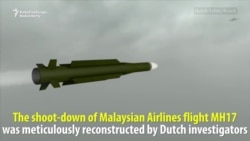
The JIT announced initially in 2016 that the sophisticated Buk missile system, which was used to shoot down the Malaysia Airlines Boeing 777, came from Russia.
Russia's 53rd Antiaircraft Missile Brigade had transported the Buk in 2014 to and from Ukraine, JIT additionally concluded in May 2018.
Moscow seized control of the Crimean Peninsula in March 2014 and has supported the separatists who control parts of the eastern Ukrainian regions of Donetsk and Luhansk in a war that has killed some 13,000 people since April of that year.
The passenger flight was downed in the conflict zone over non-government-controlled territory.
Russia denies involvement in the tragedy. It has blamed, among others, Ukraine and the U.S. Central Intelligence Agency for the disaster.
The airliner flying between Amsterdam and Kuala Lumpur was blasted out of the sky on July 17, 2014, over territory in eastern Ukraine held by pro-Russia separatists.
The JIT probe of the attack consists of investigators from Australia, Belgium, Malaysia, the Netherlands, and Ukraine.
It has declined to confirm that it will announce charges.
With reporting by AFP, Reuters, the BBC, and Interfax-Ukraine
This ends our live blogging for June 18. Be sure to check back tomorrow for our continuing coverage.
Will Russia return to PACE next week?
By Rikard Jozwiak
BRUSSELS -- On June 24, the Parliamentary Assembly of the Council of Europe (PACE) will begin its summer session in Strasbourg and it is expected to vote on a report that could welcome Russia back to the chamber after a three-year hiatus.
If this happens, it would become the first set of major Western sanctions imposed on Moscow since its annexation of Crimea in 2014 to be revoked.
What Has Happened So Far?
In 2014, PACE reacted to the Russian annexation of the Ukrainian peninsula of Crimea and Moscow's backing of militant separatists fighting in eastern Ukraine by stripping the Russian parliamentary delegation of its voting rights, depriving its members of the right to lead committees and to participate in governing bodies and supervisory missions until the end of the year. Russian delegates could still speak at the sessions, initiate decisions and vote in the various PACE committees.
These sanctions were prolonged the following year before Russia, in 2016, decided it would no longer participate in the assembly. On top of that, Russia has for the past two years not paid its annual contribution of 33 million euros, roughly 7 percent of the council's budget.
There has also been talk that Russia might withdraw from the Council of Europe altogether if its delegation isn't reinstated and it can't vote on the next secretary-general to succeed Norway's Thorbjorn Jagland. This vote will happen at the June 24-28 session and many member states are now feeling the heat from Russia.
What Is The Report About?
The title of the report that is expected to be discussed on June 24, Strengthening The Decision-Making Process Of The Parliamentary Assembly Concerning Credentials And Voting, seems innocuous enough and its 12 paragraphs don't mention anything about Russia.
The report does, however, contain two key lines that, if passed, not only would blunt PACE's ability to impose sanctions similar to those on Russia in the future but would also welcome Russia back into the fold immediately. On the first issue, the report states that "the members' rights to vote, to speak and to be represented in the assembly and its bodies shall not be suspended or withdrawn in the context of a challenge to or reconsideration of credentials."
As for the Russian delegation returning immediately, the report states that "the assembly also notes that the Committee of Ministers, having regard to the importance of the elections of the secretary-general and of judges to the European Court of Human Rights, would welcome that delegations of all member states take part in the next June session of the Parliamentary Assembly."
If the report passes, Moscow's delegates could take part in key votes starting the following day. Looking at the agenda for the June 24-28 session, this is entirely feasible. The report will be debated and voted already on June 24 (normally no such debates are held the first day). On the morning of June 25 there is a scheduled session allowing the assembly to examine and approve the credentials of the Russian delegation and on June 26 the election of the new secretary-general, as well as judges to the European Court of Human Rights (ECHR), will take place
How Will This Likely Play Out?
At this point, it is considered likely that the report will pass and Russia would then be back with full voting rights almost instantly. In the foreign-ministerial meeting of the Council of Europe in Helsinki last month, a declaration was adopted overwhelmingly stating that "all member states should be entitled to participate on an equal basis" in the organization, adding that its members "would welcome that delegations of all member states be able to take part" in the council's Parliamentary Assembly in June. This paved the way for PACE's Rules Committee to back the report by 18 votes to 6 during its meeting in Paris on June 3.
France and Germany have been the main drivers of the change and most of the delegates from Berlin and Paris will vote in favor. The main argument for reinstating Russia is that it is better to have Russia in PACE to promote dialogue even if one doesn't see eye to eye on many issues.
Keeping Russia out -- or having it leave the Council of Europe altogether -- according to those who favor Moscow's full return, will also prevent Russian citizens from taking their cases to the ECHR and will further exacerbate the budget shortfall.
Delegates from countries such as Georgia, Ukraine, the United Kingdom and the three Baltic states will try to muster enough support to sink the report -- something that has happened on several occasions before at PACE when documents proposing easing the way back for Russia have been voted down.
What Happens To PACE If Russia Returns In June?
Those who argue against dropping the sanctions against Moscow say inviting Russia back could damage PACE' reputation. This would mean that Russia would return without actually having implemented any of the demands that the chamber put on it.
More importantly, it would create a precedent for other countries to follow, since sanctions in the future would be harder to impose. It would also weaken the assembly's right to challenge unbalanced delegations and could in a sense legitimize Russia's annexation of Crimea, if Russia decided to send a Duma member from the peninsula -- a scenario that PACE would find almost impossible to challenge.
More symbolically, however, restoring Moscow's voting rights could be interpreted by Russia as evidence that the West wants to "get back to business" and it could potentially lead to more Western sanctions being dropped in the future, though there are no concrete indications of that as of yet.