



European court extends decision to ban Ukrainian authorities' access to journalist's phone:
By RFE/RL
The European Court of Human Rights (ECHR) has extended a decision made last month to prevent Ukrainian authorities from accessing data from RFE/RL investigative reporter Natalia Sedletska's mobile phone.
The ECHR on September 18 issued a one-month interim decision ordering Ukraine's government to ensure that the authorities there do not access any data from Sedletska's phone.
In a letter to the Ukrainian government on October 16, the ECHR announced said it "decided to prolong until further notice" the measure adopted last month.
The ECHR order gives Sedletska time to prepare a full complaint against a Ukrainian court ruling allowing investigators to review data from her phone.
On August 27, Kyiv's Pechersk district court approved a request from the Prosecutor-General's Office to allow investigators to review all data from Sedletska's phone from July 1, 2016, through November 30, 2017.
The ruling stemmed from a criminal investigation into the alleged disclosure of state secrets to journalists in 2017 by Artem Sytnyk, director of the National Anticorruption Bureau of Ukraine.
On September 18, a Ukrainian appeals court ruled to restrict the original request to geolocation data from around the offices of the National Anticorruption Bureau in Kyiv, but upheld the original time frame.
Sedletska is the host of Schemes, an award-winning anticorruption television program by RFE/RL's Ukrainian Service and Ukrainian Public Television.
The Schemes program reported on several investigations involving senior Ukrainian officials, including Prosecutor-General Yuriy Lutsenko, during the period in question.
The United States, the European Union, and international media watchdogs have expressed concern over the Ukrainian court ruling.
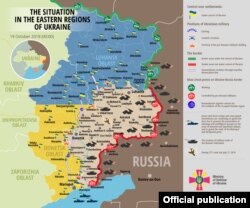
Here is today's map of the security situation in eastern Ukraine, according to the National Security and Defense Council (click to enlarge):
From the RFE/RL news desk:
The International Monetary Fund said it had reached a new agreement with Ukraine, paving the way for a fresh $4 billion loan.
The agreement followed an announcement earlier on October 19 by Prime Minister Volodymyr Hroysman that household gas rates would rise by nearly 25 percent.
Aid from the fund, known as the IMF, has been essentially frozen since April 2017 as Ukraine's government has slowed efforts at major economic reforms.
The IMF said the new 14-month deal would replace an existing financial-aid package that was first agreed to in March 2015, about a year after the country was plunged into turmoil amid the so-called Euromaidan mass protests.
Final approval, which must still come from the fund's board later this year, will be contingent on Ukrainian lawmakers approving a 2019 budget that is "consistent with IMF staff recommendations," the IMF said.
That must include increases in household gas and heating rates.
In televised comments earlier on October 19, Hroysman said gas prices would be raised by nearly 25 percent beginning November 1. He said Ukraine risked default if it failed to meet the IMF conditions.
"We have no other option to prevent extremely difficult events," Hroysman said.
The hike in gas rates is politically unpopular and comes just as the country is gearing up for presidential elections in March.
Gas rates have been kept artificially low since the Soviet era, which economists say has resulted in waste and inefficiency.