




Putin Blasts Kyiv For 'Blatant Interference' In Orthodox Church
By RFE/RL's Russian Service
Russian President Vladimir Putin has accused Ukraine’s government of “blatant interference” in the Orthodox Church in Ukraine after a new national institution split from Moscow’s patronage.
Speaking at a Russian Orthodox Church event attended by Patriarch Kirill in Moscow, Putin said on January 31 that the push for the new church was rooted in "the struggle for power" and provoked "animosity and intolerance."
“Russian authorities believe that any interference in the affairs of the church is absolutely unacceptable,” Putin said.
In early January, the Orthodox Church in Ukraine was granted independence, or autocephaly, ending more than 330 years of Russian religious control in Ukraine.
Russia long opposed such efforts by the Ukrainians for an independent church, which intensified after Russia seized Ukraine's Crimean Peninsula in March 2014 and began supporting separatists shortly thereafter in parts of Ukraine's eastern regions of Donetsk and Luhansk.
“We have always respected the independence of church life, particularly in a sovereign neighboring state. Nevertheless, we reserve the right to respond and do everything possible to protect human rights, including freedom of religion," Putin said.
“It is a blatant interference in church life and those who initiated it seem to have learned from the godless people of the last century, who expelled believers from churches and prosecuted the clergy," he added.
With reporting by Reuters and AP
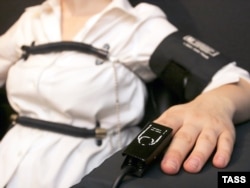
Lie-Detector Loyalty Tests Proposed For Ukrainians In Separatist-Controlled East
By Ron Synovitz
Ukraine's chief military prosecutor has called for lie-detector tests to determine the loyalty of residents in the parts of eastern Ukraine that are under the control of Russia-backed separatists.
The timing of the proposal has raised questions about whether lie-detector tests could be used to restrict the voting rights of those from separatist-controlled territory when they try to register and cast ballots in Ukraine's upcoming presidential election.
That's because voters who live in separatist-controlled areas must cross into government-held territory to take part in the March 31 vote.
But Oleksandr Kluzhev, an analyst at the Civil Network OPORA, says he thinks it will be impossible for authorities in Kyiv to implement the policy because it would violate the Ukrainian Constitution.
"If this policy is established, of course we will see the misuse of it in the context not only of elections but also in the context of human rights," Kluzhev told RFE/RL.
"It's obvious the proposal is discriminatory because it is based on the registration of the place of a person's residence and not an individual's activities," Kluzhev said.
"It's important for officials to crack down on provocations by the Russia state, but I personally see this as an unrealistic proposal made by a public official," he said. "It's an attempt to make popular claims about a conflict zone at the time of elections."
Military Prosecutor-General Anatoly Matios proposed the lie-detector tests during a January 29 interview with the private 112 Ukraine TV channel.

Although Matios didn't specify details of his plan, his remarks suggest lie-detector tests are being considered for an estimated 7,000 people who cross the "line of contact" in eastern Ukraine every day from the parts of the Donetsk and Luhansk regions held by separatists pitted against Ukrainian government forces.
Matios said Ukrainian President Petro Poroshenko had called for ideas to determine whether residents in separatist-controlled parts of eastern Ukraine are loyal to the government in Kyiv or support the Russia-backed separatists.
READ THE FULL STORY HERE.
That time of the week again: