



Ukraine Moves To Bar Election Monitors From 'Aggressor State' Russia
Ukrainian lawmakers have voted to ban Russian citizens from serving as election monitors in the country.
The draft legislation was passed by the Verkhovna Rada on February 7, ahead of next month’s presidential election and parliamentary polls later in the year.
According to the bill, Russia will not be able to send observers to the elections -- even under the auspices of the Organization for Security and Cooperation in Europe (OSCE), of which both Ukraine and Russia are member states.
The OSCE has submitted a list of candidates for the presidential election observation mission, and it included two Russians.
But the proposed legislation, which must now be signed by President Petro Poroshenko to go into effect, says that election observers cannot be citizens of a country recognized by the Ukrainian parliament as an "aggressor state or occupying state."
Ukraine's parliament declared Russia an "aggressor state" in January 2015, after Moscow illegally annexed Ukraine’s Crimea Peninsula in March 2014. Russia is also backing armed separatists in a conflict in eastern Ukraine that has killed more than 10,300 people since April 2014.
Following the passage of the bill, the head of the State Duma’s Foreign Affairs Committee called into question the “openness and democratic nature of the election process in Ukraine.”
Moscow will raise the issue at the next OSCE Parliamentary Assembly session later this month, Leonid Slutsky said.
Meanwhile, the U.S. special envoy for Ukraine, Kurt Volker, said that Ukraine "needs" OSCE observers, even if some are Russian citizens, "to prove it adheres to democratic standards."
Ukraine "needs to have confidence in its own democratic institutions," he tweeted.
Based on reporting by dpa, AFP, AP, and Interfax
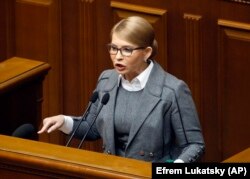
After Slip In Polls, Tymoshenko Goes Low In Ukraine Campaigning
By Christopher Miller
KYIV -- As she slipped from the top spot in preelection polls, Ukrainian presidential candidate Yulia Tymoshenko has offered explosive and seemingly unsubstantiated claims this week in an apparent effort to climb back atop an expanding field.
The first accusation came on February 4, when the former prime minister accused President Petro Poroshenko's reelection campaign of attempting to buy Ukrainians' votes for 1,000 hryvnyas ($36). Without providing proof, she urged Ukraine's interior minister and prosecutor-general to launch probes into the matter.
Members of Poroshenko's party, in turn, accused Tymoshenko's camp of bribing voters and improperly collecting their personal data.
But it was at the kickoff of Tymoshenko's nationwide campaign tour on February 5 in her hometown of Dnipro that especially resonated with her critics on social media. She told a crowd of supporters waving blue-and-yellow posters adorned with her "I Believe!" slogan that U.S.-born acting Ukrainian Health Minister Ulana Suprun was "sent by foreigners" who want to "experiment on Ukrainians."
The full video of the campaign stop was published on Tymoshenko's Facebook page.
But it was a clip that highlighted the "experiment" comment shared by activist group EuroMaydan that quickly spread across Ukrainian social media.
Tymoshenko's campaign has not commented on the remarks since.
Earlier that same day, a district administrative court in Kyiv had ruled that Suprun could no longer head the Health Ministry. It cited a Ukrainian regulation that says a person may be acting minister for only one month and another that stipulates that government officials may not hold foreign passports.
READ THE FULL STORY HERE.
That concludes our live-blogging of the Ukraine crisis for February 7, 2019. Check back here tomorrow for more of our continuing coverage. Thanks for reading and take care.
France backs changes to EU energy rules seen as threat to Nord Stream 2:
By RFE/RL
France says it supports European Union energy-rules amendments that could potentially threaten the completion of an underwater natural-gas pipeline between Russia and Germany under the Baltic Sea.
EU member states were set to discuss extending EU gas-market regulations to offshore pipelines such as the planned Nord Stream 2 pipeline at a meeting in Brussels on February 8.
On the eve of the talks, the French Foreign Ministry said that France "intends to support the adoption of such a directive."
"Work is continuing with our partners, especially Germany, on the changes that could be made to the text," it added.
The move puts Paris at odds with Berlin, which has championed the planned 1,230-kilometer project, which is also being pushed by the Kremlin.
However, the project faces opposition from the United States and many countries in Eastern and Central Europe, because it would avoid existing gas pipelines through Ukraine and increase Europe's energy dependence on Russia.
"We are not for or against Nord Stream 2," a French diplomatic source told the AFP new agency. "We are asking that there are guarantees for the security of Europe and for the security and stability of Ukraine."
An EU source has said that France's vote will be decisive, likely leaving Germany short of a blocking minority, according to Reuters.
The EU executive wants a say over how Nord Stream 2 is used before its construction, which involves European companies, is completed.
In the United States, a bipartisan group of senators drafted a resolution calling for the cancelation of the pipeline project, and leaders of the Senate Foreign Relations Committee said they would take up the resolution at their next meeting.
In its current form, Nord Stream 2 is fully owned by Russian state energy giant Gazprom and would not be compliant with the proposed new rules.
In a joint op-ed published by Germany's Deutsche Welle, the U.S. ambassadors to Germany, Denmark, and the European Union on February 7 urged EU member states to support the proposed change in the EU regulations.
"Nord Stream 2 would further increase Europe's vulnerability to Russian blackmail in the energy sector," the ambassadors wrote.
Russian officials and German Chancellor Angela Merkel have insisted that the pipeline is a purely economic project.
Speaking during a visit to Slovakia, Merkel said on February 7 that Nord Stream 2 would not make Germany dependent on Russia for gas "if we diversify at the same time."
Germany considers it important for Ukraine to maintain its role as a transit country for Russian gas, she added.
In Moscow, Russian Foreign Ministry spokeswoman Maria Zakharova expressed "hope that when making [their] decision, EU member countries will be guided by their own national interest." (w/dpa, AFP, Reuters, and Interfax)
Dutch "confident" Moscow will agree to talks on findings of MH17 probe:
By RFE/RL
The Netherlands says it is "increasingly confident" Russia will agree to formal talks about the findings of an international investigation that Moscow bears legal responsibility for its role in the 2014 downing of a Malaysian passenger jet over Ukraine.
The Dutch Foreign Ministry on February 7 said initial diplomatic contacts with Russia took place in "a positive atmosphere" and that it was hopeful the discussions will lead to formal talks on the matter.
"We are in contact with Russia over national accountability via diplomatic channels," a Foreign Ministry spokeswoman said. "We are increasingly confident that we will sit down with the Russians shortly."
Foreign Minister Stef Blok told reporters that "there are diplomatic contacts to see if we can begin formal talks about national responsibility for shooting down MH17."
He said it was too early to speculate on where and when formal talks might be held.
A Dutch-led international criminal investigation has concluded that the Buk missile that shot down the Malaysia Airlines flight over Ukraine in 2014 came from Russia's 53rd Antiaircraft Missile Brigade.
The Joint Investigative Team (JIT) "has come to the conclusion that the Buk-TELAR that shot down MH17 came from the 53rd Antiaircraft Missile Brigade based in Kursk in Russia," top Dutch investigator Wilbert Paulissen told reporters on May 24. "The 53rd Brigade is part of Russia's armed forces."
The JIT comprised authorities from the Netherlands, Australia, Belgium, Malaysia, and Ukraine.
MH17 was shot down over the conflict zone in Ukraine's Donetsk region on July 17, 2014, killing all 298 people on board.
About two-thirds of the people killed were Dutch citizens. The Netherlands has been one of the main driving forces behind seeking accountability for the attack.
Following the announcement of the JIT findings, Russia's Defense Ministry reiterated it had nothing to do with the downing of the plane.
The Russian Foreign Ministry said the findings were based on "fake data" presented by bloggers and that Moscow's information regarding the case was largely ignored.
Months after the downing, the Russian military made a new claim, asserting that the missile that brought the flight down was sent to Soviet Ukraine after it was made in 1986 and never returned to Russia.
Kyiv swiftly disputed the Russian assertion, which a senior Ukrainian official called an "awkward fake," while the JIT said that it was still waiting for Russia to send documents it requested long before and that Moscow had made "factually inaccurate" claims in the past.
If Russia were ultimately to acknowledge some form of legal responsibility, it could lead to compensation claims from relatives of the people killed.
The United States, Britain, and other allies have backed the JIT findings.
"It is time for Russia to acknowledge its role in the shooting down of MH17 and to cease its callous disinformation campaign," U.S. State Department spokeswoman Heather Nauert said at the time. (w/Reuters, Meduza, and AP)