



That concludes our live-blogging of the Ukraine crisis for July 30, 2019. Check back here tomorrow for more of our continuing coverage.
Good morning. We'll start the live blog today with this item that was posted by our news desk overnight:
Zelenskiy's Economic Team Head Wants New IMF Loan, To Lift Farmland Sale Ban
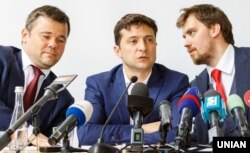
Ukraine wants a new, longer-term International Monetary Fund (IMF) program with an emphasis on attracting foreign investment, selling state-owned assets, and lifting the ban on the sale of farmland.
Oleksiy Honcharuk, who leads Ukrainian President Volodymyr Zelenskiy’s economic team, told Bloomberg in an interview published on July 30 that he wants to pursue market-based policies.
To help do that, Honcharuk, 35, said he wants to replace the current 14-month, $3.9 billion IMF program that expires at the end of this year.
Instead he wants a staff-level agreement for up to four years as early as September.
"When we show changes in the approach to privatization, farmland sales, when we attract a couple of big companies to extract natural resources -- all of these examples will give clear signals that the rules have changed," Honcharuk said.
Economic Growth Target
Kyiv currently is targeting yearly economic growth of 5 percent, an improvement on the past three years when the economy increased on average by 2-3 percent.
To unlock growth, creating a farmland market by lifting the moratorium could add $15 billion a year to economic output and increase yearly gross domestic product by about 1.5 percentage points, according to the World Bank.
Honcharuk said talks are underway with the World Bank on whether to allow foreigners to purchase farmland or limit the size of sales. Ukraine has more than 40 million hectares of fertile farmland that covers nearly 70 percent of its territory.
"We’re looking for the least painful but most efficient version," Honcharuk told Bloomberg.
Corruption One Of Main Obstacles
There is a catalogue of more than 200 state-owned companies that the State Property Fund is ready to sell.
However, "corruption is one of the main obstacles to carrying out long-awaited reforms of state-owned enterprises," according to a report by the Organization for Economic Cooperation and Development (OSCE).
Still, Honcharuk said minority stakes could be offered to large state-run enterprises, such as the national railway company and postal service.
Other challenges remain, such as a Kremlin-backed separatist conflict in two regions of easternmost Ukraine and a shrinking workforce.
In its July macroeconomic report, the Ukrainian Finance Ministry said that nearly 18 percent of the "economically active population age 15-70" are labor migrants. More than 3.2 million people are working abroad.
However, labor migration is driving wage growth because competition is fiercer between companies to hire the remaining talent, the Finance Ministry said.
With reporting by Bloomberg
And here's another item from our news desk that should be of interest to Ukraine-watchers:
EU: Black Sea Has Twice As Much Trash As Mediterranean
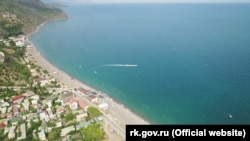
The Black Sea contains almost twice the amount of marine litter as the Mediterranean Sea, the European Union delegation to Ukraine said in a July 30 news release.
Based on surveys conducted since 2017 in the coastal waters of Georgia, Ukraine, Russia, and in the open sea, the EU said 83 percent of the marine litter is plastic: "namely bottles, candy wrappers, and bags."
Ukraine's large rivers bring six to 50 items of trash per hour to the sea.
Thus, there are 90.5 litter items per square kilometer in the Black Sea. By comparison, there are 50 litter items per square kilometer in the Mediterranean Sea.
Moreover, the Black Sea surveys state that "concentrations of some pollutants exceed their toxicity threshold value."
Some chemical substances found are dangerous to marine and human life.
Among them are benzo(a)pyrene, "several pesticides, insecticides, and also mercury and flame retardants in fish," the EU said.
The population sizes of all species of dolphins that swim in the Black Sea are "relatively low," the EU said. The largest groups of dolphins were found in the Danube River delta and Zmiynyi Island.
The number of invasive species is growing. Among them are Monrovia doctorfish, red barracuda, and burrowing goby.
On the positive side, the EU said the status of the world’s biggest red algae field -- Zernov’s Phyllophora Field -- improved from "poor" to "moderate."
Also, the European sturgeon, which was considered almost extinct, was found in many samples across the Black Sea.
"The obtained results of the surveys should contribute" to improving the "status of the Black Sea…as well as to global understanding of current risks and threats to [the] marine ecosystem," said Jaroslav Slobodnik, the EU project’s leader.
The EU Black Sea monitoring project runs through 2020 and has a budget of 1.6 million euros.