



Court rules against TV that called violent far-right group "neo-Nazi":
By Christopher Miller
KYIV -- A Ukrainian court has ruled in favor of a violent far-right organization labeled a "nationalist hate group" by the U.S. State Department that claimed a news outlet damaged its reputation when it labeled it as "neo-Nazi" in a tweet last year.
The independent Hromadske TV said in a statement on August 6 that the Kyiv City Commercial Court decided that the outlet could not provide sufficient evidence to support its claim that C14, which takes its name from a 14-word phrase used by white supremacists, and whose own members have admitted to joining it because of its neo-Nazi ideology, was, in fact, a neo-Nazi organization.
The ruling orders Hromadske TV to retract its tweet and pay 3,500 hryvnyas ($136) in court fees for C14.
"The decision is incorrect and illegal, it introduces an egregious tendency that suppresses freedom of speech. We will appeal it," said Oksana Tchaikovska, an attorney for Hromadske TV.
Hromadske TV's editor in chief, Angelina Karyakina, said she was "surprised by the decision."
"Not only does it contradict judicial logic, but [it] is also a dangerous precedent for other media and for freedom of speech in general," she said.
Karyakina said that Hromadske stood by its characterization of C14 as neo-Nazi despite the ruling.
RFE/RL could not reach C14 members for comment. Hromadske TV said C14 had declined its request for comment on the ruling, but it spoke to a lawyer who represented the group at a previous court hearing.
"The position of C14 is that they are not a neo-Nazi group in their activities or in the nature of their activities," Victor Moroz was quoted by Hromadske TV as saying. "They are a nationalist group, but they are by no means neo-Nazi."
He said that Hromadske TV calling the organization neo-Nazi harmed the "business reputation" of C14.
Other media outlets, as well as human rights organizations such as the Kharkiv Human Rights Protection Group, have also referred to C14 as neo-Nazi.
The tweet that led to the lawsuit was published by Hromadske TV's English-language account on May 4, 2018.
In the tweet, Hromadske called C14 a "neo-Nazi group" when reporting that several of its members had seized a Brazilian man who fought on the side of Russia-backed separatists against Ukrainian forces during the five-year war still raging in the country's eastern Donbas region.
The Brazilian, Rafael Lusvarghi, had been discovered earlier by RFE/RL in Kyiv.
C14, whose social-media pages show the group's use of white-supremacist symbols, has a long history of violence. Two of its members, Andriy Medvedko and Denys Polishchuk, are currently on trial in Ukraine for the high-profile 2015 murder of Ukrainian reporter Oles Buzyna. They deny the charges.
Other members of C14 have been behind several violent attacks against minority groups, including the Romany community. In some cases, they have live-streamed and posted videos and photographs of those attacks on social media.
The group's violent actions and imagery, along with its hateful posts have led to it being banned from Facebook, company officials told RFE/RL.
Nevertheless, C14 has received state funding for two years running from the Ministry of Youth and Sport to conduct "national-patriotic education" courses at summer camps for the country's youth.
This ends our live blogging for August 6. Be sure to check back tomorrow for our continuing coverage.
Good morning. We'll get the live blog rolling today with a couple of news items that were filed overnight:
Moscow Court To Hear Appeals Case Of Ukrainian Sailors
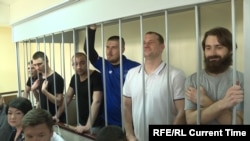
The Moscow City Court will hear arguments on August 16 in the case of six of the 24 Ukrainian crewmen detained in Russia, the TASS news agency has reported.
They, along with seven other sailors, have been ordered to stay in pretrial detention until October 24, while 11 others will be held until October 26.
A lower court prolonged their detention on July 17 as they await trial on charges of "trespassing" in what Russia claims are its territorial waters.
If found guilty, the sailors face up to six years in prison.
Russia has held the Ukrainian sailors since its forces fired on, boarded, and seized their vessels near the Kerch Strait on November 25.
The Kerch Strait is the sole passage from the Black Sea to the Sea of Azov. It runs between Russia and Crimea, the Ukrainian peninsula that Russia seized in March 2014 after sending in troops and staging a referendum deemed illegitimate by Kyiv, the United States, and at least 100 countries.
The takeover of the peninsula, and subsequent Russian support for separatist militants who seized parts of eastern Ukraine at the start of a conflict that has now killed some 13,000 people, came after pro-European protests pushed Moscow-friendly Ukrainian President Viktor Yanukovych from power in Kyiv.
Ukraine called the attack and capture of 24 crewmen a violation of international maritime law.
Western leaders have demanded that Russia release the crew, and the incident has led to the imposition of additional sanctions on Russia.
In May, the U.S. sanctioned six Russians, including at least two Federal Security Service officers and about a half-dozen defense firms, in coordination with the European Union and Canada.
Ukraine the same month won a favorable ruling from the Hamburg-based International Tribunal for the Law of the Sea, which ordered Russia to release all 24 sailors and the three impounded vessels.
In a resolution on July 18, the newly elected European Parliament called on Russia “to release without further delay and unconditionally all illegally and arbitrarily detained Ukrainian citizens both in Russia and in the temporarily occupied territories of Ukraine.”
The sailors were specifically mentioned in the nonbinding resolution.
In a March 12 report, the UN’s Office of the High Commissioner for Human Rights stated that Russia breached international humanitarian law and called the 24 captive Ukrainians "prisoners of war."
Based on reporting by TASS and RFE/RL’s Ukrainian Service
Ukrainian Political Prisoner Goes Free In Crimea
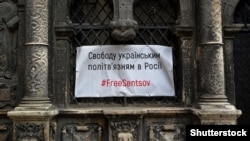
A Ukrainian whom Kyiv considered a political prisoner was released early from incarceration in Russian-annexed Crimea on August 6, the office of the Ukrainian presidential mission in Crimea said.
Oleksandr Steshenko is on his way to Kharkiv, Ukraine’s second largest city, said Ihor Kotelyanets, head of the Relatives of Kremlin Political Prisoners Association.
He was sentenced to two years in prison on August 22 on what Ukrainian human rights groups and officials said were trumped-up charges of "inciting ethnic tension" and being part of an "extremist group."
He was detained while crossing into Crimea on April 11, 2018.
Ukrainian officials deemed Steshenko one of 64 political prisoners who are being held in Russia or annexed Crimea.
Thirty-six are Crimean-Tatar and 54 of the prisoners were either arrested in Crimea, incarcerated on the peninsula, or taken from there.