




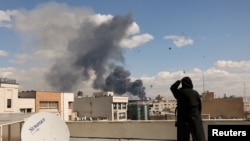
WASHINGTON -- As the war with Iran enters a volatile new phase, analysts in Washington say the Islamic Republic is confronting a convergence of crises unseen since its founding in 1979: the death of Supreme Leader Ali Khamenei amid a sustained US-Israeli air campaign, and the possibility of internal unrest that could reshape the political order.
Khamenei, who had ruled for 36 years, was the Islamic Republic’s second supreme leader, succeeding Ruhollah Khomeini in 1989. No successor had been publicly designated before his death, though Reuters reported in 2015 that a choice had been made but would remain undisclosed.
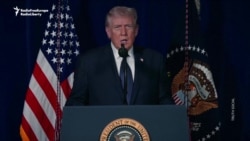
In announcing the US operation, President Donald Trump told Iranians that the government "will be yours to take," calling the moment potentially "your only chance for generations."
But what, exactly, does that mean -- and how far is Washington prepared to go?
Resetting the Equation, Not Rebuilding a State
According to Ilan Berman, senior vice president of the American Foreign Policy Council, the Trump administration is not seeking a repeat of Iraq or Afghanistan-style regime change, which came with long-term post-war institution-building efforts.
"I think it’s necessary to understand that the administration has no appetite for regime change of the types that we saw in Iraq and Afghanistan," Berman said in an interview on March 1, arguing that current US officials remain wary of prolonged nation-building efforts and the destabilizing aftermath that followed both conflicts.
Instead, when the administration speaks of "regime change," Berman said it envisions something narrower and faster -- potentially a rapid shift at the top of the system to facilitate negotiations, similar in concept to US actions in Venezuela, that saw the toppling and quick capture of President Nicolas Maduro in January.
At the same time, Berman, who is also a member of the RFE/RL board, noted that Washington’s track record with the Iranian opposition has been uneven. Over the past two decades, multiple exile and diaspora groups have sought to persuade US policymakers that they represent Iran’s future. But they have often been divided and adversarial toward one another.
During Trump’s first term, former Secretary of State Mike Pompeo and special envoy Brian Hook attempted to encourage greater unity among opposition figures, but those efforts fell short, Berman said, leaving skepticism within parts of the administration about relying heavily on organized opposition movements.
That experience helps explain Trump’s recent remarks, he added, in which the US president encouraged Iranians to take over their government.
"America can’t be more Iranian than the Iranians," Berman said. In his view, Washington is attempting to "soften the target" -- weakening the regime’s upper ranks while signaling that Iranians themselves must decide whether to seize the opportunity.

Recent strikes have not only killed the supreme leader but also targeted senior military officials and figures in the clerical line of succession. Berman described that as significant, suggesting it points to a strategy of limiting the regime’s ability to consolidate power while leaving space for internal change.
"The more senior-level officials are limited, the likelier the chances are that the Iranians have a shot at taking matters into their own hands," he said. "They may not, but I think the plan for the administration is that they want to create that opportunity."
If that opportunity is not seized, Berman said he would personally view it as a lost chance. But he stressed that Trump’s promise that “help is on the way” should not be interpreted as a pledge to dismantle the Islamic Republic outright.
"What he meant was not that he is going to get rid of the regime and just sort of take out the Islamic Republic and all of its component parts," Berman said. Rather, the goal is to reset the power equation. "What happens next really is up to the Iranians themselves."
A Succession Crisis in Wartime
That uncertainty is compounded by the unprecedented timing of Khamenei’s death.
Speaking at a special briefing hosted by the Middle East Institute, Iran analyst Alex Vatanka described the moment as a watershed.
"This is only the second time since 1979 that the Islamic Republic has faced a leadership succession," he said. The first followed Khomeini’s death in 1989, when Iran was at peace and political heavyweights such as former President Akbar Hashemi Rafsanjani helped orchestrate a managed transition.

"None of those conditions exist today," Vatanka noted. Iran is at war, public anger simmers beneath the surface, and there is no clear political broker capable of engineering consensus behind the scenes.
Tehran has formed an interim leadership council that includes President Masoud Pezeshkian and senior clerical and judicial figures. Publicly, officials are projecting continuity and defiance, framing the conflict as "not a war against the regime, but a war against Iran," Vatanka said.
Yet beneath that rhetoric lies deep uncertainty. "The fundamental question," he said, "is how the leadership reads US intentions."
If Iranian leaders conclude that Washington is committed to regime change for the long haul, they may seek an off-ramp. If they believe Trump will pursue only limited strikes, they may calculate that retaliation -- and endurance -- could outlast American resolve.
Vatanka also pointed to what he described as a potentially telling development: the reported assassination of former President Mahmoud Ahmadinejad.

Ahmadinejad was no longer politically central, Vatanka said, raising questions about whether the targeting reflects a broader political strategy aimed at shaping Iran’s postwar leadership landscape. "If there is a list," he suggested, "it may not be purely military."
So far, Vatanka said, he sees no clear signs that the regime is unraveling. But conditions differ markedly from previous waves of unrest. With US and Israeli forces actively engaged, Tehran’s ability to suppress large-scale protests could be constrained in ways not seen during earlier crackdowns.
"If people come into the streets," he said, “this time the regime would be managing both internal dissent and an external war simultaneously."
A “Fires Fight” in the Air
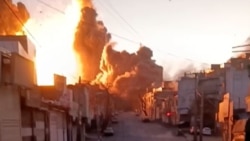
On the military front, retired US Marine Corps Major General Scott Benedict characterized the conflict not as a maneuver war but as a high-intensity exchange of long-range strikes.
The United States has deployed significant naval power to the region, including two aircraft carriers -- a rare concentration of force. While overall troop numbers may not be historically unprecedented, Benedict said the maritime buildup represents one of the largest in recent years.
Benedict assessed that early strikes successfully degraded Iran’s command-and-control infrastructure and air defenses, lowering what he called the “barrier to entry” for follow-on operations. The daylight targeting of senior leadership figures, he suggested, likely disrupted Iranian decision-making cycles.
Yet Iran retains substantial retaliatory capability through ballistic missiles, cruise missiles, and drones. Defensive operations across the Gulf region remain complex and ongoing.
"Iran doesn’t have much of an air force," Benedict said, "but they have a significant counterpunch capability."
So far, regional proxy forces such as Hezbollah and the Houthis have not entered the conflict in a major way -- a development Benedict described as a potential “game changer” should it occur.
As for how long the campaign could last, Benedict cautioned that the answer ultimately rests with political leadership. Militarily, however, he suggested US planners likely have sufficient munitions in theater to execute their near-term objectives.
"As you degrade higher-end targets," he explained, "you can transition to more available ordnance. But the broader global munitions picture is something policymakers will have to manage carefully."
Regional Ripples -- and a Waiting Public
Berman stressed that the unfolding crisis extends beyond a bilateral US-Iran confrontation. Iran’s recent attempts to broaden the conflict -- including actions directed at Saudi Arabia, the United Arab Emirates, and the Gulf countries-- may backfire, he argued, reinforcing perceptions that Tehran is an unpredictable and dangerous neighbor.
In his assessment, Iran’s own actions risk consolidating a broader anti-Iran coalition in the region, complicating any effort by the remaining leadership to stabilize the situation.
Ultimately, analysts agree that the next phase hinges less on military capability than on political choices -- in Tehran, in Washington, and potentially in Iran’s streets.
"They’re not predetermining what the outcome is going to be," Berman said of the US approach. "What they’re trying to do is fundamentally reset the table."
Whether that reset leads to reform, retrenchment, or wider war may depend on how Iran’s leaders -- and its people -- respond in the days ahead.

