




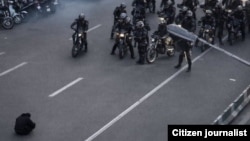
Iran's leadership is facing mounting pressure from abroad and emerging dissent from within as street protests over its reeling economy and the threat of a new round of military strikes hang over the country.
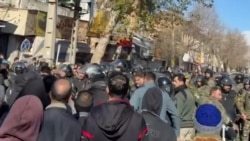
Demonstrations were reported in several cities, with markets and shops shuttered and students holding rallies at universities, on December 30.
This follows two days of demonstrations that saw security forces launch volleys of tear gas to disperse crowds. People were chanting anti-government slogans to protest a sharp weakening of the currency.
Third Day Of Closures
Videos posted on social media showed a third day of closures and demonstrations.
One video, verified by RFE/RL, showed protesters pushing back security forces in Tehran. Projectiles were thrown at the police, who appeared to fire tear gas at the crowd.


"We're in a new phase of turmoil in the country, which is the phase of the dollarization of the Iranian economy...which led to protests," Tehran-based political analyst Hamid Asefi told RFE/RL's Radio Farda.
"The situation in the bazaars and in the economy does not have a [bright outlook]. We can't say that in 4, 5 months everything will be back to normal," he added.
As Iran reeled from the street protests put down with tear gas and batons, a new threat was looming from across the Atlantic as US President Donald Trump hosted Israeli Prime Minister Benjamin Netanyahu at his Mar-a-Lago residence in Florida.

Asked whether he would support new Israeli military strikes on Iran if it continued with its missile program or nuclear program, Trump was unequivocal.
"If they will continue with the missiles -- yes; the [continuation of its] nuclear [program] -- fast. One will be 'yes, absolutely,' the other one, 'we'll do it immediately.'"

Moments earlier, Trump also noted the domestic challenges facing the Iranian authorities.
"They’ve got a lot of problems in Iran. They have tremendous inflation. Their economy is bust…and I know that people aren’t so happy. But don’t forget, every time they have a riot or somebody forms a group, little or big, they start shooting people,“ he said.
Iranian Rial Plunges Sharply
The Iranian rial is trading at around 1.4 million to the dollar, compared to around 800,000 a year ago, on unofficial markets. Official exchange rates are better but unavailable to many Iranian individuals and businesses.
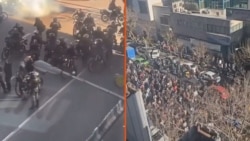
Many stores have closed as traders shuttered their businesses in protest and joined the demonstrations.
"It's the bread and butter issues: Merchants don't know if they sell their goods today, will they be able to buy more goods and sell them? And if they're supposed to sell them at a huge loss, they come to the streets and make themselves heard," analyst Asefi said.
US-based Iranian political analyst Ali Afshari agreed, underlining the role of Iran's international isolation under US and UN sanctions in pummeling the economy.
"The government cannot resolve this issue fundamentally, it needs a change in foreign policy, which is very difficult due to the stances by the Trump administration," he told RFE/RL.
"It makes it hard to reach an agreement and as long as the sanctions are in place, Iran is isolated. In such a situation, it is very difficult to fix the economy," he added.
The poor state of the economy may not be the only factor driving the renewed protests in Iran.
Crowds were also chanting "death to the dictator," a slogan often heard during the mass nationwide Women, Life, Freedom protests that rocked the country in 2022.
Against this backdrop, the prospect of further strikes by Israel appears to have increased following Netanyahu's visit to Florida.
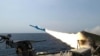
"They know the consequences. The consequences will be very powerful, maybe more powerful than the last time," Trump said, referring to the 12-day war in June, when Israel and the United States launched a bombing campaign targeting Iranian nuclear and military sites.
"To some extent Netanyahu has shifted the focus, spotlighting the missile threat as the next frontier of confrontation and as justification for potential military action," Sanam Vakil, head of the Africa and Middle East program at the London-based Chatham House think tank, told RFE/RL.
"This does not make military strikes more likely on their own, but it broadens the list of possible triggers and rationales for future action.... Heavy blows to military infrastructure could rally nationalist sentiment around the regime, even as they exacerbate economic and political pressures," she added.
Officials in Tehran have responded to the twin challenges with threats and appeals.
Ali Shamkhani, a senior adviser to Supreme Leader Ayatollah Ali Khamenei, responded to the comments by saying any attack on Iran would prompt "an immediate harsh response."
"Under Iran's defense doctrine, responses are set before threats materialize," Shamkhani wrote on X on December 29, adding that Iran's missile capability and defense are not "containable or permission-based."
Iranian President Masud Pezeshkian said "the response of the Islamic Republic of Iran to any oppressive aggression will be harsh and regrettable."
Earlier, he said he had asked the Interior Ministry to listen to protesters' "legitimate demands through dialogue with their representatives" -- a different approach than that adopted by security forces in Tehran in recent days.