




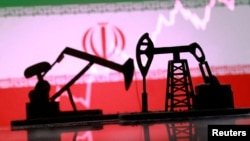
Weeks of US and Israeli air strikes, sanctions, and restrictions have hit Iran hard, but it could be geology that eventually pushes it into making concessions in its ongoing standoff with the United States.
As the US naval blockade of Iran approaches the end of its third week, data from shipping and industry monitors suggests that tankers have been unable to move Iranian crude through the Strait of Hormuz toward markets in Asia.
This means that Iranian oil storage capacity is rapidly filling, and the clock is ticking before Iran will need to cease production. That's the problem for Tehran, analysts say, as it tries to withstand US pressure to negotiate a peace agreement.

'Geological Impact'
"That creates more of a geological impact rather than anything else, to do with how oil is extracted," Stephen Innes, managing partner at SPI Asset Management, a foreign exchange and commodity advisory, told RFE/RL.
Once the valves get turned off, "oil tends to settle down at the bottom of the reservoir. And it's quite viscous and it's quite thick and it takes a lot of propulsion to bring that up," he said.
The result, he added, could even be "an endgame" for the sector.
"The whole process to build up pressure again and successfully get [oil] coming up the well again, could possibly take a year…. A lot of people think it's just the end of the production because it's just going to be too costly [to restart]," Innes said.

A research note issued by Goldman Sachs on April 23 stated that "the share of country production with relatively low reservoir pressure is estimated to be higher in Iran and Iraq than elsewhere in the Gulf."
The note, which was considering oil sectors in all Persian Gulf countries, said that recovery of oil production levels "may be only partial after a prolonged closure."
Mehdi Moslehi, a UK-based Iranian risk consultant who worked in the oil sector for a decade, agreed that the timescale of any extraction shutdown would be important.
"If production at a well is stopped for a short period, say between one week up to two or maximum three weeks, then it can be brought back into operation again," he told RFE/RL's Radio Farda.
"But if a well remains shut for a long period -- especially because the oil wells in southern Iran mostly have high sulfur content, and depending on how old the well is -- there will be serious problems. Reservoir pressure may drop."
A Race Against Time?
Of course, Iran may not need to shut down production. But data released this week suggested that it's now a race against time.
A recent report by Kpler, a commodities and shipping analytics company, said "no confirmed tanker has exited the US blockade zone" since Washington began enforcing the blockade on April 13.
"Several tankers passed through the Strait of Hormuz but failed to clear the US blockade, which sits further south between the Gulf of Oman and the Arabian Sea," it said.
This is why Iran's oil stores are filling up. Kpler estimated Iran had about 12 days spare capacity. Some analysts have suggested a time window of 2-3 weeks.
"Before, we could say time was on the side of the Islamic republic. But now we can't really say that anymore," Kpler analyst Homayoun Falakshahi told Radio Farda. "The rules of the game have become somewhat balanced."
Iran's blockade of the Strait of Hormuz, preventing oil exports by other Gulf nations, is also exerting pressure. It has led to a spike in oil prices and sent supply shocks through the world economy, hitting not only oil but also gas and other vital commodities.
As this goes on, the global pain increases.
"Right now this is a game of endurance, of seeing which side gives in more in the short term…. Prices around $100–110, even up to $120 per barrel are still levels the global economy can tolerate. However, if the Strait of Hormuz is closed in the coming days or weeks, prices will probably rise further," Falakshahi said.
On April 29, Brent crude rose sharply to $115 per barrel following a report in The Wall Street Journal that US President Donald Trump had told aides to prepare for an "extended" blockade.

In the meantime, Iran is seeking other ways to ease storage pressures. There's talk of delivering oil by train to China, which is Iran's biggest customer by far. But this would be more expensive and in smaller volumes than by tanker and so have limited impact.
Iran's next step may be further escalation.
Many other Persian Gulf producers have been able to alleviate the storage pressures Iran is facing by using other routes, such as Saudi Arabia's East-West pipeline to the Red Sea. Amid curtailed output this has helped keep the pumpjacks jerking and the trunk lines pressurized.
Iran could mobilize its Houthi proxy forces in Yemen to attack this route, by targeting shipping in the Bab al-Mandab Strait, through which roughly 10 percent of the world's seaborne oil passes.
But this would also entail risk for Tehran. In recent weeks, the United States has added to its massive military presence in the region and indicated the possibility of a return to hostilities.
"The feeling around the market is that something's going to get done on the deal front between now and the next three weeks," Innes said.



