



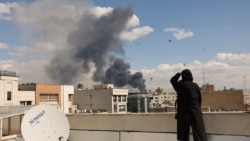
Dozens Of Oil Tankers Halted In Persian Gulf
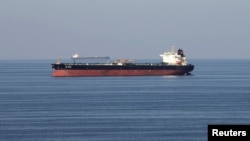
Dozens of oil tankers have stopped moving in the waters of the Persian Gulf, Reuters reports.
Citing the Marine Traffic monitoring website, the news agency said “at least 150 tankers,” including crude oil and liquefied natural gas carriers, have anchored near the Strait of Hormuz and are not moving.
Following the start of US and Israeli attacks on Iran on February 28, the naval force of the Islamic Revolutionary Guards Corps warned that it would prevent ships from passing through the Strait of Hormuz.
According to Reuters, the tankers are anchored near major crude oil and gas producers such as Iraq, Saudi Arabia, and Qatar.
Trump Says That 48 Iranian Leaders Have Been Killed

US President Donald Trump said that 48 Iranian leaders have been killed.
"Nobody can believe the success we're having, 48 leaders are gone in one shot. And it's moving along rapidly," Trump said in an interview with Fox News.
Officials from US Central Command, which oversees operations in the Middle East, announced that three US military personnel have been killed in action and five seriously wounded. The announcement gave no details where and how the personnel were targeted saying only that several other troops “sustained minor shrapnel injuries and concussions and are in the process of being returned to duty.”
From our latest news wrap.
Retired General Jack Keane Says US-Israeli Operation Aims to Dismantle Iranian Leadership

Jack Keane, a retired four-star general and former Vice Chief of Staff of the U.S. Army, says the US-Israeli military campaign launched against Iran on February 28 is a calculated effort to dismantle the Islamic Republic’s political and military architecture.
Keane, who now serves as chairman of the Institute for the Study of War, told RFE/RL in an interview the strikes, and reports that Supreme Leader Ayatollah Ali Khamenei was killed in the operation made for a “historic day of tremendous significance.”



Keane said the first phase of the operation has exceeded expectations, pointing to strikes that targeted senior leadership, missile systems, drone infrastructure, and key elements of Iran’s military command structure.
The campaign was designed to “strip away the entire political leadership and the structures that support it,” including the Islamic Revolutionary Guards Corps, and to continue for “two to three weeks if necessary,” depending on how the regime responds, he added.
RFE/RL: General, first, what are your thoughts on this extremely busy day, including President Trump's confirmation that Khamenei has been killed?
Jack Keane: Well, I think it's an historic day of tremendous significance because President Trump and [Israeli] Prime Minister Netanyahu have made a decision that they're not going to permit the Iranian regime to continue to destabilize the Middle East, to continue to conduct proxy wars, to continue the ballistic missile development program and their nuclear program.
They have decided that they want to put the Iranian regime on a pathway to its collapse and return to a democratic form of government at some point. That is the decision that has been made and it's being reflected in this brilliant military operation that is being executed today.
So we're stopping the Iranians from having the capability to impose their will in the region, number one, and number two, setting the conditions so that the regime will collapse and eventually the people of Iran will take their country back.
Read more here
Iran's Supreme Leader Is Dead. Who Will Succeed Him? It's Complicated.

The death of Iran’s supreme leader -- Ayatollah Ali Khamenei -- sent shock waves across the Middle East. Now the question has turned to who will replace him.
The rubble of the Tehran building where Khamenei and other top Iranian officials were killed continued to smolder on March 1, a day after an Israeli air strike flattened the structure.
Since the 1979 Islamic Revolution, Iran’s supreme leader has played a singular role in the country’s stewardship, also serving as head of state. A vacuum at the top risks destabilizing the entire regime.
Iran’s leadership is now scrambling to ensure the power structures that govern the country remain functional, a process that includes quickly finding a successor to Khamenei.
That man -- who will become the country’s third supreme leader -- will take the helm at a time when US officials have openly called for toppling the theocratic government that has ruled the country since 1979.
Read more here
Iranian Drones Attack Naval Base In Abu Dhabi
- By RFE/RL
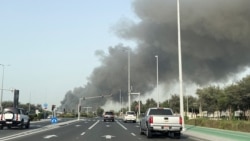
An Iranian drone attack on Al Salam Naval Base in Abu Dhabi caused a fire but no casualties, UAE's Defense Ministry said on March 1 as Iran continued to launch attacks across the region for a second day after an initial wave of US-Israeli strikes.
3 US Service Members Killed In Operation Epic Fury
WASHINGTON – Three US service members were killed in action and five others seriously wounded as part of Operation Epic Fury, US Central Command announced.
According to the United States Central Command, the casualties were confirmed as of 9:30 a.m. eastern US time on March 1. Several additional service members sustained minor shrapnel injuries and concussions and are being evaluated and returned to duty.
Major combat operations remain ongoing and response efforts continue, officials said.
“The situation is fluid,” Centcom said in a statement, adding that out of respect for the families, the identities of the fallen will be withheld until 24 hours after next of kin have been notified.
No further details were immediately released.
A freelancer for RFE/RL's Radio Farda has sent us this report from the Israeli town of Beit Shemesh, where there was a fatal missile attack today. The reporter's name is being withheld for safety reasons.
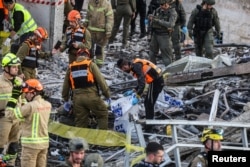
A ballistic missile fired from Iran hit a residential neighborhood in the central Israeli town of Beit Shemesh on Sunday afternoon, killing at least nine civilians.
Israel Police Chief Daniel Halevi and Israeli rescue and fire chiefs at the scene said efforts were ongoing to rescue others who may still be trapped under the rubble.
The wounded in the attack were taken to hospitals in Jerusalem, some 30 kilometers from Beit Shemesh.
The Iranian missile, which reportedly had a payload of 500 kilograms of explosives, hit a bomb shelter and a neighboring house in an old neighborhood. Six bodies were recovered from the shelter and three from the house next door.
The mayor of Beit Shemesh told reporters that the shelter, located in the basement of a synagogue, did not meet the standards of a modern shelter, and that an investigation was underway for possible negligence.
The Israeli military also said it was investigating why the country's missile defense system failed to intercept the Iranian missile. Israeli air defense systems have intercepted more than 200 other Iranian missiles in the past two days.
This is the deadliest incident in Israel since the start of the joint US-Israeli operation against the Islamic republic that began on the morning of February 28.
On the night of February 28, another Iranian missile hit several residential buildings in Tel Aviv, killing a 50-year-old woman and another 68-year-old woman who collapsed while rushing to a shelter.
Hours after Iran confirmed the death of Supreme Leader Ali Khamenei in an Israeli air strike on the morning of February 28, the Islamic Revolutionary Guards Corps announced that a wave of heavy missile strikes against Israel and US targets in the region was coming.
With a number of key posts in Iran's leadership now vacant, now is perhaps a good time to re-up this interactive graphic explaining how the country is governed:
The US Embassy in Baghdad has issued a security alert for American citizens, advising them "to exercise increased caution, keep a low profile, limit their movements, and shelter in place as needed. Reports of missiles, drones, or rockets in Iraqi airspace continue."
Fatalities Reported In Iranian Attacks
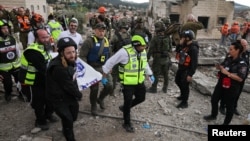
Israel’s emergency services announced March 1 that at least six people were killed and several others injured in an Iranian missile attack on the city of Beit Shemesh.
The individuals were killed when a missile fired from Iran struck a building in the city, located some 30 kilometers west of Jerusalem.
Officials in the United Arab Emirates also announced that three people have been killed and 58 others injured in the country since Iran began attacks on the Persian Gulf region in response to US and Israeli military operations.
The UAE Defense Ministry said that the country had detected 165 ballistic missiles, 152 of which were destroyed. Two cruise missiles were also intercepted. In a statement, the ministry added that a total of 541 Iranian drones had been detected and that 506 of them had been intercepted and destroyed.
According to the ministry, the attacks resulted in the deaths of three individuals of Pakistani, Nepali, and Bangladeshi nationality.
Kuwaiti officials also said on March 1 that so far one person has been killed and 32 others injured in Iranian attacks on the country.
Saudi Arabia Summons Iranian Envoy Over Attacks On Gulf States
Saudi Arabia's Foreign Ministry says it has summoned the Iranian ambassador to Riyadh, Alireza Enayati, over Tehran's targeting of states around the Persian Gulf.
"The Kingdom of Saudi Arabia condemns and denounces in the strongest terms the blatant Iranian aggression against the Sultanate of Oman and Iran’s flagrant violation of its sovereignty, affirming the Kingdom’s full solidarity with the Sultanate of Oman," the ministry said in a statement.