

Iran-Linked Hacker Group Claims Responsibility For Attack on US Company
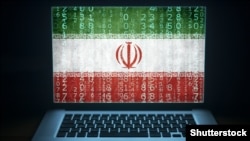
The hacker group Handala, which is reportedly linked to Iran’s Intelligence Ministry, has claimed responsibility for a cyberattack on a medical technology company in the United States.
Stryker, a company headquartered in Michigan that produces a wide range of medical equipment and technologies, was the target of the attack.
One employee of the company, speaking anonymously to the US network NBC, said that mobile phones provided by the company to employees stopped working and communication with colleagues was completely cut off.
Details about how the hack was carried out remain unclear. However, public evidence suggests the hackers may have gained access to the company’s Microsoft account. According to a specialist, it appears Handala reset some employees’ devices to factory settings from there.
NBC described the incident as the first significant example of a US company being hacked by Iran since the start of the war between the two countries.
Ariel Cohen: Iran's Energy Pressure Campaign 'Ultimately Unsustainable'

WASHINGTON -- With tanker traffic through the Strait of Hormuz down sharply since the start of the US-Israeli war with Iran and oil prices up amid fears of Iranian attacks on Gulf energy infrastructure, analysts increasingly warn that global energy flows themselves are becoming part of the strategic battlefield.
Iran produces only a small share of global oil supply but sits beside one of the world’s most important maritime energy choke points. That has raised questions about whether Tehran is attempting to exploit global dependence on Gulf oil to raise economic costs for its adversaries.
In an interview with RFE/RL, Ariel Cohen -- senior fellow at the Atlantic Council, managing director of energy, growth, and security at the International Tax and Investment Center, and founder of the advisory firm International Market Analysis -- discussed Iran’s long history in oil geopolitics, the limits of its ability to disrupt global markets, and why he believes the structural advantages remain on the side of the US and its partners.
[...]
RFE/RL: How sustainable is Iran’s strategy of disrupting energy markets? Can Tehran maintain meaningful pressure over time, or do structural advantages still lie with the US and its partners?
Ariel Cohen: The military, kinetic advantages are clearly on the side of the United States and its partners. The Iranians are making a huge mistake because they appear to underestimate the scope of destruction the United States and Israel could bring upon Iran.
The Iranian people have a regime that has spent hundreds of billions of dollars supporting proxies across the Middle East that are now being wiped out, building a nuclear program that is being destroyed, and developing ballistic missile capabilities that are also being destroyed.
So, in terms of sheer economics, the regime has failed. Iran could have been a very rich country with the oil resources it has. Instead, it is a poor country. Many people who had the ability to leave -- doctors, engineers, scientists -- have emigrated.
This regime is not only destroying physical infrastructure but also destroying Iran’s human capital.
In terms of energy markets, oil prices today are around $87 a barrel. When we look at previous peaks -- in 2008, 2014, and 2022 -- prices were significantly higher. A price around $87 is not something that will destroy the American economy.
The situation in Asia and Europe is more difficult, but those countries are not the ones deciding the course of the conflict.
I believe this war may continue for weeks, not for months. And by the end of it, there is no way this regime will be better off than it was when the war started.
Read more here.
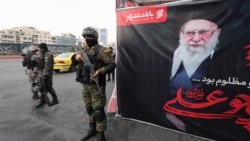
Iran Tightens Checkpoints After Drone Attacks in Tehran
Following drone attacks on security personnel stationed at urban checkpoints, the Fars news agency reported on March 12, quoting an official from the pro-government Basij militia, that a “new mechanism” for these inspections has been “implemented” and will continue with “precise planning and unified command.”
Fars, which is close to the Islamic Revolutionary Guards Corps, did not provide details about the new mechanism.
The name and position of the Basij official were not disclosed, but he said that “checkpoints are carrying out their missions more actively than before.”
He also claimed that “due to the strict observance of security protocols and the vigilance of the forces, a significant number of the attacks have gone astray and failed to hit their intended targets.”
Fars confirmed late March 11 that “around 10” government personnel stationed at nighttime checkpoints in Tehran had been killed in drone attacks.
Earlier, images and reports of large numbers of drones flying over Tehran had circulated on Telegram channels and social media. Some users said the drone flights continued for a long time and that explosions were heard in several parts of the city.
Oil Tops $100 Again As Gulf Attacks Rattle Markets
Asian stock markets fell on March 12 as oil prices surged more than 9 percent above $100 a barrel after reports of further attacks on ships in Persian Gulf waters and the shutdown of key oil terminals.
Investors remained uneasy despite the International Energy Agency’s plan to release 400 million barrels from emergency reserves, including 172 million from the United States starting next week.
Brent crude rose to $100.37 while US crude climbed to $94.26. Share markets across the region dropped, with Japan’s Nikkei falling 1.4 percent and markets in China and Hong Kong also lower. US and European markets were expected to open down as well.
The escalation, including tanker strikes in Iraqi waters and tensions around the Strait of Hormuz, has raised fears of higher inflation and borrowing costs, with analysts warning oil prices could rise further.
Based on reporting by Reuters
Italian Base Struck By Missile In Iraq
The Italian Defense Ministry says the country's base in Irbil, near the Iranian border in northern Iraq, was struck by a missile.
"There are no casualties or injuries among Italian personnel," the ministry said in a post on X on March 12.
Italian Foreign Minister Antonio Tajani later issued a "strong condemnation" of the attack.
New Wave Of Air Strikes Rocks Several Iranian Cities
US and Israeli attacks on Iran continued for a 13th day on March 12, with reports from inside the country indicating that several cities -- including Tehran, Karaj, Isfahan, Kashan, and surrounding areas -- have been targeted by strikes.
According to these reports, repeated explosions were heard in Parand, southwest of Tehran, as well as in Karaj, just west of the capital, and Kashan, a historic city in central Iran between Tehran and Isfahan, in the early morning hours.
Citizens in Kashan reported hearing at least several explosions between 4 a.m. and 4:10 a.m. local time, and some said the force of the blasts caused houses to shake, while the sound of fighter jets could also be heard in the sky above the city.
In other messages, explosions in Arak, an industrial city in central Iran, were also reported around 4 a.m. There have also been reports that the Hasanabad Fashafuyeh Industrial Town and the Parand Industrial Town were targeted.
At the same time, the US Central Command released videos stating that it had targeted large military transport aircraft belonging to the Islamic republic.
"The Iranian regime is losing air capability day by day." it said. "US forces aren’t just defending against Iranian threats, we are methodically dismantling them."
The Israeli military also announced that a “large wave of attacks” had begun against what it described as “Iranian regime infrastructure in Tehran.”
Meanwhile, reports emerged of several explosions in Ahvaz, the capital of Khuzestan province in southwestern Iran near the Iraqi border.
Some residents said that at around 6:50 a.m. local time, several consecutive explosions were heard in the city, and the sound of fighter jets flying overhead continued in the sky over the area for some time.
Trump Says 'We Won' But Fight Will Go On, As Iran Targets Gulf Shipping
- By RFE/RL
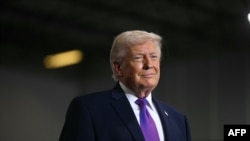
US President Donald Trump claimed the United States has "won" the war against Iran but says its forces will continue to attack until the job is finished, while Tehran has hit at least six vessels in the region and vowed further strikes.
"You never like to say too early you won. We won," Trump said during a campaign-style rally in Kentucky on March 11.
"In the first hour it was over," he said.
Comments from Trump and the White House over recent days have varied, from speculating that the war could last four to six weeks or longer to the possibility that it could be over "soon."
Trump has said the US-Israeli attack on Iran, begun on February 28, had "virtually destroyed" the Middle East nation, wiping out much of its leadership, armed forces, and nuclear program.
Still, the president and others in his administration have indicated that there will be no letup in attacks.
"We don't want to leave early, do we?" Trump said. "We got to finish the job."
Israel has also made clear it is not ready to end its campaign, including attacks in Lebanon on Iran-allied Hezbollah forces, saying a "a broad bank of targets" remains.
"We will expand our operations," military spokesman Brigadier General Effie Defrin told a televised briefing on March 11.
In the early morning hours of March 12, the Israeli military announced a "wide-scale wave of strikes on Tehran -- an almost nightly event in recent days.
Read more here.
Swiss Embassy In Tehran, Which Represents US Interests, Temporarily Closes
Switzerland said it has temporarily shuttered its embassy in Tehran because of an "increasing security risk."
"Due to the volatile situation, it is currently not foreseeable when consular services will resume," a notice on its website said.
Switzerland for decades has represented US interests in Iran since Washington and Tehran do not have diplomatic relations.
The US Embassy in Bern said Washington "respects the Swiss government's decision" and is "deeply grateful for the dedication" of the embassy and its staff.
The Swiss government said it would "continue to maintain an open line of communication between the United States and Iran."
Iran Continues To Target Gulf Oil Sites With Eye On '$200 A Barrel'
Iran continued to attack Gulf oil fields and shipping, telling the world to prepare for petroleum at $200 a barrel, a price that, if it should occur, would be sure to roil the world economy.
Saudi Arabia early March 12 said it intercepted a drone heading toward the massive Shaybah oil field, often a target of Iranian projectiles since the US-Israeli air strikes that began on February 28.
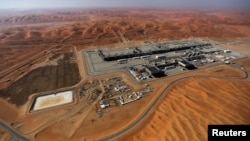
"A drone heading towards the Shaybah oil field was intercepted and destroyed," a spokesman for the country's Defense Ministry posted on X.
Saudi officials a day earlier also said defense forces had intercepted several drones targeting the oil field, which is one of the most important in the kingdom, which has long been a geopolitical rival of Iran.
Separately, Bahrain on March 12 said Iran had hit fuel tanks in the Muharraq region of the small island nation and urged area residents to remain at home.
"The blatant Iranian aggression targets fuel tanks at a facility in Muharraq Governorate," Bahrain's Interior Ministry said.
The UN Security Council on March 11 condemned Tehran's attacks on Gulf states and other countries in the region, with Russia and China abstaining in the vote.
It also said it "condemns any actions or threats by the Islamic Republic of Iran aimed at closing, obstructing, or otherwise interfering with international navigation through the Strait of Hormuz."
Meanwhile, at least one crew member was killed in an attack on two oil tankers near Iraq, authorities in Baghdad said, calling the action "sabotage" but not directly blaming Iran. Risk analysts pointed to Iranian explosive-laden boats as the culprits.
Oil prices soared earlier in the week to nearly $120 a barrel before settling back to around $90. They rose 5 percent on March 11 amid renewed fears about supply disruption.
Iran vowed to keep up the economic pressure on the rest of the world.
"Get ready for oil to be $200 a barrel, because the oil price depends on regional security, which you have destabilized," Iranian military spokesman Ebrahim Zolfaqari said in comments directed at the United States.
Wit reporting by Reuters and AFP
US To Provide 172 Million Barrels To IEA Oil Reserve Release
The United States said it would release 172 million barrels of oil from its strategic reserve, part of a wider program by the 32 member nations of the International Energy Agency to put 400 million extra barrels on the market.
“Earlier today, 32 member nations of the International Energy Agency unanimously agreed to President [Donald] Trump’s request to lower energy prices with a coordinated release of 400 million barrels of oil and refined products from their respective reserves," a statement said.
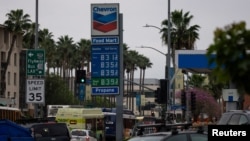
The IEA said its members had agreed to release 400 million barrels into the market to help keep stem price rises.
The move comes as oil prices have surged amid fears of a major disruption to output and shipping in the Gulf region following the US-Israeli air strikes against Iran and subsequent retaliatory strikes by Tehran in the Gulf region.
“For 47 years, Iran and its terrorist proxies have been intent on killing Americans. They have manipulated and threatened the energy security of America and its allies. Under President Trump, those days are coming to an end," the statement said.