


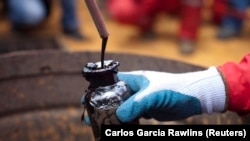
The US military strikes in Venezuela and comments afterwards by President Donald Trump have raised the prospect of a massive increase in Venezuelan oil production under US control.
It’s not clear when, how, or even if this can happen. But Venezuela has the world’s largest proven reserves and Trump has suggested that US companies can bring them to market.
Venezuela's extra-heavy crude is highly sought after as it's ideal for specialized refineries -- such as those on the US Gulf Coast -- that have coker units allowing them to process this dense oil into high-margin products like gasoline and diesel fuel.
With the situation still in flux, this is one of several potential impacts for the global economy -- and Venezuela’s key partners: Russia, Iran, China, and Cuba.
Russia
Strong supply meant oil prices saw their biggest annual fall in 2025 since the COVID-19 pandemic led to a collapse in global economic activity in 2020.
For Moscow, these declines have already hit and events in Venezuela following the detention of ousted Venezuelan leader Nicolas Maduro could add to the pain.
“If our American ‘partners’ get control of the oil fields in Venezuela,” wrote oligarch Oleg Deripaska on January 3, “they will control more than half of the world’s oil reserves. They probably plan that our oil prices don’t go higher than $50 per barrel.”
Deripaska is one of the few oligarchs to have criticized Russia’s 2022 full-scale invasion of Ukraine. But his comments reflect the Kremlin's interest in keeping oil prices high.
“The prospect of the United States gaining influence over Venezuelan oil production…is clearly unwelcome in Moscow,” Berlin-based political analyst Alexandra Sitenko told RFE/RL.
It’s not clear if the United States will gain control of Venezuela’s oil. Interim President Delcy Rodriguez, sworn in by Venezuela's parliament on January 5, has made vague comments about cooperating with Washington on development, but the strength of her grip on power and what she aims to do with it are also unclear.
“Substantial investments would be required for Venezuela to reverse the declines in production seen in recent decades,” a spokesman for the International Energy Agency (IEA) told RFE/RL.
Sitenko said that given these challenges, caused by long-term mismanagement and international sanctions, ramping up production would be time-consuming.
“Strategically, the Kremlin is likely more concerned with market power than with volumes alone. Expanded US influence over Venezuelan oil would strengthen Washington’s ability to shape global energy flows and pricing, potentially undermining coordination mechanisms such as OPEC+, on which Russia also relies to stabilize its revenues,” Sitenko added.
Amid Venezuela’s pariah status, Western companies have left the country, with the notable exception of US oil major Chevron.
“Where [the sector] is not destroyed, there are Russian, Iranian, and Chinese companies. Of course, the United States wants to push them out,” political analyst Ivan Preobrazhensky told RFE/RL’s Russian Service.
On the other hand, there could be space for collaboration. Washington has signaled it is interested in economic benefits from working with Moscow. The National Security Strategy talks of the wish to “reestablish strategic stability with Russia.”
Russia has also felt threatened by President Trump’s announcement in December of a blockade of sanctioned tankers heading to or from Venezuela -- upping risk and uncertainty levels for Russian shadow fleet tankers, which Moscow uses to evade sanctions.
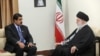
Iran
The blockade is one of many things exposing Iran to the same risks as Russia, as highlighted last month when US forces seized a tanker that was part of Iran’s shadow fleet as it was sailing off the coast of Venezuela.
The country has helped Iran to evade international sanctions for years.
A key product, which Venezuela has also sourced from Russia, is diluent -- agents for diluting Venezuela’s thick, heavy grade of crude oil. Using shadow fleet vessels, Iran has exported large quantities of diluent to Venezuela in exchange for oil (that it has shipped to China) and gold.
Venezuela has also been a buyer of Iranian weapons, with the latest US sanctions relating to the trade announced on December 30. It notes purchases of drones and “conventional weapons” as well as chemicals for ballistic missiles.
The future of these lucrative trades looks uncertain, to say the least, amid the current massive US naval presence in the Caribbean.
Meanwhile, even amid Iran’s own ongoing political turmoil, some Iranian media speculated that the fate of Venezuela’s $2-billion debt to Tehran was in doubt.
China
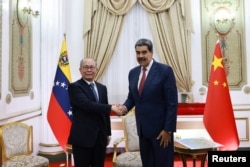
China is another key partner for Venezuela and said it “strongly condemns the US blatant use of force against a sovereign state.”
The last sighting of Maduro, hours before his capture by US forces, was at a meeting with Qiu Xiaoqi, China’s envoy for Latin American affairs. Maduro also met Chinese leader Xi Jinping in Moscow last year.
Alongside the diplomatic contacts, China has also been Venezuela’s main oil customer, according to the IEA.
Daniel Sternoff from the Center on Global Energy Policy at the Columbia School of International and Public Affairs, suggested US control of Venezuela’s industry could endanger those supplies.
“Venezuelan crude exports could be meaningfully redirected away from China and towards the US Gulf Coast,” he wrote on January 4.
But while this trade has been important for Caracas, it’s perhaps less so for Beijing.
China covers approximately 4 percent to 5 percent of its oil imports from Venezuela. Losing some or all of that would be a blow, but not a catastrophe.
And, as work continues to renegotiate the China-US trade relationship, Venezuelan oil is only part of a much bigger picture.
At any rate, President Trump has sought to play down speculation that these supplies would be curtailed. "They’re going to get oil," he told Fox and Friends on January 3.
Another important aspect of the economic relationship is Venezuela’s estimated 10-billion-dollar debt to China. This is partly covered by the oil exports.
Like Russia and Iran, China has also invested in Venezuela’s economy, pumping in some $18 billion since 2005 according to an online tracker by the American Enterprise Institute (AEI). In a commentary on January 3, American Enterprise Institute (AEI) senior fellow Hal Brands suggested it would not give up on investments in Latin America.
“Trump has served notice that there’s only one great power in the Americas, when it comes to military muscle…But China will keep seeking economic, technological and political ties in the region, as part of a play for long-term advantage,” he wrote.
Cuba
Perhaps no country is so vulnerable to the overspill effects of US action in Venezuela than Cuba.
The cash-strapped country is heavily reliant on Venezuela for energy supplies, which it has received at heavily subsidized, bargain basement prices.
“Venezuela supplies Cuba today with approximately 35,000 barrels per day of oil; which represents 50 percent of the Island's oil deficit,” Jorge Pinon of the University of Texas at Austin told RFE/RL.
“Cuba does not have the financial resources to purchase that possible shortfall” he said, adding that to avoid an economic collapse “the US government could request Venezuela to continue supplying Cuba with oil.”
US sanctions enforcement has already led to energy supplies dwindling, and Cuba has been suffering increasing amounts of blackouts -- hitting both residential properties and industry.
Trump has commented that Cuba was “going down for the count.”

