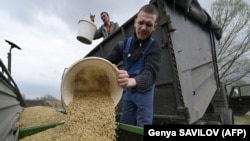
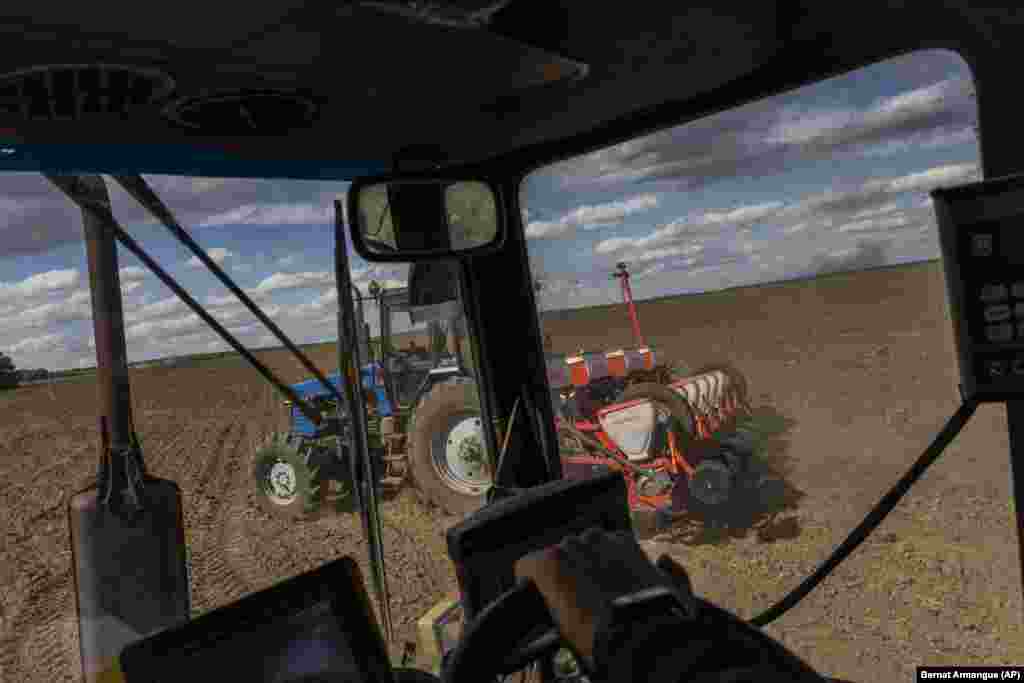
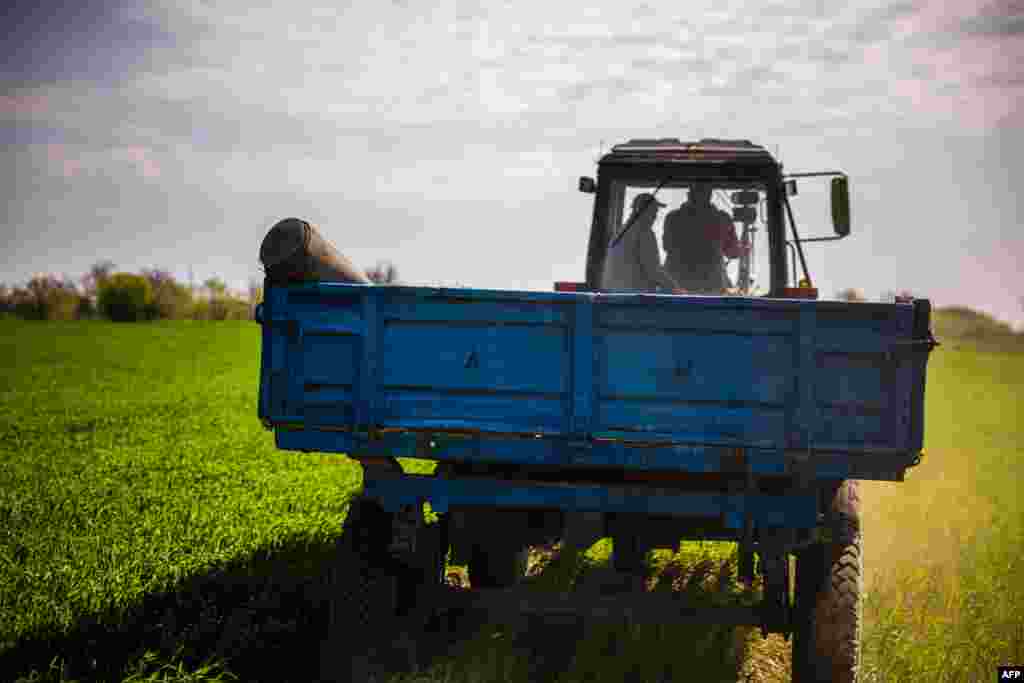
Farmers load oats into the seeding machine to sow in a field east of Kyiv.
Turkish Foreign Minister Mevlut Cavusoglu says a meeting with his Russian counterpart, Sergei Lavrov, has made progress toward accepting a plan that would restart Ukrainian grain shipments from its seaports to help stave off a looming global food crisis as EU officials again accused Moscow of weaponizing food.
Supplies of grain from Ukraine, a major exporter, have been drastically reduced due to Russia's blockade of the country's ports and the targeted bombardment of warehouses as part of its war against Ukraine, launched in late February.
Cavusoglu told journalists on June 8 that an international effort will be needed to open a safe passage for Ukraine's agricultural exports but that he believed it was achievable.
"Various ideas have been put out for the export of Ukrainian grains to the market and most recently is the UN plan (including) a mechanism that can be created between the UN, Ukraine, Russia, and Turkey," Cavusoglu said.
Ukrainian Farmers Risk Their Lives As Global Food Crisis Looms
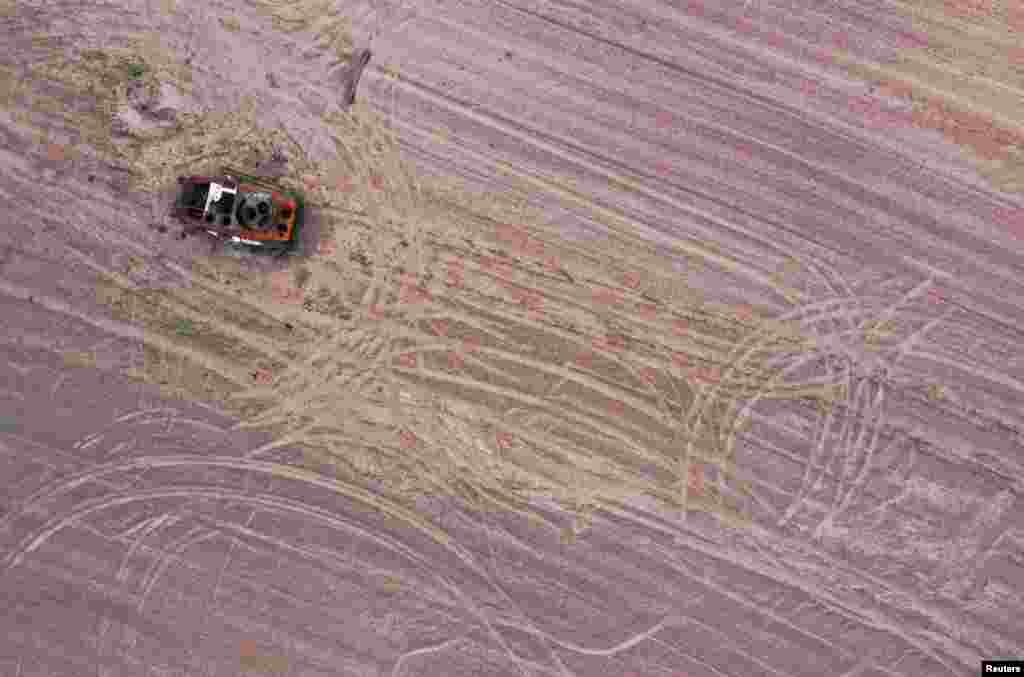
1/9A destroyed military vehicle in a previously mined grain field in Chernihiv, northern Ukraine, in late May.
In a normal farming season, Ukraine's farmers would work according to strict schedules depending on the crops. Now, farmers must wait for it to be safe to plant -- often at night under the cover of darkness. The hardships faced by farmers are many: severe diesel shortages, indiscriminate artillery strikes, mines, the charred remains of armored vehicles in their fields, and personnel shortages.
The inability of Ukraine to transport millions of tons of grain and other agricultural products amid Russia's invasion has aggravated a global food crisis. The country is a major exporter of seed oils, corn, and wheat, but the war and Russia's blockade of Ukraine's ports have effectively stopped a significant amount of that flow. While Ukraine's leaders seek ways to export the country's agricultural output, its farmers face perilous conditions as a result of the ongoing conflict.
Show moreShow less
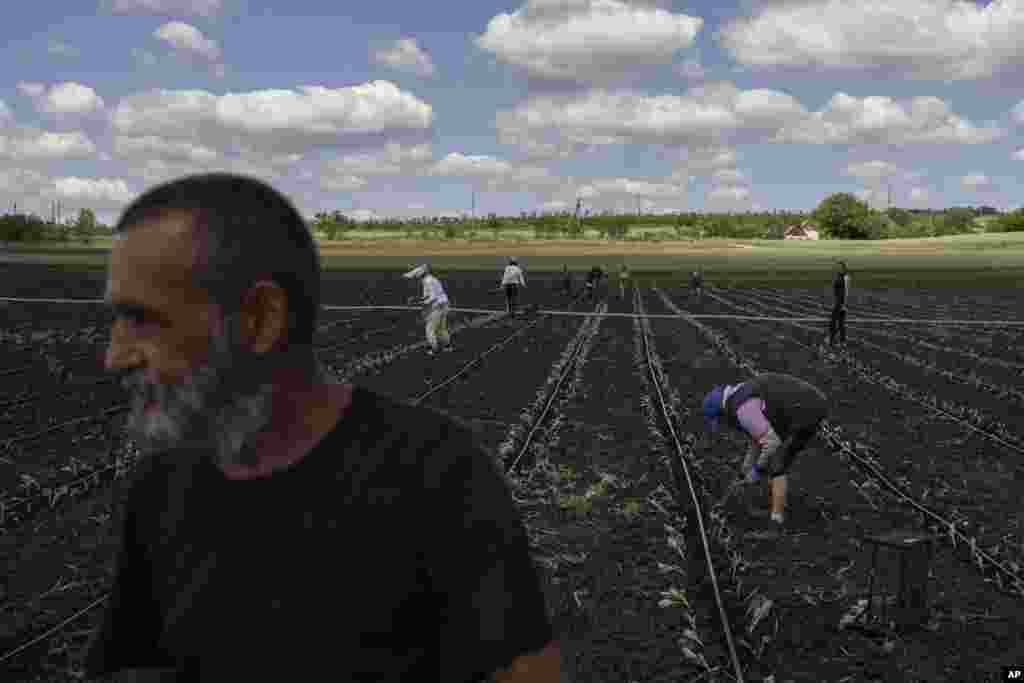
2/9Farmers work in a field near Soledar in eastern Ukraine on June 6.
Prior to the war, Ukraine exported more than 5 million metric tons of grain per month, the vast majority of which passed through its Black Sea ports. Russian warships have blocked those ports, making such shipments impossible and putting global food supplies and Ukraine's agricultural sector at risk.
The inability of Ukraine to transport millions of tons of grain and other agricultural products amid Russia's invasion has aggravated a global food crisis. The country is a major exporter of seed oils, corn, and wheat, but the war and Russia's blockade of Ukraine's ports have effectively stopped a significant amount of that flow. While Ukraine's leaders seek ways to export the country's agricultural output, its farmers face perilous conditions as a result of the ongoing conflict.
Show moreShow less
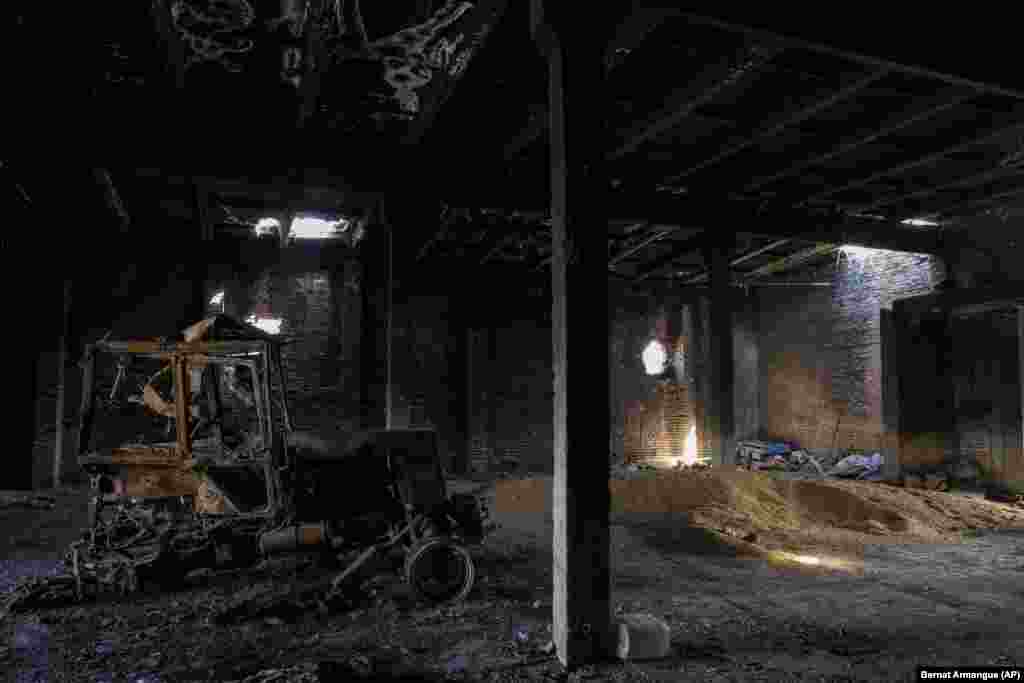
3/9A tractor charred by a Russian attack lies inside a warehouse at a grain farm in Cherkaska Lozova, near Kharkiv, on May 28.
"It's an almost grotesque situation we see at the moment in Ukraine, with nearly 25 million metric tons of grain that could be exported but that cannot leave the country simply because of lack of infrastructure, the blockade of the ports," said Josef Schmidhuber, a deputy director at the UN's Food And Agriculture Organization.
Ukraine, its neighbors, and the EU, are now scrambling to find other routes to get Ukrainian grain to markets, with rail emerging as a viable option despite many logistical challenges.
The inability of Ukraine to transport millions of tons of grain and other agricultural products amid Russia's invasion has aggravated a global food crisis. The country is a major exporter of seed oils, corn, and wheat, but the war and Russia's blockade of Ukraine's ports have effectively stopped a significant amount of that flow. While Ukraine's leaders seek ways to export the country's agricultural output, its farmers face perilous conditions as a result of the ongoing conflict.
Show moreShow less
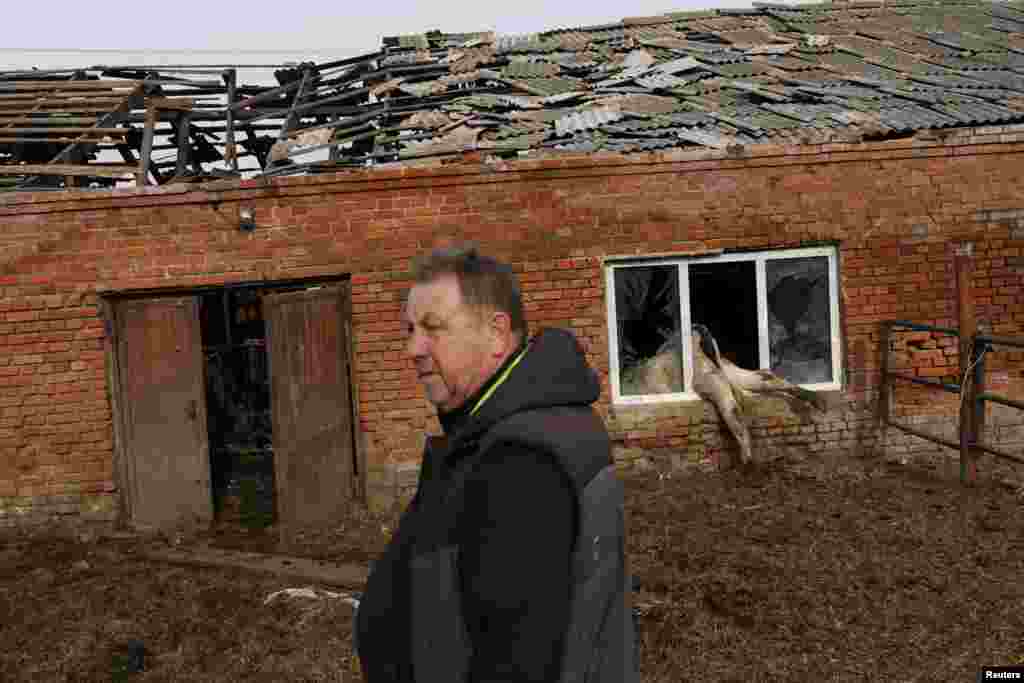
4/9Farmer Oleksandr Novikov, 58, surveys the damage to his farm in Vilhivka, near Kharkiv, on May 11.
Russian forces have been accused of looting grains and selling them to other countries, destroying fields, and killing livestock in an intentional effort to harm Ukrainian farmers during their invasion of Ukraine.
The inability of Ukraine to transport millions of tons of grain and other agricultural products amid Russia's invasion has aggravated a global food crisis. The country is a major exporter of seed oils, corn, and wheat, but the war and Russia's blockade of Ukraine's ports have effectively stopped a significant amount of that flow. While Ukraine's leaders seek ways to export the country's agricultural output, its farmers face perilous conditions as a result of the ongoing conflict.
Show moreShow less
5/9Smoke from shelling rises on the horizon while farmers seed sunflowers in a field in Cherkaska Lozova, near Kharkiv, in late May.
According to FAO estimates, in addition to the 720 to 811 million people who were facing chronic hunger in 2020, Russia's war in Ukraine risks raising -- by 7.6 million to 13.1 million -- the number of undernourished people in 2022 and 2023. Jordan, Yemen, Israel, and Lebanon are among the countries most at risk, as they rely heavily on basic commodities imports, with significant shares from Russia and Ukraine.
The inability of Ukraine to transport millions of tons of grain and other agricultural products amid Russia's invasion has aggravated a global food crisis. The country is a major exporter of seed oils, corn, and wheat, but the war and Russia's blockade of Ukraine's ports have effectively stopped a significant amount of that flow. While Ukraine's leaders seek ways to export the country's agricultural output, its farmers face perilous conditions as a result of the ongoing conflict.
Show moreShow less
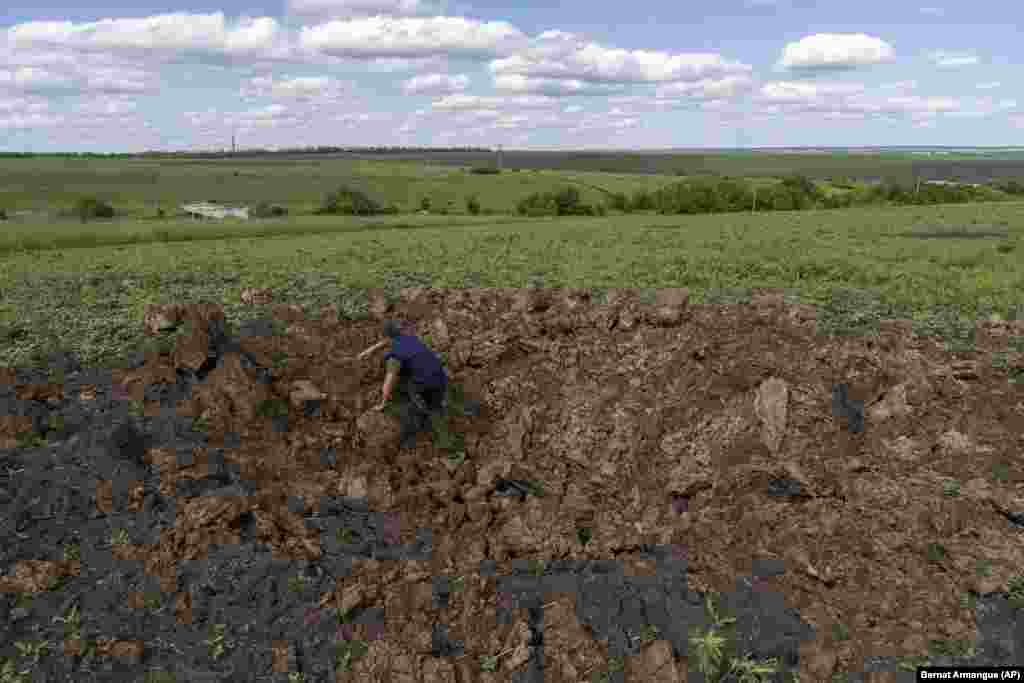
6/9A farm worker climbs out of a crater caused by shelling in Cherkaska Lozova.
The European Parliamentary Research Service reports that Russia and Ukraine supply more than half of cereal imports in northern Africa and the Middle East, while countries in eastern Africa import 72 percent of their cereals from Russia and 18 percent from Ukraine.
The inability of Ukraine to transport millions of tons of grain and other agricultural products amid Russia's invasion has aggravated a global food crisis. The country is a major exporter of seed oils, corn, and wheat, but the war and Russia's blockade of Ukraine's ports have effectively stopped a significant amount of that flow. While Ukraine's leaders seek ways to export the country's agricultural output, its farmers face perilous conditions as a result of the ongoing conflict.
Show moreShow less
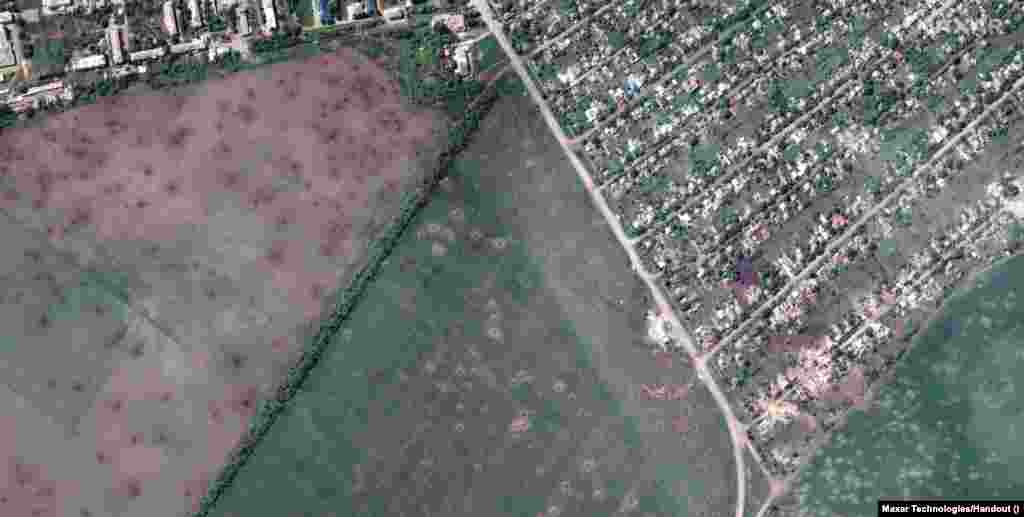
7/9A satellite image of Lyman, Ukraine, shows artillery craters in fields and destroyed buildings in late May.
According to the FAO, 50 countries rely on Russia and Ukraine for at least 30 percent of their wheat imports. In the Middle East and North Africa, these countries include Lebanon, Egypt, Libya, Oman, Saudi Arabia, Yemen, Tunisia, Iran, Jordan, and Morocco.
The inability of Ukraine to transport millions of tons of grain and other agricultural products amid Russia's invasion has aggravated a global food crisis. The country is a major exporter of seed oils, corn, and wheat, but the war and Russia's blockade of Ukraine's ports have effectively stopped a significant amount of that flow. While Ukraine's leaders seek ways to export the country's agricultural output, its farmers face perilous conditions as a result of the ongoing conflict.
Show moreShow less
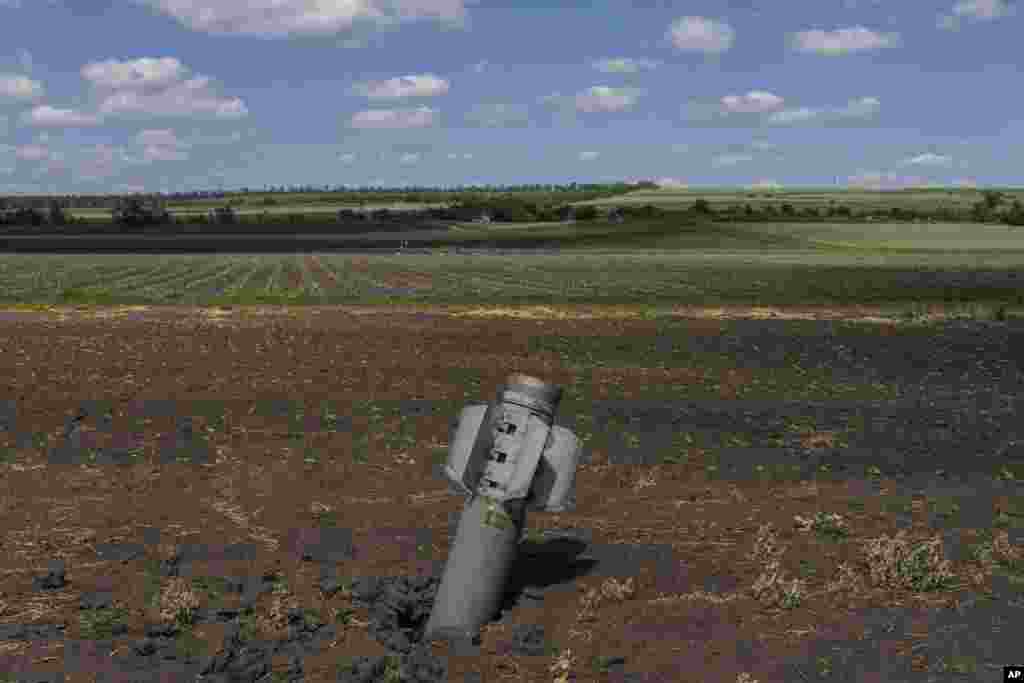
8/9A Russian projectile lies in a field near Soledar in eastern Ukraine on June 6.
On April 29, Ukraine's Agriculture Ministry reported that nearly 30 percent of the country's farmland is now occupied, unsafe, or unable to be farmed. Bread prices have increased in some of the world's poorest and most vulnerable countries as a result of Russia's invasion.
The inability of Ukraine to transport millions of tons of grain and other agricultural products amid Russia's invasion has aggravated a global food crisis. The country is a major exporter of seed oils, corn, and wheat, but the war and Russia's blockade of Ukraine's ports have effectively stopped a significant amount of that flow. While Ukraine's leaders seek ways to export the country's agricultural output, its farmers face perilous conditions as a result of the ongoing conflict.
Show moreShow less
9/9Farmers remove an unexploded shell from their fields near the village of Hryhorivka, Zaporizhzhya, eastern Ukraine, in early May.
World Food Program Executive Director David Beasley has warned: "When a nation that is the breadbasket of the world becomes a nation with the longest bread line of the world, we know we have a problem." He adds that the failure to open Ukraine's port in Odesa is a declaration of war on global food security, resulting in famines, destabilization, and mass migration around the world.
Russia has said it will lift the blockade if Western sanctions are lifted, a demand Ukrainian Foreign Minister Dmytro Kuleba has characterized as an attempt at "blackmail."
The inability of Ukraine to transport millions of tons of grain and other agricultural products amid Russia's invasion has aggravated a global food crisis. The country is a major exporter of seed oils, corn, and wheat, but the war and Russia's blockade of Ukraine's ports have effectively stopped a significant amount of that flow. While Ukraine's leaders seek ways to export the country's agricultural output, its farmers face perilous conditions as a result of the ongoing conflict.
Show moreShow less
Previous slide
Next slide
"We see it as reasonable...Of course, both Ukraine and Russia must accept it," he added.
Lavrov again blamed Ukraine for the impasse, saying President Volodymyr Zelenskiy had "categorically refused" to resolve the problem of demining areas around Ukraine's ports.
Russian President Vladimir Putin, however, threw doubt on any real progress being made on the issue, reiterating on June 8 that any possibility of grain shipments would be conditioned on the lifting of international sanctions against Russia for its unprovoked invasion.
Western governments have ruled out such a move, prompting many of them to accuse Russia of weaponizing the global food-supply crisis.
"Food has become now part of the Kremlin's arsenal of terror, and we cannot tolerate this," European Commission President Ursula von der Leyen told the European Parliament in Strasbourg, France, on June 8.
She added that 20 million tons of grain are currently trapped in Ukraine.
Turkey, which has good relations with both Russia and Ukraine, has said it is willing to play a role within an "observation mechanism" based in Istanbul if a deal is reached.
The director of the Ukrainian grain traders union, Serhiy Ivashchenko, however, said that Turkey alone is not strong enough to be the sole guarantor of grain shipments.
RFE/RL journalists report the news in 24 languages in 18 countries where a free press is banned by the government or not fully established. We provide what many people cannot get locally: uncensored news, responsible discussion, and open debate.