



Here's another item from RFE/RL's news desk:
Ukraine President Signs Constitutional Amendment On NATO, EU Membership
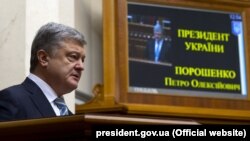
Ukrainian President Petro Poroshenko has signed a constitutional amendment committing the country to becoming a member of NATO and the European Union.
Addressing parliament on February 19, Poroshenko said he saw securing Ukraine's membership in NATO and the EU as his "strategic mission."
Ukraine should "submit a request for EU membership and receive a NATO membership action plan no later than 2023," the president told the Verkhovna Rada.
However, he acknowledged that his country needs to come a "long way" to meet the criteria of joining both institutions.
European Council President Donald Tusk attended the signing of the constitutional amendment in the parliament building.
Addressing the lawmakers in Ukrainian, Tusk, who is Polish, said that "there can be no Europe without Ukraine.”
He also warned Ukrainian politicians against using populist and nationalist tactics ahead of the March 31 presidential election, in which Poroshenko is running for a second five-year term.
"Go around temptations of radical nationalism and populism, as you have done so far," Tusk said in his speech.
The EU official also warned lawmakers against "internal conflicts," which he said only benefit "that third country," hinting at Russia.
Tusk is on a three-day visit to Ukraine, which is commemorating the fifth anniversary of the Euromaidan protests, which led to the ouster of Moscow-friendly President Viktor Yanukovych in February 2014.
Following Yanukovych's downfall, Russia seized and annexed Ukraine's Crimea region in March 2014.
Moscow is also supporting separatists in eastern Ukraine in a conflict that has killed more than 10,300 people since April 2014.
With reporting by dpa, AFP, and AP
This tweet seems to reference a Euromaidan Press article from May last year, which you can find here.
ICYMI:
For what it's worth, here's what the Ukrainian open-source investigative site InformNapalm has to say about Beric:
The aggressor’s sniper pairs consist of both regular servicemen of the Russian Armed Forces and mercenaries trained in Russian military camps. However, it is necessary to distinguish the “propaganda snipers” from the real ones, who are there to perform actual combat missions. Both these categories have a role in the hybrid war and are dangerous in their own way.
There are several mercenaries who front as snipers in the Russian propaganda stories. One of them is the Serb Dejan Berić, call sign Deki. He constantly features in the propaganda stories distracting attention from the regular Russian military personnel present in Donbas. Four independent competent sources in Serbia have informed us that Berić is just a recruiter and a propagandist posing for the cameras, while real combat missions are performed by other mercenaries.
Berić, being a much hyped media character, helps to misinform and distract attention from the real operatives. The same role was performed by the “separatist warlords” Givi and Motorola; however when they got carried away playing tough leaders and lost their value for Moscow, these “heroes” were eliminated quickly and efficiently. The media activity of the Serbian “sniper” is a good example of military cunning, achieving both propaganda and disinformation objectives with a single asset.
Read more here.
Here's an item from our news desk:
Amnesty International: Five Years After Euromaidan, Justice For The Victims 'Still Not Even In Sight'
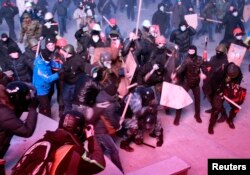
Amnesty International says the Ukrainian criminal justice system has "resisted and obstructed justice" when dealing with the human rights violations committed by police during the Euromaidan protests five years ago.
Colm O Cuanachain, senior director at the office of the London-based group's secretary-general, made the comment on February 19, which marked the fifth anniversary of the protest movement’s worst day of violence.
Three months of peaceful protests in Kyiv, known as the Euromaidan, forced Moscow-friendly President Viktor Yanukovych to flee to Russia in February 2014.
More than 100 people were killed and 2,500 injured in clashes with security forces, some of them shot dead by snipers.
The death toll included at least 13 police officers, according to the Ukrainian authorities.
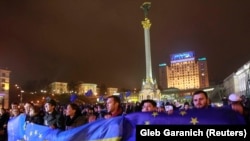
The Evolution Of Euromaidan
As of the end of 2018, the Ukrainian Prosecutor-General’s Office had identified 441 suspects, most of them former law enforcement officers, according to Amnesty.
The rights watchdog said that the cases of 288 individuals had been sent to court, 52 of them resulting in court decisions.
Out of 48 convictions, "only nine custodial sentences were handed down," it added, and not one of those jailed was a former police officer.
Justice for most victims who suffered at the hands of Ukrainian police "is still not even in sight," Cuanachain said. "Promises were made, strong words were said by the post-Yanukovych authorities, but time and facts speak volumes."