



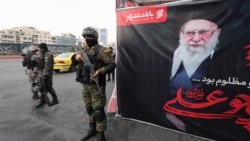
Iran's New Supreme Leader Makes First Statement
In remarks read out by a female presenter from a statement on Iranian state TV on March 12, Iran's newly appointed supreme leader -- Ayatollah Mojtaba Khamenei, son of his predecessor -- makes his first address. The younger Khamenei, however, has not been seen in public since before the US-Israeli attacks that killed his father and other Iranian officials on February 28.
Among other comments, he said:
On the Strait of Hormuz: "The lever of closing the Strait of Hormuz must certainly continue to be used. Studies have been conducted regarding the opening of other fronts where the enemy has little experience and will be severely vulnerable; their activation will take place should the state of war persist and in accordance with strategic considerations."

On the death of late Supreme Leader Ayatollah Ali Khamenei and others in Iran: "I give this assurance to all: We will not relinquish revenge for the blood of your martyrs. The retribution we have in mind is not limited to the martyrdom of the great leader of the revolution alone -- every member of the nation martyred by the enemy constitutes an independent matter for the file of retribution."
"The crime the enemy deliberately committed against the Shajara Tayyiba school in Minab and certain similar cases holds particular standing in this reckoning."
Seeking reparations: "We will extract reparations from the enemy, and if they refuse, we will seize from their assets to the extent we deem appropriate -- and if that too is not possible, we will destroy an equivalent amount of their assets."
Congress To Be Briefed As Probe Examines Iran School Strike, Sources Tell RFE/RL

WASHINGTON -- A final assessment by US military officials of events surrounding a deadly missile strike on an Iranian girls' school will be shared with Congress in the coming days, sources told RFE/RL amid growing reports that the attack was likely launched by the United States.
Evidence is building that the strike may be the result of US forces relying on outdated intelligence, according to two US officials familiar with the matter, though they cautioned that the assessment remains preliminary.
The officials, who spoke to RFE/RL on March 11 on condition of anonymity because the investigation is ongoing, said they could not confirm or deny reports -- which have appeared in The New York Times and Reuters, among other media outlets -- on the faulty intelligence, but they added that early findings point in a similar direction.
The February 28 missile attack hit the Shajarah Tayyebeh girls’ elementary school in the southern Iranian city of Minab, in the Hormozgan province, killing at least 175 people, including 168 children, according to local officials.
Read more here.
Navy Not Yet In A Position To Escort Ships In Gulf, US Energy Secretary Says

The US Navy is not ready to escort oil tankers through the Strait of Hormuz, though it may be in a position to do so by the end of the month, US Energy Secretary Chris Wright told CNBC in an interview.
“It’ll happen relatively soon but it can’t happen now,” Wright said in the March 12 interview. “We’re simply not ready. All of our military assets right now are focused on destroying Iran’s offensive capabilities and the manufacturing industry that supplies their offensive capabilities.”
He said the navy is likely to be in a position to escort tankers by the end of March.
“I’ll be over at the Pentagon later today -- that is what the military is working on,” he added.
Israel Says It Struck Iranian Nuclear Site
The Israeli military says it has hit a nuclear facility near Tehran known as Taleqan.
In a statement on March 12, the Israeli military said it had "struck" the Taleqan compound, saying Tehran had used it “to develop advanced explosives and conduct sensitive experiments as part of the covert 'AMAD' project," referring to a suspected Iranian nuclear weapons research program that is thought to have operated in the early 2000s.
The site includes Taleqan-2, a building at the Parchin military complex southeast of Tehran.
It had previously been reported that Taleqan-2 was targeted during the 12-day US-Israeli war against Iran in June.
About a month ago, the Washington-based Institute for Science and International Security published satellite images saying new construction activity had taken place at the site.
According to the institute, Iran had reinforced the facility’s concrete layers and then covered large sections of the Taleqan-2 site with earth.
Officials and media in the Islamic republic have not yet commented on Israel’s claim.
Up To 3.2 Million Displaced In Iran Amid Conflict, Says UN Refugee Agency
The UN refugee agency (UNHCR) says that up to 3.2 million Iranians have been temporarily displaced within Iran as the conflict intensifies.
"Between 600,000 and 1 million Iranian households are now temporarily displaced inside Iran as a result of the ongoing conflict, according to preliminary assessments, representing up to 3.2 million people," the UNHCR statement said on March 12.
The statement added that most of these individuals are reportedly fleeing Tehran and other major urban areas for rural areas in the north of the country to seek safety.
"This figure is likely to continue rising as hostilities persist, marking a worrying escalation in humanitarian needs," the agency warned.
Georgian Sailors Survive Iranian Attack On Ship Off Iraqi Coast
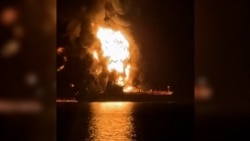

All 23 Georgian crew members aboard a Malta-flagged tanker struck by Iran off the Iraqi coast have been rescued, a relative of one of the sailors told RFE/RL's Georgian Service.
Two oil tankers sailing in Iraqi territorial waters were struck in the Persian Gulf early on March 12, with sailors describing a coordinated attack involving drones and explosive devices.
Iranian state television confirmed that Iranian forces had attacked the tankers, reporting that at least one vessel was hit by an Iranian unmanned vehicle from the water.
One of the targeted ships was the Malta-flagged tanker ZEFYROS, which included the 23 Georgian sailors, while the second vessel that was hit, SAFESEA VISHNU, was sailing under a Marshall Islands flag and was chartered by an Iraqi company, according to the Iraqi State Organization for Marketing of Oil (SOMO).
“I spoke with him around midnight and everything was fine,” Nincho Surmanidze, the wife of Georgian sailor Irakli Jashi, told RFE/RL. “Then he called me again around 2:30 a.m. and quickly said: ‘We’re all okay, everyone survived.’”
Later in the morning, she said, her husband told her that a drone had struck their tanker, triggering a fire that heavily damaged the vessel.
“He said everything burned,” Surmanidze added.
Read more here.
Revolutionary Guards Confirm Death Of Aerospace Commander
The Iranian Fars news agency reported on March 12 that Esmail Dehghan, a commander in the aerospace force of Iran’s Islamic Revolutionary Guards Corps (IRGC), was killed at his residence in the city of Arak in central Iran.
Fars, which is close to the IRGC, said Dehghan was assassinated earlier this week on March 10 along with his wife, two children, and his wife’s grandmother in the Hafezieh neighborhood of Arak.
In recent days, images of an attack on a residential house in one of Arak’s neighborhoods and speculation about the target of the strike had circulated on social media and Telegram channels.
Fars confirmed the assassination after news and photos of Dehghan’s memorial ceremony were shared on social media on March 11.
According to Fars, Dehghan’s funeral was held in Arak that day.
Since the start of the US-Israeli war on Iran, a significant number of senior Iranian military commanders have been killed in various attacks, with several of them dying on the first day of the war on February 28, including Supreme Leader Ayatollah Ali Khamenei.
Bangkok Summons Iranian Ambassador After Hormuz Ship Strike
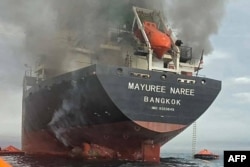
Thailand summoned Iran’s ambassador in Bangkok on March 12 after a Thai-flagged cargo ship, the Mayuree Naree, was struck in the Strait of Hormuz, as search efforts continued for three missing crew members.
The bulk carrier, carrying 23 Thai sailors, was hit at the stern while sailing through the strategic waterway after leaving Abu Dhabi.
Oman’s navy rescued 20 crew members and brought them ashore in Khasab, where officials said none had serious injuries.
The remaining three are believed to be trapped near the engine room, where a fire broke out.
Thai diplomats in Muscat are coordinating with Omani authorities on rescue operations.
Bangkok condemned the attack and said all Thai vessels have now left the Strait of Hormuz.
Iran-Linked Hacker Group Claims Responsibility For Attack on US Company
The hacker group Handala, which is reportedly linked to Iran’s Intelligence Ministry, has claimed responsibility for a cyberattack on a medical technology company in the United States.
Stryker, a company headquartered in Michigan that produces a wide range of medical equipment and technologies, was the target of the attack.
One employee of the company, speaking anonymously to the US network NBC, said that mobile phones provided by the company to employees stopped working and communication with colleagues was completely cut off.
Details about how the hack was carried out remain unclear. However, public evidence suggests the hackers may have gained access to the company’s Microsoft account. According to a specialist, it appears Handala reset some employees’ devices to factory settings from there.
NBC described the incident as the first significant example of a US company being hacked by Iran since the start of the war between the two countries.
Ariel Cohen: Iran's Energy Pressure Campaign 'Ultimately Unsustainable'

WASHINGTON -- With tanker traffic through the Strait of Hormuz down sharply since the start of the US-Israeli war with Iran and oil prices up amid fears of Iranian attacks on Gulf energy infrastructure, analysts increasingly warn that global energy flows themselves are becoming part of the strategic battlefield.
Iran produces only a small share of global oil supply but sits beside one of the world’s most important maritime energy choke points. That has raised questions about whether Tehran is attempting to exploit global dependence on Gulf oil to raise economic costs for its adversaries.
In an interview with RFE/RL, Ariel Cohen -- senior fellow at the Atlantic Council, managing director of energy, growth, and security at the International Tax and Investment Center, and founder of the advisory firm International Market Analysis -- discussed Iran’s long history in oil geopolitics, the limits of its ability to disrupt global markets, and why he believes the structural advantages remain on the side of the US and its partners.
[...]
RFE/RL: How sustainable is Iran’s strategy of disrupting energy markets? Can Tehran maintain meaningful pressure over time, or do structural advantages still lie with the US and its partners?
Ariel Cohen: The military, kinetic advantages are clearly on the side of the United States and its partners. The Iranians are making a huge mistake because they appear to underestimate the scope of destruction the United States and Israel could bring upon Iran.
The Iranian people have a regime that has spent hundreds of billions of dollars supporting proxies across the Middle East that are now being wiped out, building a nuclear program that is being destroyed, and developing ballistic missile capabilities that are also being destroyed.
So, in terms of sheer economics, the regime has failed. Iran could have been a very rich country with the oil resources it has. Instead, it is a poor country. Many people who had the ability to leave -- doctors, engineers, scientists -- have emigrated.
This regime is not only destroying physical infrastructure but also destroying Iran’s human capital.
In terms of energy markets, oil prices today are around $87 a barrel. When we look at previous peaks -- in 2008, 2014, and 2022 -- prices were significantly higher. A price around $87 is not something that will destroy the American economy.
The situation in Asia and Europe is more difficult, but those countries are not the ones deciding the course of the conflict.
I believe this war may continue for weeks, not for months. And by the end of it, there is no way this regime will be better off than it was when the war started.
Read more here.