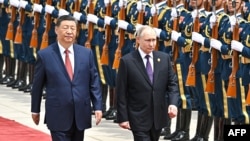



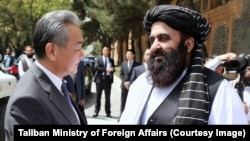
Since the withdrawal of international forces and the Taliban’s return to power in August 2021, Afghanistan’s once-diverse media landscape has collapsed under a lack of funding and restrictions -- and Chinese state media is looking to fill the void.
Hundreds of outlets have shut down, thousands of journalists have lost work, and those remaining face censorship, intimidation, and severe economic pressure. Against that backdrop, China’s media footprint has become highly visible and is aiming to grow further.
China has significantly expanded its media presence in Afghanistan since the Taliban seized power in 2021, with Afghan journalists telling RFE/RL that Chinese outlets in the country are producing content that highlights Beijing’s positive role while avoiding stories about poverty, repression, or human-rights abuses.

A Kabul-based Afghan journalist who has worked for a Chinese outlet told RFE/RL’s Radio Azadi that reporters face tight editorial control.
“Our work focuses only on positive issues. We are told to produce documentaries and reports that strengthen [China’s] relations with the [Taliban] government," a Kabul-based Afghan journalist who has worked for a Chinese outlet in the country told RFE/RL under condition of anonymity. “We see hunger and hardship when visiting fields, but those stories are not wanted. The reality is hidden.”
RFE/RL spoke with several Afghan journalists working for Chinese outlets in Kabul. All said they were warned not to speak with other media and risk losing their jobs if they did.
Former Afghan employees of China Central Television (CCTV) and China Global Television Network (CGTN) who spoke to RFE/RL said that Chinese outlets used to provide news content to Afghan channels promoting Beijing’s “constructive role," although Chinese coverage also often stressed corruption, insecurity, and political dysfunction -- content that supported Beijing’s rivalry with Washington.
“When I worked with them, it was clear China wanted stories that made the previous government look weak and ineffective, focusing mostly on problems, challenges, and negative issues,” said one former CGTN journalist granted anonymity. “It didn’t feel like a constructive role, though it served their political interests.”
A senior Afghan manager at a Chinese media organization told RFE/RL that coverage has shifted toward regional political and security issues since the Taliban's takeover, particularly tensions between Afghanistan and Pakistan.
He said Chinese outlets have deepened cooperation with Taliban-controlled state media, such as the Bakhtar News Agency, through joint programs, content sharing, and technical support.
Expanding Through Local Partners
Analysts told RFE/RL that the effort is part of Beijing’s broader push to strengthen its political and economic influence in Afghanistan as Western outlets withdraw and local media struggle under current Taliban restrictions.
Hazrat Bahar, a researcher at Leipzig University in Germany, said China’s expanding influence in Afghan media serves both strategic and economic goals.
“Countries that support foreign media often do so for political and cultural reasons, and China is one of them,” he told RFE/RL. “You can even see it on social media, through CRI Pashto or programs like China Flowers on Facebook. After Western media collapsed and left a vacuum, China saw an opportunity to expand its influence”
Bahar’s recently published research shows Beijing’s involvement has grown through support for Afghan media outlets and through the expansion of its own networks.
According to him, private broadcasters such as Shamshad TV and Axon Media have received Chinese financial assistance. Axon’s CRI Pashto, part of the China Radio International network, runs twice-daily programs in Kabul and Kandahar and has attracted millions of followers online.
Chinese state networks, including CCTV and CGTN, maintain offices in Kabul producing English-language content.
Some Afghan stations, such as Kabul News, previously aired documentaries about China’s Belt and Road Initiative (BRI), the trillion-dollar infrastructure project launched by Beijing in 2013.

Bahar’s research was included in a 2025 report by the Center for Social and Economic Progress (CSEP), an Indian think tank, and found that China’s presence in Afghan media has expanded significantly since 2021. The report cites financial backing, content partnerships, and training programs for Afghan journalists as key tools in promoting a pro-China narrative.
The report describes this effort as part of Beijing’s “soft power” diplomacy, using information outreach to shape public opinion and project an image of China as a stable partner in a turbulent region.
Hamed Obaidi, head of the Afghan Media Support Organization (AMSO), said Chinese funding also serves economic aims.
“Media investment can be part of China’s broader economic and political strategy,” he told RFE/RL. “They want to promote their projects in Afghanistan and improve their image across the region.”
Managing The Message In Afghanistan
Jawed Qaim, the last ambassador of the former Afghan government to China prior to the Taliban's takeover, told RFE/RL that despite Beijing’s deepening engagement in Afghanistan, its role is still more pragmatic than transformational.
“Afghanistan is not extremely important for China, but in terms of security, including South and Central Asia, Afghanistan is part of China’s regional strategy,” Qaim said.
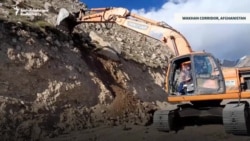

“Because it shares a border with [China's northwestern province of] Xinjiang, while China fears militant Islamist groups, China maintains relations with whoever is in power in Afghanistan, as long as no threat comes from there.”
Qaim also stressed that China "now is more involved, but not in a deeply strategic way -- just enough to exert control and maintain stability.”
According to him, Beijing’s media investment remains limited in financial scale but given the low levels of funding available in Afghanistan's media sector, it still gives Chinese officials influence over content and an opportunity to align it with Chinese state interests.
Meanwhile, Afghanistan’s independent media sector continues to face collapse.
Many journalists have fled, and numerous outlets face imminent shutdown. Whereas outlets once funded by Western donors have lost financial support. Taliban regulations have also imposed sweeping censorship systems, banned entertainment programming and films, and placed restrictions on women’s participation in media.