



US Renews Waiver To Allow Purchases Of Some Russian Oil
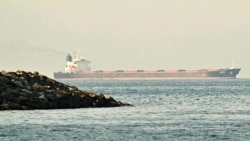
The US administration on April 17 issued a waiver allowing countries to buy sanctioned Russian oil and petroleum products at sea for one month, two days after Treasury Secretary Scott Bessent said Washington would not be renewing the expiring waiver.
The Treasury is allowing purchases of the oil loaded on vessels as of April 17 through May 16, extending the original 30-day waiver that expired on April 11, a document on the department's website said.
The sanctions waiver is a bid by Washington to keep a lid on global energy prices that have surged during the US-Israeli war with Iran.
"As negotiations (with Tehran) accelerate, the Treasury wants to ensure oil is available to those who need it," a department spokesperson said.
The US on March 20 also issued a similar 30-day waiver to allow purchases of Iranian petroleum products already at sea that is to expire on April 19. Bessent on April 15 also said that waiver would not be renewed, and the April 17 announcement did not include an extension of the Iranian waiver.
Read more here.
Iran's Powerful Parliament Speaker Says Strait Will Be Closed Again Unless Blockade Ends
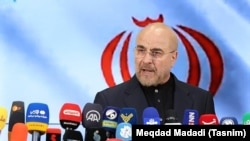
Iran's powerful parliament speaker set up another potential standoff with US President Donald Trump, saying Tehran will again close the strategic Strait of Hormuz if the United States continues its blockade of Iranian ports.
"With the continuation of the blockade, the Strait of Hormuz will not remain open," Mohammad Baqer Qalibaf wrote on X, adding that passage through the crucial waterway would depend on authorization from Iran.
The comments come after Trump said he did not see any "significant differences" with Iran in peace talks and that he expected a deal "in the next day or two," according to an interview published by Axios.
Trump wrote "THANK YOU!" to Iran for opening the strait but insisted that a US blockade of Iranian ports would remain in "full force" until completion of a peace deal.
"Iran has agreed to never close the Strait of Hormuz again. It will no longer be used as a weapon against the World," Trump said on April 17.
Qalibaf, who has had the prominent position within Tehran's negotiating team, wrote: "The president of the United States made seven claims in one hour, all seven of which were false."
"With the continuation of the blockade, the Strait of Hormuz will not remain open," he wrote.
He added that "passage through the Strait of Hormuz will be conducted based on the 'designated route' and with 'Iranian authorization.'"
His comments follow those by media outlets close to Iran's hard-line Islamic Revolutionary Guards Corps (IRGC) criticizing what they said has been the "silence" of Iranian officials regarding an agreement with the US on reopening of the strait, potentially indicating a split among Iranian leadership.
An hour after Foreign Minister Abbas Araqchi announced the opening of the strait, through which one-fifth of the world's oil and liquefied natural gas supplies transited before the US-Israeli war with Iran began on February 28, the Fars and Tasnim news agencies both published several articles that implicitly criticized the move.
Tasnim also criticized Araqchi, calling his post on X -- where the announcement about the strait was made -- "bad and incomplete and a complete bad taste in information dissemination."
Trump Says Doesn't See 'Significant Differences' With Iran Negotiators
WASHINGTON -- US President Donald Trump on April 17 said talks with Iran were progressing and he downplayed reports of major disagreements, adding that a blockade of Iranian ports would end once an agreement is signed.
Speaking to reporters in Phoenix, Trump described the day as significant for ongoing discussions involving Iran and the broader region.
“A big day. We'll see how it all turns out, but it should be good, some very good discussions,” Trump said.
“The talks are going on and going over the weekend, and a lot of good things are happening. That includes Lebanon, too.”
Asked about reports that Tehran sees “significant differences” remaining in negotiations, Trump dismissed the characterization.

“I don't think there's too many significant differences,” he said. “If there are, I'm going to straighten it out.”
On how long he would be willing to maintain the blockade tied to the talks, Trump said it would be lifted immediately upon a deal being reached.
“When the agreement is signed, the blockade ends,” he said.
Trump did not say when an agreement might be finalized and indicated negotiations would continue through the weekend. CNN reported that delegations would return to Islamabad over the weekend and that face-to-face talks mediated by Pakistan would resume on April 20. The White House did not comment.
US Vice President JD Vance led a US delegation in talks in Islamabad on April 11-12, but the negotiations broke off without a breakthrough.
Read more here.
Ryan Kirkley: From Oil To Bitcoin, Markets Shifting With Strait Of Hormuz Announcement
WASHINGTON -- Cryptocurrency markets surged and oil traders recalibrated after signals that the Strait of Hormuz is reopening, even as military tensions and policy contradictions persist.
While equities have been slower to react, analysts say the divergence reflects how different parts of the global financial system process risk and liquidity.
In an interview with RFE/RL on April 17, Ryan Kirkley, CEO of blockchain payments company Global Settlement Network, explains the worldwide economic importance of the Strait of Hormuz, why markets are moving at varying paces, and why oil prices may already be turning.
To read the full interview, click here.
Iranian Media Close To IRGC Criticize Hormuz Announcement
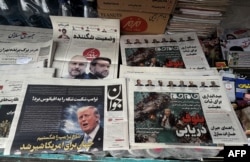
Media outlets close to Iran's hard-line Islamic Revolutionary Guards Corps (IRGC) have criticized what they say has been the "silence" of Iranian officials regarding an agreement with the United States about the reopening of the Strait of Hormuz.
An hour after Iranian Foreign Minister Abbas Araqchi announced the opening of the strait, through which one-fifth of the world's oil and liquefied natural gas supplies transited before the US-Israeli war with Iran began on February 28, the Fars and Tasnim news agencies both published several articles that implicitly criticized the move.
In an article titled "Dear Officials! At Least Explain Your Failure To Explain," Fars demanded that Iranian officials justify their "silence" regarding recent developments, writing: "Iranian society is plunged into a state of confusion."
"If it is in the country's interest not to disclose the details of recent negotiations or developments, why is this interest itself and the reason for avoiding transparency not explained to the people?" another article published by Fars asked.
Tasnim also criticized Araqchi, calling his post on X -- where the announcement about the strait was made -- "bad and incomplete and a complete bad taste in information dissemination."
The message "was published without necessary and sufficient explanations and created various ambiguities about the conditions of passage and the details and mechanisms of passage, and caused much criticism," it said.
Tasmin called on the Foreign Ministry to "reconsider" its decision, writing: "Any creation of concern or despair in this envoy nation is an example of political sin and a disruption in national cohesion."
In another reaction, Nizam Mousavi, a media figure close to the IRGC and former editor in chief of the IRGC-owned Javan newspaper, posted a message on X saying: "The meaning of people's trust in negotiating officials does not mean that we disregard public opinion."
Addressing Iranian officials, he wrote: "Gentlemen! Say something!"
Iran Says Strait Of Hormuz 'Completely Open' During Israel-Lebanon Cease-Fire; Trump Says US Blockade Of Iranian Ports Remains In Place
Iranian Foreign Minister Abbas Araqchi says the Strait of Hormuz, a key waterway for global trade, will be "completely open" for the duration of the cease-fire signed between Lebanon and Israel.
US President Donald Trump posted a thank-you message shortly after the Iranian announcement but said the US blockade of Iranian ports would remain in place until Washington and Tehran reach a deal to end the war.
"In line with the ceasefire in Lebanon, the passage for all commercial vessels through Strait of Hormuz is declared completely open for the remaining period of ceasefire, on the coordinated route as already announced by Ports and Maritime Organization of the Islamic Rep. of Iran," he wrote in a social media post on April 17.
Trump then posted on his Truth Social platform: "IRAN HAS JUST ANNOUNCED THAT THE STRAIT OF IRAN IS FULLY OPEN AND READY FOR FULL PASSAGE. THANK YOU!"
In a subsequent post, he said the US blockade would "remain in full force and effect as it pertains to Iran, only, until such time as our transaction with Iran is 100% complete." He said he expects a resolution will come "very quickly," asserting that "most of the points are already negotiated."
The Strait of Hormuz, through which a fifth of the world's oil and liquefied natural gas transits, has been effectively closed amid US-Israeli air attacks on Iran that started on February 28 and Tehran's retaliatory strikes at targets around the Middle East, including ships in the Persian Gulf.
The United States imposed the blockade, aimed at preventing ships from entering or leaving Iranian ports, on April 13.
To read the full report, click here.
Iran's Internet Blackout Shows No Signs Of Ending
Nearly 50 days after Iran imposed a near-total nationwide Internet shutdown, two members of Iran's parliament have offered a glimpse of the authorities’ thinking on the restrictions.
Fazlollah Ranjbar, a member of the parliament's Social Affairs Commission, said on April 17 in an interview with the semiofficial ILNA news agency that "it may not be advisable for the Internet to be available under such circumstances."
Deputies in parliament still have unfiltered access to the Internet.
The Internet is one of the "bridges through which the enemy can gain entry and create cohesion between hostile forces," Ranjbar said. "The enemy was able to create problems for the country at times with the tools and weapons of the Internet."
The deputy also alluded to compensation worth billions of dollars for businesses damaged by the Internet outage, saying: "This is a decision that must be made after the war...[although] it is not possible to announce right now that compensation will be paid immediately."
Ahmad Bakhshish Ardestani, a deputy and member of parliament's National Security Commission, was also skeptical about lifting the restrictions, saying that the West was working hard to bring the Internet back to Iran.
Ardestani said that the restrictions would be lifted "quickly after the agreement," an apparent reference to a possible future peace deal stemming from current negotiations.
Following the start of the US-Israeli war with Iran on February 28, the Iranian authorities cut off ordinary people's access to the Internet. In January, there was another near-total shutdown as the country was engulfed by nationwide protests. That cut-off lasted around 20 days.
In April, Iran set a world record with 36 days for the longest time that a previously connected society had been cut off from the Internet. According to web access monitor Netblocks on April 17, ordinary Iranians have not had access to the web for 49 days or 1,152 hours.
Iran Cancels Army Day Parade
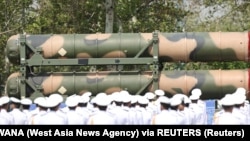
The spokesman for Iran's army, Brigadier General Mohammad Akraminia, has announced that it is not possible to hold the Army Day parade this year, saying that "the current cease-fire is no different to war conditions."
The first Army Day, marked annually on April 18, was held in 1979 shortly after the Islamic Revolution. It was established by Ayatollah Ruhollah Khomeini to demonstrate the Iranian army’s loyalty to the new Islamic republic. It was first held in Tehran and later expanded to other cities during the 1980–88 Iran-Iraq war.
The parade was cancelled in 2020 due to the coronavirus pandemic and the following year it was held in a closed format because of continued restrictions.
Instead of a parade, Akraminia said, cultural programs will be held in the barracks and officers and soldiers will also attend Friday Prayers.
France Says European Countries Could Ensure Safe Passage Through Strait Of Hormuz
French Defense Minister Catherine Vautrin said on April 17 that European countries such as Belgium, the Netherlands, and France possess mine-clearance capabilities that could help secure safe passage through the Strait of Hormuz.
In an interview with TF1 television, Vautrin said there are "possibilities to provide fully supported escorts for ships -- escorts that are in no way aggressive and are aimed at ensuring safe passage through the strait. This will be discussed today in Paris."
France and the United Kingdom are cohosting a meeting on April 17 in Paris involving around 40 countries. The meeting is focusing on planning a multilateral, defensive mission to restore freedom of navigation in the Strait of Hormuz.
Iran has effectively blocked or severely restricted shipping through the strait since the war began on February 28, causing a major disruption to global energy markets.
Since April 13, the United States has blockaded Iranian ports and coastal areas, targeting all maritime traffic entering or exiting Iran, while allowing transit through the strait to non-Iranian destinations.
Two Iranian Women Soccer Players Thank Australia For 'Safe Haven'
Two Iranian women's soccer players thanked the Australian government on April 17 for offering a "safe haven" and said they wanted to resume their sporting careers
Fatemeh Pasandideh and Atefeh Ramezanisadeh, in their first public comments since being granted humanitarian visas, said in a statement that the support shown to them had given them hope for a future in which they could live and compete in safety.
"We wish to express our deepest gratitude to the Australian government, and particularly Home Affairs Minister Tony Burke, for granting us humanitarian protection and a safe haven in this beautiful country," they said.



Seven members of the Iranian women's soccer team sought asylum in Australia in March after they declined to sing Iran's national anthem ahead of an Asian Cup game, sparking a backlash on Iranian state media.
But five of them later withdrew their asylum claims and joined the rest of the team as they traveled through Malaysia en route to Iran.
Pasandideh and Ramezanisadeh remained behind in Australia as rights advocates raised fresh concerns that some team members were returning home under intense government pressure.
Pasandideh and Ramezanisadeh have been pictured training with A-League Women's team Brisbane Roar.
The women's action came against the background of the war in their home country that broke out when US and Israeli air strikes hit Iran on 28 February.