


Middle East
- By RFE/RL
2 US Service Members Killed, 1 Missing In Jordan As Iran Steps Up Attacks, Threats
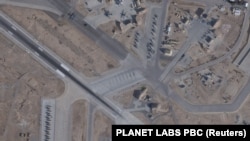
The US military suffered its first combat fatalities since March in the Iran war, with the Pentagon saying two service members were killed and another was missing during defensive operations in Jordan, as hostilities ramped up in the region and further endangered a fragile cease-fire.
"On July 17, two US service members in Jordan were killed in action as US Central Command...and partner forces defended against Iranian ballistic missile and drone attacks. Additionally, one service member is currently missing in action," CENTCOM said on X on July 18.
Four others service members were injured and evacuated to Jordanian hospitals, CENTCOM added. Two of them have been discharged from the hospital, while several others were evaluated for minor injuries and returned to duty, it added.
The statement did not specify where in Jordan the attack occurred. Identification of the victims was not provided pending notification of family members.
The main site of US operations on the territory of the Middle East ally is the Muwaffaq Salti Air Base, about 80 kilometers outside Amman. US forces also have operations at the Prince Hassan Air Base and at other military facilities in Jordan.
The Wall Street Journal, citing sources, reported that the strike occurred at the Muwaffaq Salti base, which US forces have used to launch air strikes against Iran.
US President Donald Trump told the NewsNation network that the deaths were "very sad. It's a very sad thing."
"We hate to see it happen. It’s in service to our country," he said in a brief interview.
US defense chief Pete Hegseth wrote on X: "Godspeed, heroes. Their sacrifice only stiffens our resolve."
First Combat Fatalities Since Renewed Hostilities
The deaths would bring the total of known fatalities among US service members since the start of the US-Israeli strikes on Iran on February 28 to 16, with all but one listed as combat deaths.
Six service members were killed on March 1 when a drone hit a command center in Kuwait.
On March 8, a US soldier was killed during an attack on the Prince Sultan Air Base in Saudi Arabia.
On March 12, six members of a refueling aircraft were killed when their plane crashed in western Iraq.
A Navy pilot was also killed in what was described as a noncombat incident when a helicopter crashed in the Arabian Sea in early July.
Iran Says MOU 'Suspended'
The latest deaths come as Iranian officials said an interim agreement -- the memorandum of understanding (MOU) between Washington and Tehran -- had been "suspended" following the recent wave of US strikes on Iran.
"Unfortunately, the Americans have violated their obligations under the Islamabad declaration of intent through their aggressive measures," Deputy Foreign Minister Kazem Gharibabadi said in a televised interview, adding Tehran was suspending implementation of its commitments.
Foreign Ministry spokesman Esmail Baqaei made similar remarks, saying the MOU had "effectively been suspended."
Iran has responded to the US strikes by launching missiles and drones at US Gulf Arab allies, including Kuwait, Bahrain, and Saudi Arabia, along with its attacks on Jordan.
Iranian Major General Mohsen Rezaei threatened that Tehran was ready to resume "full-scale offensive operations" if US strikes against were to continue for another two or three days.
The MOU was intended to give the sides 60 days to sign a permanent end to the war, but hostilities -- although not full-out war -- have been reignited over Iran's military actions in the Strait of Hormuz.
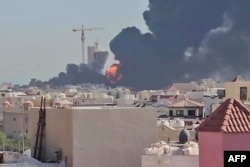
A key clause of the MOU was a US demand to open the strait, through which much of the world's oil and gas supplies transited prewar but which Iran had effectively blocked.
Traffic has moved erratically through the waterway, although it is virtually shut again after recent strikes by Iran on vessels it said had not received permission to transit, prompting the latest wave of US strikes on Iranian coastal sites and bridges, tunnels, and railway stations in the south of the country.
Washington has said Tehran's attempt to control the strait is a violation of the MOU. CENTCOM and the White House have said the purpose of the attacks was to degrade Tehran's ability to strike ships in the strait.
Written Supreme Leader Statement
Meanwhile, a statement attributed to Iranian Supreme Leader Mojtaba Khamenei on July 18 blasted the United States for what it said were repeated violations of the MOU.
"Now that the American enemy seeks to incite war and bear its most serious consequences, it should know that the dear Iranian nation and the axis of resistance have unforgettable lessons to offer it," said the statement, read by state TV late on July 18.
Khamenei has not been seen in public since February 28, when his father -- the previous supreme leader -- was killed in US-Israeli air strikes.
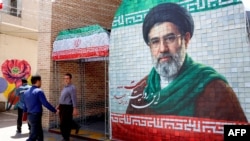
The 56-year-old Khamenei was reportedly severely injured in the attack, raising questions about his health and his ability to carry out his duties as supreme leader.
There have been no known audio or video recordings of Khamenei since February 28. He was not seen throughout six days of ceremonies and rallies during funeral services for his father in early July.
Experts said his absence from the funeral services inflicted a further blow to Khamenei's legitimacy and intensified questions about who runs the Middle Eastern country of some 90 million people.
According to the authorities, he did not attend his father's funeral because of security concerns.
David Des Roches: Iran Is Losing The Long Game
WASHINGTON -- As Washington debates whether the recent cease-fire with Iran reflects strategic restraint or strategic drift, retired US Colonel David Des Roches says the broader trajectory of the conflict tells a different story.
Des Roches, former director of Arabian Peninsula Policy at the Pentagon and now a professor at the Near East South Asia Center for Strategic Studies in Washington, D.C., argues that Iran is losing the long game and that its decline as a regional power began long before the latest war.
In an interview with RFE/RL, Des Roches said that despite Tehran's efforts to portray the war as a success, the Islamic republic has emerged weaker militarily, more isolated diplomatically, and increasingly vulnerable economically.
RFE/RL: Let's start with the Iran talks. Mediators in Doha described the latest round as "positive," but there was no breakthrough on the bigger strategic issues. Negotiators focused on shipping and financial issues rather than the nuclear file or regional power. Does that suggest both sides have less leverage than many expected?
David Des Roches: Yes, you can make that case. We don't really know what's going on, but there are a couple of problems here for both sides.
First off, both sides are desperate to portray this as a win. Both sides are saying, we won, the other side didn't. That obviously makes it hard to come to an agreement when both are trying to impose conditions the other says it can't accept.
The second problem is we're not really sure who's in charge in Iran. Negotiators will say one thing, and then different IRGC [Islamic Revolutionary Guards Corps] officers or members of parliament will say, no, we can't accept this, we can't accept that.

That was apparent from the start of this process. After the Islamabad talks -- and remember, we sent the vice president to Islamabad, which is a long flight -- almost as soon as the talks were over, Tasnim, the Iranian press agency, said the foreign minister had exceeded his brief and what he said was not Iranian policy. And we see this over and over again.
It's quite possible some of the ship attacks we're seeing may be individual IRGC officers acting without overall command. It's hard to make an agreement when you're really not sure what's going on, when Iranian negotiators have to satisfy hard-liners back home while also trying to make a deal with the Americans. It's just a mess, and I think that's something we should expect for a while.
RFE/RL: The next round of diplomacy has now been delayed until after the funeral ceremony for the late ayatollah. How much uncertainty does this leadership transition create?
Des Roches: We don't even know if the current ayatollah is alive. There's no evidence. We haven't heard his voice. We haven't seen a picture of him. This could be a hard-line faction ginning up its own message and saying, this is what the supreme leader says. There's a lot of uncertainty here, and frankly, the position we're in right now is where we're going to be for a while.
Both sides are at risk of overplaying their hand. It's clear to me the thing motivating [US] President [Donald] Trump is the price of oil, because that has domestic impacts in the United States and affects the midterm elections.
Right now, oil prices have dropped, and there has been so much destruction of the Iranian Navy that their ability to disrupt neutral civilian shipping has diminished. And it's important to note: Iran has not projected power against the US Navy. It has projected power against Indian cargo ships. Oil is still getting through. If the talks drag on past the elections, it's quite possible Trump says, "We gave this a shot," and returns to combat operations.
It's in both sides' interest to get an agreement. But Iran's position is far more tenuous than people think.
The Strait Of Hormuz And The 'Insurance War'
RFE/RL: Iran's joint military command has warned that all oil tankers transiting the Strait of Hormuz must follow Iranian-approved routes. Is that a sign of naval dominance or defensive posturing from a weakened regime?
Des Roches: It's important to note Iran's target audience here is not military -- it's the commercial insurance market in London. Basically, they're trying to create uncertainty so maritime insurance underwriters charge prohibitively high rates. That discourages neutral commercial shipping from transiting the strait.
Right now, maritime insurance is around 8 percent of insured value. That's too high for most businesses. That's what they're trying to do.
Meanwhile, state-owned tankers and US warships are still transiting. They're operating in Omani territorial waters. And whenever an Iranian attack is directed against one of these ships, there's an immediate response against the point of launch and associated command-and-control systems. So, militarily, it's not really a threat.
What Iran is doing here is commercial extortion. It's like someone telling a pharmaceutical company with 4 million bottles of paracetamol on the market: We're going to poison two of them somewhere. That's the equivalent.
RFE/RL: Iranian officials keep warning of immediate retaliation if threatened. Does Tehran still have the conventional capacity for sustained military escalation?
Des Roches: No. Iran's capability is not militarily significant, and it hasn't been throughout this war. If Iran had wanted to fight this as a real war and inflict serious damage on the United States, then on day one it would have launched hundreds of missiles at US air bases in the Levant.
If they had 600 missiles and launched 400 effectively, maybe some would get through. Maybe you'd see satellite imagery showing Joint Strike Fighters destroyed on the ground.

That would have been catastrophic. But they couldn't do that. Instead, they've launched scattered attacks, not concentrated volleys, against civilian infrastructure in the Gulf and some US facilities. This is not militarily significant. It's harassment.
They haven't sunk a US Navy ship. They're attacking neutral civilian cargo ships. None of that is permissible under the law of land warfare. This is the behavior of a dying regime trying to make its own crisis into a global crisis by attacking people who can't fight back.
Wake-Up Call In The Gulf
RFE/RL: You've argued that Gulf states have had a strategic wake-up call. Has Iran's attempt to pressure them away from Washington actually backfired?
Des Roches: Absolutely. Before these attacks, there was a new generation in the Gulf that looked at Iran the way some West German politicians in the 1960s and 1970s looked at East Germany: It's a problem, we don't like it, but it's our neighbor. We have to find a way to live with it.
There was a belief commercial ties and cultural links would provide insulation. That illusion is gone. The Gulf states denied the US and Israel access and overflight rights for these operations. They stayed out of it. And they still got attacked. That changes everything.
It's going to take regime change and probably a generation for Iran to be viewed as anything other than a permanent threat. Future Gulf-Iran relations will be understood through coercion -- almost extortion -- not engagement.
RFE/RL: Is Iran still holding its regional proxy network together or are we seeing the axis of resistance start to fracture?
Des Roches: Iran still retains influence, but it's obvious they've betrayed Lebanese Hezbollah. The whole negotiation process has been about Iran getting money.
And when this started, if there were an honest conversation, they'd admit they couldn't take any more economic suffering for Hezbollah's sake. Only after the Axios report -- where President Trump was quoted saying he would make maximalist demands -- did Iranian leaders try to push Lebanon to the front of negotiations. That was for appearances. They couldn't admit publicly they were abandoning Hezbollah. But they've done almost nothing to help. And they knew full well when they ordered Hezbollah into action that Israel would welcome that as an opportunity to eliminate them.
What we're seeing is Iranian leadership prioritizing Iranian interests. That's economic. The so-called axis of resistance isn't an alliance of equals. It's a wheel.
Iran is the hub. Hezbollah, Iraqi militias, Assad -- they're the spokes. And spokes are expendable. You can ride a bicycle with two missing.
Iran's Strategic Decline
RFE/RL: Looking beyond the battlefield, what should policymakers watch to judge whether this war has truly changed the strategic balance?
Des Roches: The key point is the relationship between politics and the military. What you see in Iran is a military branch, the IRGC, that has become the center of political power.
Since 2009, it has been mounting a slow-motion coup. Its goal is to keep Iran focused narrowly on dominating its near neighbors. That has consumed immense wealth. Iran is a country of untapped commercial potential and intellectual genius, and all of that has been flushed away.
If conflict resumes, what has been most effective has been targeted assassinations of Revolutionary Guardsmen and increasing the isolation of the Guards and their families. That's what really pressures the system. They will not give up power voluntarily. That's the reality.
RFE/RL: Based on everything you've said -- limited diplomacy, constrained military options, and economic pressure -- is Iran entering a period of long-term strategic decline?
Des Roches: Iran has been in strategic decline since the fall of [former Syrian President] Bashar al-Assad. When the archives open, we'll discover the Syrian war drained Iran of enormous resources -- manpower and money. They tried to sustain it by importing fighters from Iraqi militias, Pakistani militias, and Afghan militias.
But the core cadre -- the IRGC officers -- suffered major losses. And the money spent was insane. That was the inflection point. Then when Assad fled to Moscow, Hezbollah's logistical pipeline was disrupted in a way that made Hezbollah vulnerable. That's where the decline really accelerated.
But if you go back even further, to 2009, when the IRGC decided to dominate Iranian politics during the Green Movement, that may prove to be the deeper turning point. When a security state starts running a country, the individuals inside it start making decisions that benefit themselves rather than the nation. And that's when national decline begins. In Iran's case, that process started a long time ago.
US Keeps Military Option Alive As Iran Talks Near A Critical Test
WASHINGTON -- US Vice President JD Vance has again signaled that the White House is prepared to use force against Iran if diplomacy fails, raising the stakes around a 60-day memorandum of understanding (MOU) that has halted open hostilities but left the core disputes unresolved.
In an interview on The Michael Knowles Show released on June 30, Vance cast the US approach toward Iran as a stark choice: a longer-term agreement anchored in permanent, verifiable nuclear inspections, or renewed military action to preserve what Washington sees as gains already secured. He said President Donald Trump wants diplomacy to continue but only if Tehran accepts enforceable limits on its nuclear program.
Vance described Iran's public messaging as contradictory, pointing to what he said was a gap between Tehran's public denial of peace talks and its acknowledgment of ongoing technical discussions.

"They'll say, 'No, no, there aren't peace talks ongoing, but there are technical talks between the United States and Iran about the peace deal,'" Vance said. "It's a Persian negotiating tactic and a Persian rhetorical device that I don't understand."
Responding to critics who have urged a harder military line, Vance defended Trump's approach as one of calibrated coercion rather than open-ended escalation. "The president is saying, 'I'm willing to drop bombs,' and he's clearly shown that he's willing to drop bombs, but only if it serves an objective," he said.
In a separate interview with Fox News, Vance said Washington was focused less on rhetoric than on whether Tehran was prepared to make "real concessions."
"We care a lot less about what the Iranians say. We care a lot more about what they do," he said.
The remarks come as uncertainty hangs over the next phase of negotiations. Iranian negotiators did not meet US envoys in Doha on June 30 as expected, clouding hopes that the current cease-fire framework could quickly evolve into a broader settlement.
Back in Washington, analysts warn the current arrangement amounts less to a peace agreement than a temporary pause in fighting. That tension between diplomacy and deterrence was at the center of a discussion at the Council on Foreign Relations (CFR) on June 30.
A Military Posture That Can Hold, For Now
Speaking at the CFR panel, retired General Joseph L. Votel -- former Commander of US Central Command (2016–2019) -- said US forces remain capable of sustaining deterrence through the current 60-day negotiation period. This comes even as Washington reassesses the vulnerabilities exposed by the recent conflict.
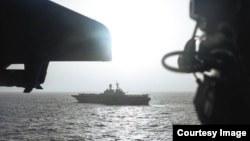
Votel noted that Washington retains significant operational flexibility because of its naval presence, particularly through two carrier strike groups operating in regional waters.

"Right now we are sustainable from a military standpoint," Votel said, while cautioning that maintaining such a posture becomes harder "after several months."
While Votel noted that official details regarding damage to US security infrastructure have been closely held by the military, he characterized the damage to the US regional basing network as "widespread" and "operationally relevant."
Open-source reporting indicates that since the war began on February 28, 16 to 20 regional sites were struck. These included major installations such as the Fifth Fleet headquarters in Bahrain, Ali Al Salem Air Base in Kuwait, Prince Sultan Air Base in Saudi Arabia, and the forward CENTCOM headquarters at Al Udeid Air Base in Qatar.
Votel noted the conflict had definitively exposed the vulnerability of fixed military infrastructure across the Gulf against sustained attacks, triggering an active review of Washington's regional basing strategy.
Potential adjustments being weighed by planners include hardening core hub facilities, reducing exposure in vulnerable areas like Kuwait and Saudi Arabia, shifting assets westward into the Levant, or moving toward a more resilient distributed network model.
Gulf States Still Caught Between War And Diplomacy
For Elisa Catalano Ewers, senior fellow for Middle East Studies at the CFR, the larger challenge is fundamentally political. She noted that while the Gulf states bore the brunt of Iran's attacks during six to seven weeks of hot conflict, the subsequent pause in fighting has done little to resolve the "core issues" driving regional instability, specifically Iran's ballistic missile capabilities, drone networks, and proxy forces, which were left out of the current MOU.
Ewers, who previously served on the National Security Council under the George W. Bush and Barack Obama administrations, observed that the MOU does not look like a strategic victory for the Gulf. Instead of permanently degrading Iran's leverage, the current framework has left Tehran with newfound leverage over the Strait of Hormuz and a resumption of oil sales via US sanctions waivers.

Consequently, Ewers described the MOU as "the best of bad options," leaving regional governments to hedge their bets by aggressively pursuing diplomatic de-escalation with Tehran while simultaneously trying to shore up their security coordination with Washington.
She remained highly skeptical that the 60-day negotiation window would yield a comprehensive breakthrough.
"The can gets kicked down the road," Ewers said, suggesting an extension of the current temporary arrangement remains the most likely outcome.
This assessment was strongly echoed by Robert Mogielnicki, nonresident fellow at the Arab Gulf States Institute and Middle East Advisor at Teneo. He stated that his "base case" remains a continuation of the status quo interim agreement, likely extended multiple times, rather than a final, comprehensive deal.
Oil And Shipping Remain Central
The economic pressure behind the diplomacy remains significant. Vance has repeatedly linked the talks to stabilizing global oil supplies, and recovering shipping traffic through the Strait of Hormuz is central to that effort.
At the CFR panel, Mogielnicki noted that maritime traffic through the Strait has dropped to roughly a third of pre-war levels. He warned that the economic disruptions across the Gulf remain deeply uneven.
Larger economies with diverse export routes and pipelines such as Saudi Arabia, Oman, and the UAE are better positioned to manage the headwinds. In contrast, countries like Qatar (which has suffered energy infrastructure damage), Bahrain, and Kuwait lack alternative export routes and remain highly vulnerable.
Mogielnicki also highlighted a cruel twist in the conflict's economic fallout: economic diversification programs have not served as a safety net. Core non-oil sectors like tourism, aviation, and logistics hubs such as Dubai's Jebel Ali port have suffered severe operational disruptions and higher costs directly because of their proximity to the conflict zone.
Furthermore, the fiscal juggle to fund these diversification initiatives has grown increasingly strained. Mogielnicki pointed out that Saudi Arabia's recent budget revealed an unprecedented quarterly deficit of $34 billion due to rising investment spending and falling oil revenues, which recently tumbled from near triple digits down to around $70 per barrel.
A Temporary Framework, Not A Settlement
The broad consensus emerging from Washington is that the 60-day framework is highly unlikely to produce a final, comprehensive settlement. Instead, it is being utilized as a fragile mechanism for managing escalation while deeper structural disputes remain unresolved.
The most probable outcome remains a series of extensions to the interim arrangement. However, panelists at CFR emphasized that this creates a highly volatile landscape.
A return to open military confrontation remains a live possibility, whether triggered by a diplomatic collapse, regional proxy miscalculations, or unilateral military actions by Israel.
Ultimately, Votel warned that absent a fundamental and broader strategic understanding, the region's security landscape is poised to look exactly the same when the 60 days expire as it does today.
For Washington, the immediate hurdle is no longer ending an active war but preventing this diplomatic pause from becoming the mere prelude to the next conflict.
- By RFE/RL
Qatar Says No High-Level US-Iran Talks Scheduled In Doha Despite Trump Claim
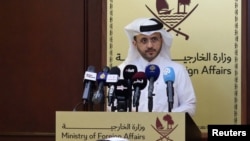
Qatar's Foreign Ministry said no high-level meeting between US and Iranian officials is scheduled in Doha in the coming days, after US President Donald Trump said Iran had requested talks and the White House announced senior US envoys would travel to Qatar for negotiations.
"To the best of my knowledge, there are no direct meetings scheduled between the two parties in the coming days," Qatari Foreign Ministry spokesman Majed Al Ansari told reporters on June 30, adding that the American delegation would meet with Qatari mediators.
The comments came after the White House announced that US envoys Steve Witkoff and Jared Kushner would travel to Qatar for top-level talks. US President Donald Trump said on June 29 Iran had "requested a meeting" that would take place in Doha the following day.
Iran has also said no talks are scheduled with the United States this week.
Foreign Ministry spokesman Esmail Baqaei said on June 30 that the Iranians would not be prepared to meet for negotiations on ending the war, nearing its fifth month, until certain criteria are met. He said such talks are subject to the "implementation of the clauses of the memorandum of understanding" (MOU) by the United States, specifically regarding the conflict in Lebanon.
"We must evaluate the current process in the coming days and decide based on that how and when to begin negotiations for a final agreement," Baqaei said at a press conference.
He referred to the first paragraph of the MOU signed between Iran and the United States on June 17 and announced that the "main criterion" for Tehran is that Washington "force" Israel to stop its attacks on Lebanon.
The interim agreement was intended to halt fighting that erupted after US and Israeli strikes on Iran at the end of February and to reopen the Strait of Hormuz to commercial traffic while broader negotiations continued.
Baqaei said the US has pledged to end the war on all fronts, including Lebanon, and added: "For us, the main criterion is America's adherence to these commitments and America's forcing the Zionist regime to implement these commitments."
The day before, he said an Iranian technical team would visit Doha this week but that it had no relation to US officials visiting the Arab country.
"We will not have any negotiations at any level with the American side in the coming days, and the fact that American representatives are traveling to Qatar has nothing to do with the Iranian delegation's trip," Baqaei said on June 29.
Qatar, along with Pakistan, has been acting as a mediator between Washington and Tehran.
The conflicting statements come after the United States and Iran traded tit-for-tat strikes over the weekend, further straining the fragile cease-fire and casting doubt on efforts to resume negotiations.
Iran, citing US attacks on the country and what it said were violations of the recently agreed MOU, refused to meet with US negotiators as scheduled on June 28.
"One of the reasons is checking if we have access to the unfrozen funds. If there is no access, then this condition has not been fulfilled," said Mehdi Fazaeli of the Iranian supreme leader's office.
The release of the funds is part of the MOU.
Baqaei said on June 29 the Iranian technical team would be in Doha to discuss the release of around $6 billion in frozen Iranian assets held in Qatar. US officials say no frozen Iranian assets have been released to date.
Meanwhile, White House spokeswoman Karoline Leavitt said on June 29 that Witkoff and Kushner would be attending talks with Iran in Doha.
"Special Envoy Witkoff and Jared Kushner will be flying to Doha for high-level meetings this week, as we continue to discuss the memorandum of understanding. On the sidelines of those high-level talks, there will be the technical talks," she said in an interview with Fox News.
Iran fired on commercial vessels in the strait over the weekend, leading US forces to strike Iranian coastal radar and military sites in an effort to protect shipping.
On June 28, Iran's Foreign Minister Abbas Araqchi claimed Tehran had regained sole control over shipping in the Strait of Hormuz for the next 30 days, warning against any attempt to bypass Iranian-approved routes.
Earlier that day, Iran launched missiles and drones targeting US military sites in Kuwait and Bahrain shortly after Trump warned Washington could escalate its military campaign if Tehran failed to abide by the cease-fire.
The escalation followed US strikes on Iranian military sites hours earlier, which Washington said were carried out in response to Iranian attacks on commercial shipping in the Strait of Hormuz.
US Central Command said its forces targeted Iranian drone storage facilities, radar installations, and coastal surveillance infrastructure after a tanker was hit by an Iranian drone on June 27.
With reporting by RFE/RL senior correspondent Alex Raufoglu, Axios, AFP, and dpa
- By Kian Sharifi
Skepticism In Iran Over Israel-Lebanon Framework Agreement
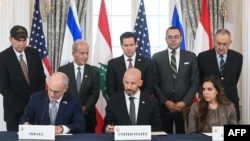
When the United States, Israel, and Lebanon signed their trilateral framework agreement in Washington, the reaction in Tehran was swift -- and, across the political spectrum of Iranian state-aligned media -- almost uniformly hostile.
The deal, which commits Lebanon to the verified disarmament of Hezbollah as a precondition for the progressive withdrawal of Israeli forces from southern Lebanon, was variously described as a "document of shame," a "strategic error," and "humiliating" by Iranian outlets ranging from the state broadcaster's newspaper to outlets with close ties to the Islamic Revolutionary Guards Corps (IRGC).
The consensus critique was less about the deal's existence than its sequencing.
Every major outlet focused on the same structural point: that Israeli withdrawal is conditioned on Hezbollah disarmament, not the reverse -- a formulation Iranian commentators portrayed as proof the agreement was dictated by Israel and rubber-stamped by a Lebanese government they described as "pro-West" and subservient.
Hezbollah is both a militant group and a political party that controls much of southern Lebanon. It is considered a terrorist organization by the United States, while the European Union has only blacklisted its armed wing.
What is largely absent from the Iranian media coverage is any serious engagement with the Lebanese government's own position -- that it had limited leverage in a war where Israel holds decisive military superiority and unconditional US backing.
Lebanon’s government has looked to distance itself from Tehran, which has used the establishment and funding of Hezbollah in Lebanon to make it a strategic linchpin to project regional power. But some in Iran said it may have gone too far in the other direction with this agreement.

The government-run Iran newspaper called it the "great gamble of Aoun and Salam," a framing that placed blame squarely on Lebanese President Joseph Aoun and Prime Minister Nawaf Salam personally, rather than on Lebanon as a state.
Iran's official IRNA news agency described the agreement as an "accommodationist agreement," a loaded phrase in Iranian political discourse that carries strong connotations of capitulation.
Hezbollah’s October 8, 2023 rocket attack on Israel, launched in solidarity with the devastating Hamas attack a day earlier, ignited a year-long cross-border conflict that escalated into the killing of Hezbollah’s top leaders, a ground invasion of southern Lebanon, and widespread destruction.
Israel has occupied a swathe of land in southern Lebanon during renewed fighting with Hezbollah that began on March 2, when the Tehran-backed proxy opened fire at Israel after Iran came under attack from US and Israeli air strikes.
Solving the Lebanon-Israel question has been at the heart of diplomatic efforts to end the broader conflict between Iran and the United States. Tehran has been steadfast in insisting that a peace deal includes Lebanon.
Washington, meanwhile, has helped facilitate the dialogue between Beirut and Israel even though Hezbollah leadership has been against the move.
Jaam-e Jam, the newspaper of Iran's state broadcaster IRIB, framed the deal as a violation of Lebanese law, citing a 1955 Lebanese statute prohibiting direct negotiations with Israel.
The paper argued that Beirut had accepted Hezbollah's disarmament "against the national interest" while Israeli forces remain on Lebanese soil, and went further, suggesting Israel was using the diplomatic process to achieve territorial expansion it had failed to secure militarily since 2000 -- a reference to Israel's withdrawal from southern Lebanon that year after 18 years of occupation.
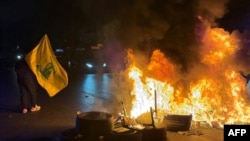
The Tasnim News Agency, linked to the powerful IRGC, also drew historical parallels, noting when Syria tried to present a moderate face to Washington and Israel last year, only for Israeli jets to bomb the presidential palace in Damascus and Israeli tanks to advance into Syrian villages to protect the Druze religious minority following days of deadly sectarian violence.
The lesson drawn: Accommodation and resistance produce the same result from Israel, so Lebanon should expect no different.
Tasnim also published Hezbollah Secretary-General Naim Qassem's statement calling the deal "null and void" and "humiliating," and notably reproduced his demand that the terms of the Iran-US memorandum of understanding on Lebanon be implemented instead -- directly asserting that the Iran-US framework should supersede what Washington brokered between Israel and Lebanon.
In announcing the trilateral framework agreement on June 26, US Secretary of State Marco Rubio called the deal a "first step" in the process, adding "there's a lot of work ahead."
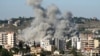
"We don’t in any way underestimate the difficulty of the task ahead, but we understand the importance of it, how vital it is,” Rubio said.
The conservative Agaah newspaper saw the agreement, as expected, quite differently, calling it a "document of shame" while singling out Aoun, a former military commander, for particular condemnation, arguing that a soldier had signed away Lebanese sovereignty.
The paper also warned that US funding to strengthen the Lebanese Armed Forces was designed to provoke internal conflict between the army and Hezbollah, predicting that any such clash would draw in what it called "Takfiri Syria" -- a reference to the government in Damascus, led by Ahmed al-Sharaa, as a further destabilizing factor.
- By RFE/RL
Iran Says No Talks With US Despite Trump Claim
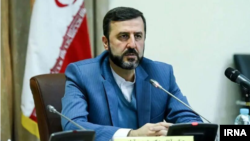
Iran has claimed no talks are scheduled with the United States in the coming days, despite US President Donald Trump saying that Tehran had "requested a meeting" and that negotiations would take place on June 30 in the Gulf state of Qatar.
Foreign Ministry spokesman Esmail Baqaei said an Iranian technical team would visit Qatar's capital, Doha, this week, but that it had no relation to US officials visiting the Arab country.
"We will not have any negotiations at any level with the American side in the coming days, and the fact that American representatives are traveling to Qatar has nothing to do with the Iranian delegation's trip," Baqaei said in a statement.
His comments came after the United States and Iran traded tit-for-tat strikes over the weekend in a reescalation of tensions.
Earlier on June 29, Trump wrote on Truth Social: "Iran has requested a meeting. It will take place tomorrow in Doha!"
White House spokeswoman Karoline Leavitt said Trump's envoys Steve Witkoff and Jared Kushner would attend talks with Iran in Doha.
"Special Envoy Witkoff and Jared Kushner will be flying to Doha for high-level meetings this week, as we continue to discuss the memorandum of understanding. On the sidelines of those high-level talks, there will be the technical talks," she said in an interview with Fox News on June 29.
Baqaei said the Iranian technical team was traveling to Doha to discuss the release of around $6 billion in frozen Iranian assets held in Qatar.
The release of the funds is part of a memorandum of understanding (MOU) signed by Tehran and Washington on June 17 aimed at ending the monthslong war.
Iran's Deputy Foreign Minister Kazem Gharibabadi said earlier on June 29 that the technical working group was not scheduled to meet this week.
"Although consultations with Qatar, including regarding the follow-up on the implementation of the other party's commitments, are ongoing as usual, the news from some media outlets that technical talks by working groups are being held in Doha cannot be confirmed," Gharibabadi told Iran's Tasnim news agency.
He added that the first round of technical talks would be held within the framework of the designated working groups once conditions are in place and after an agreement is reached on the date and location, and that consultations in this regard are continuing through intermediary countries.
The remarks come after Iran, citing US attacks on the country and what it said were violations of the recently agreed MOU, refused to meet with US negotiators as scheduled on June 28.
"One of the reasons is checking if we have access to the unfrozen funds. If there is no access, then this condition has not been fulfilled," said Mehdi Fazaeli of the Iranian supreme leader's office.
Iranian President Masud Pezeshkian announced on June 29 that Iranian assets currently being held in Qatar will be returned to Tehran, but US officials say no frozen Iranian assets have been released to date.

Tit-For-Tat Strikes
Iran fired on commercial vessels in the strait over the weekend, leading US forces to strike Iranian coastal radar and military sites in an effort to protect shipping.
On June 28, Iran's Foreign Minister Abbas Araqchi claimed Tehran had regained sole control over shipping in the Strait of Hormuz for the next 30 days, warning against any attempt to bypass Iranian-approved routes.
"Any interference or attempt to create parallel structures would further complicate the situation, generate additional tensions, and delay the reopening of this strategically vital waterway," Araqchi said, reiterating the claim that responsibility for the strait lies solely with Iran.
Earlier that day, Iran launched missiles and drones targeting US military sites in Kuwait and Bahrain shortly after Trump warned Washington could escalate its military campaign if Tehran failed to abide by the cease-fire.
"There may come a point when we are no longer able to be reasonable," Trump said in a social media post, adding that the United States could "militarily complete the job" it began on February 28.
The escalation followed US strikes on Iranian military sites hours earlier, which Washington said were carried out in response to Iranian attacks on commercial shipping in the Strait of Hormuz.
US Central Command said its forces targeted Iranian drone storage facilities, radar installations, and coastal surveillance infrastructure after a tanker was hit by an Iranian drone on June 27.
Trump and Pezeshkian signed a 14-point MOU that gives the sides 60 days to negotiate a final agreement seeking to end the war.
Qatar, along with Pakistan, has been acting as a mediator between Washington and Tehran in the current round of talks.
The interim agreement was intended to halt fighting that erupted after US and Israeli strikes on Iran at the end of February and to reopen the Strait of Hormuz to commercial traffic while broader negotiations continued.
With reporting by RFE/RL senior correspondent Alex Raufoglu, Axios, and dpa
- By RFE/RL
Iran Claims Sole Control Of Hormuz Strait As Truce Frays
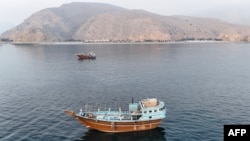
Iran’s Foreign Minister Abbas Araqchi claimed Tehran had regained sole control over shipping in the Strait of Hormuz for the next 30 days, warning against any attempt to bypass Iranian-approved routes, as a fragile US truce looked increasingly shaky amid renewed missile, drone and air strikes across the Persian Gulf on June 28.
Speaking at a press conference during a visit to Baghdad, Araqchi said the waterway would be “once again placed entirely under Iranian administration.”
“Any interference or attempt to create parallel structures would further complicate the situation, generate additional tensions and delay the reopening of this strategically vital waterway,” Araghchi said, reiterating the claim that responsibility for the strait lies solely with Iran.
Araqchi’s comments came as the tenuous truce between Iran and the United States appeared to be fraying early on June 28, with both sides accusing each other of violating an interim agreement aimed at ending months of fighting.
Iran launched missiles and drones targeting US military sites in Kuwait and Bahrain shortly after US President Donald Trump warned Washington could escalate its military campaign if Tehran failed to abide by the cease-fire.
“There may come a point when we are no longer able to be reasonable,” Trump said in a social media post, adding that the United States could “militarily complete the job” it began earlier this year.
Within hours, Kuwaiti and Bahraini authorities reported that their air defenses were responding to incoming projectiles.
Kuwait’s armed forces said two hostile ballistic missiles were intercepted in its airspace with no reported damage or casualties.
Bahrain’s military said it intercepted and destroyed several missiles and drones, while sirens sounded across the Gulf country. Bahrain’s Interior Ministry reported damage to a residential building but said no one was injured.
Regional reactions to Iran’s strikes were swift. Saudi Arabia, Qatar, and Jordan all condemned the missile and drone attacks on Kuwait and Bahrain, calling them violations of international law and threats to regional stability.
Iran’s Islamic Revolutionary Guards Corps (IRGC) said it carried out the attacks in retaliation for fresh US strikes on Iranian territory.
In a statement carried by Iranian state media, the IRGC said that US military infrastructure in Bahrain and Kuwait had been targeted, including facilities linked to the United States Fifth Fleet.
In a comment to Reuters, a US official confirmed attacks on American facilities but said there were no reported US casualties or major damage. The official added that the situation remained under review.
The overnight escalation followed US strikes on Iranian military sites hours earlier, which Washington said were carried out in response to Iranian attacks on commercial shipping in the Strait of Hormuz, a critical global energy corridor.
United States Central Command, said its forces targeted Iranian drone storage facilities, radar installations, and coastal surveillance infrastructure after a tanker was hit by an Iranian drone on June 27.
"Iran was given a chance to honor the ceasefire agreement but elected not to," Central Command said in a statement. It said the strikes were "in direct response to continued Iranian aggression against commercial shipping.”
Iran denied responsibility for endangering shipping and accused Washington of violating the truce.
Iran’s Foreign Ministry said that US air strikes on surveillance facilities along Iran’s southern coast were “terrorist acts” and vowed to defend the country’s sovereignty. The ministry warned that continued US attacks could derail ongoing diplomatic efforts.

The interim agreement, signed earlier this month, was intended to halt fighting that erupted after US and Israeli strikes on Iran on February 28 and to reopen the Strait of Hormuz to commercial traffic while broader negotiations continued.
The accord bars Iran from charging fees for ships transiting the waterway during the 60-day negotiations.
One round of mediated talks was held in Switzerland last week, and Washington later temporarily waived some sanctions on Tehran.
Araqchi told reporters in Baghdad that Iran would hold talks with Oman on how to proceed in accordance with international law and in coordination with neighboring states, though analysts have warned the question of potential transit fees could become a sticking point.
Araqchi also called for the establishment of a regional security framework involving Gulf states, Iran, and Iraq, without the presence or interference of countries from outside the region. He welcomed Iraq’s proposal to host a regional meeting.
Persistent Violence
Despite the deal, violence has persisted. Iran and the United States have repeatedly accused each other of undermining the truce, while attacks on shipping and military assets have continued.
Beyond the Gulf, tensions also flared along Israel’s northern border. The Israeli military said on June 28 that it killed several fighters from the Iran-backed Hezbollah in southern Lebanon, despite a separate cease-fire framework between Israel and Lebanon.
The Israeli military said the militants were armed with anti-tank weapons and operating near a self-declared security zone.
Hezbollah is both a militant group and political party that controls much of southern Lebanon. It is considered a terrorist organization by the United States, while the European Union has blacklisted its armed wing.
Hezbollah has rejected the Israel-Lebanon framework agreement, calling it a surrender of Lebanese sovereignty and refusing to disarm while Israeli troops remain on Lebanese territory.
With reporting by AFP, dpa, and Reuters
- By Ray Furlong
Iran's Nuclear Deal Faces Its Toughest Test: Verification
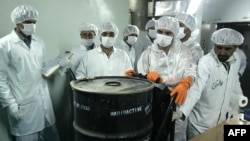
Amid an ongoing row between Washington and Tehran over whether international monitors can verify Iranian compliance with its nuclear nonproliferation commitments, former officials have told RFE/RL that the scale, scope, and degree of access are crucial to the success of inspections.
Details on those have yet to be determined, though Raffael Grossi, head of the International Atomic Energy Agency (IAEA) said the UN body "will be working on the modalities -- dates, procedures, places -- very soon."
That doesn't mean, according to experts, that the organization hasn't already drawn up a wish list for any eventual inspections.
"They almost certainly have a plan for when they go back in, what the priorities are, where they would want to go first, second, third," Laura Rockwood, a former IAEA negotiator on Iran, told RFE/RL.
"The key thing is to find out where in particular the enriched uranium is.... I'd be willing to bet you that they have in place a plan for the day they need to go back in," added Rockwood, who took part in high-level negotiations on Iran during a 28-year career at the IAEA before retiring in 2013.
Downblending Uranium
While US President Donald Trump has said that Iran has agreed to the highest level of nuclear inspections and Iran says it has no plans to allow the inspections, point No. 8 of the US-Iranian memorandum of understanding (MOU) states the two sides have agreed on a "minimum methodology" that Iran's stocks of highly enriched uranium (HEU) will be "downblended on site under the supervision of the IAEA."
But the details of this could also prove contentious.
"If IAEA inspectors were able to measure and characterize both the high and low enriched material before the downblending, then simple arithmetic gives a good sense of what the product is. They'd then want to measure to confirm, and seal that product for future accountability," Matthew Sharp, who served as director for Iran nuclear issues on the US National Security Council (NSC) from 2021-2022, told RFE/RL.
"If, on the other hand, Iran does the downblending itself and then provides the product to inspectors, it would be much more difficult to know how much HEU Iran started with, which could create uncertainties as to whether all of the 60 percent or other enriched material had been downblended or if some remained out of our awareness," said Sharp, now a senior nuclear fellow at the MIT Center for International Studies.
Right now, the location of Iran's roughly 450 kilograms of HEU is unclear. After the US and Israeli air strikes, it could be buried under rubble in a bunker beneath a mountain, or the Iranian authorities may have moved some or all of it elsewhere to hide it.
But if it can be successfully located and downblended, the next step is stopping Iran from re-enriching it again at a later date.
Monitoring Enrichment
The MOU says the two parties agreed "to discuss the issue of enrichment and other mutually agreed matters related to the Islamic Republic of Iran's nuclear needs, based on a satisfactory framework being agreed upon in the final deal."
Experts told RFE/RL that verifying this must include a role for the IAEA.
"Any suspension on uranium enrichment is relatively meaningless if it cannot be verified and if the IAEA does not have the access to ensure that there are no covert nuclear activities related to enrichment going on elsewhere in the country," said Kelsey Davenport, director of nonproliferation policy at the Arms Control Association.
"The level of access, the provision of information to the International Atomic Energy Agency, how quickly Iran has to comply with IAEA requests for access -- all of that is going to be crucial," she told RFE/RL.
"Once the enrichment level is low, below 5 percent, it's much safer to ship out that material. It could be stored under an international fuel bank in Kazakhstan," Davenport added.
The idea of shipping the downblended uranium out of Iran is something US officials appear keen on. At a recent background call with reporters, one official said dilution within Iran was "the floor" but that "we will push for more than that."
A senior US official said Washington would rely heavily on the UN nuclear watchdog and US technical teams for verification. "We're not in the trusting business," the official said.
The IAEA has previously verified Iran's compliance with its commitments to the Nuclear Non-Proliferation Treaty, which it ratified in 1970, and the 2015 Joint Comprehensive Plan of Action (JCPOA).
Lessons From The Past
Experts say many lessons have been learned from these experiences. They point to the importance of the IAEA's Model Additional Protocol, which provides additional tools for verification.
Rockwood, now a senior fellow at the Vienna Center for Disarmament and Non-Proliferation, was the principal author of the protocol.
"Under the additional protocol, instead of just routinely being limited to nuclear material, nuclear facilities, we have access to information and locations concerning the entire nuclear fuel cycle including the production of centrifuges," she said. "So, if you know roughly how many centrifuges they are capable of making, you want to know where they are, and we can ask for that kind of access with an additional protocol."
Iran signed the additional protocol in 2003 but has not sent an official letter to the IAEA that would bring it into force.
Iran has provisionally implemented its provisions, between 2003-2006 and for a period under the JCPOA. However, noted Rockwood, "there were lots of indications of noncompliance by Iran" during this time.
This, she said, could be expected to continue -- with added complications.
Iran stopped granting the IAEA access to sites hit by US and Israeli strikes on its nuclear facilities in June last year. This has disrupted what Rockwood calls the "continuity of knowledge." In other words, the IAEA has lost track of what Iran has and where it is. Also, the extent of damage is unclear, potentially complicating access, and there may also be unexploded ordinance onsite.
"There will be uncertainties, and there may be more uncertainties than there were before. In fact. I would expect that to be the case. Yeah, really, a heavy slog," Rockwood said.
Rubio Heads To Gulf As US Seeks To Cement Iran Framework, Allay Security Fears

WASHINGTON -- US Secretary of State Marco Rubio will travel to the United Arab Emirates, Kuwait, and Bahrain this week on his first official visit to the Gulf since the outbreak of the Iran war and just days after Washington and Tehran signed a framework agreement aimed at bring peace to the region.
The diplomatic mission to reassure regional allies of the Trump administration's strategic trajectory with Tehran will also look to reinforce security protocols around the volatile Strait of Hormuz.
The June 23–25 tour occurs at a critical juncture for US foreign policy: It follows intensive weekend negotiations in Switzerland that Vice President JD Vance described on June 22 as having established a "good foundation for a successful final deal" to conclude the Middle East conflict.

State Department spokesman Tommy Pigott confirmed Rubio will discuss "regional priorities including the memorandum of understanding with Iran, efforts to secure full and free safe transit through the Strait of Hormuz, and the importance of peace and stability in the region."
The high-stakes trip underscores the Trump administration's broader effort to translate tentative diplomatic breakthroughs into durable security guarantees for Gulf partners, many of whom remain deeply skeptical of Tehran's long-term compliance despite recent de-escalation.
Balancing Diplomacy And Deterrence
Rubio's Gulf itinerary is designed to advance parallel objectives: consolidating the diplomatic momentum generated in Switzerland while preserving the regional security architecture.
During the weekend talks, Vice President Vance indicated that Washington is exploring confidence-building measures to maintain momentum. Notably, the United States could consider unfreezing select Iranian assets exclusively for the purchase of American agricultural commodities, specifically soy, corn, and wheat -- a move that would target humanitarian relief while maintaining core economic leverage. Concurrently, Tehran has agreed to readmit UN nuclear inspectors, signaling a mutual intent to restore baseline verification mechanisms after months of direct confrontation.
However, Vance cautioned that comprehensive resolution remains distant. "The final deal is the house," Vance told reporters. "We set the foundation. We haven't built the house, but we've laid a successful foundation to get to a good place for the American people."
For the Gulf states, structural guarantees outweigh rhetorical progress.
Landon Derentz, former White House energy director during the first Trump administration and current vice president for energy and infrastructure at the Atlantic Council, emphasized that Rubio's primary challenge will be demonstrating institutional continuity.
"Secretary Rubio's trip is about durability," Derentz told RFE/RL. "The immediate challenge of reopening the Strait of Hormuz has largely passed; the larger challenge is convincing America's Gulf partners that the US-Iran agreement can provide the stability necessary for long-term investment, economic growth, and regional security."
Derentz added that the economic stakes are inextricably linked to geopolitical predictability.
"Energy markets run on confidence as much as supply. The Gulf's energy sector operates on investment horizons measured in decades, not quarters," he said. "If this agreement is to endure, it must earn the confidence of America's regional partners, whose support will ultimately determine whether today's de-escalation becomes lasting stability."
The Strait of Hormuz As Strategic Anchor
The explicit inclusion of the Strait of Hormuz on Rubio's agenda highlights the enduring vulnerability of a maritime chokepoint responsible for the transit of roughly one-fifth of global oil supply. While acute disruption risks have normalized, the waterway remains highly sensitive to localized escalation by Iran or its asymmetric proxies.
Luke Coffey, a senior fellow at the Hudson Institute specializing in national security, observed that the trip serves as a mechanism for both reassurance and concrete defense alignment.

"Rubio's visit comes at an important time for two reasons," Coffey told RFE/RL. "First, with all the uncertainty surrounding the peace talks in Switzerland, he will want to reassure US Gulf allies that America remains committed to stability and security in the region. Second, he will want to focus on more practical matters, such as reopening the Strait of Hormuz, where many Gulf states are important US partners and vital to any such endeavor."
Coffey highlighted Bahrain -- host to the US Navy's Fifth Fleet -- as the operational anchor of the trip, where Rubio is slated to brief US naval commanders. He warned against reading the Swiss breakthroughs as a definitive pivot toward peace.
"The events of the last 24 to 48 hours, whether in Switzerland or now in the Gulf, are a reminder that this situation with Iran is far from over," Coffey added.
In addition to bilateral state meetings, Rubio will convene with the Gulf Cooperation Council in Bahrain. The multilateral session will likely focus on aligning regional defense frameworks with Washington's shifting diplomatic stance.
For Gulf leadership, the visit represents an early litmus test of whether the administration's dual-track approach of structured engagement and active deterrence can genuinely prevent a return to conflict.
- By RFE/RL
Vance Cites 'Good Progress' On Roadmap Toward Reaching Final Iran Deal

Vice President JD Vance said "good progress" was made in negotiations on a framework toward reaching a final peace deal within 60 days, including the guarantee of safe passage through the Strait of Hormuz, an end to fighting in Lebanon, and Tehran's acceptance of visits by international nuclear inspectors.
"We laid a very good foundation for a successful final deal," Vance told reporters on June 22 at the Burgenstock resort in central Switzerland after talks between the two sides went through the night.

"The final deal is the house. We set the foundation; we haven't built the house, but we've laid a successful foundation to get to a good place for the American people."
Few specific details have been announced but the agreement appeared to reflect the aspirational goals announced in the memorandum of understanding (MOU) signed by the US and Iranian presidents last week.
That MOU left many terms of a 14-point agreement open to interpretation.
Vance said Tehran had agreed to allow International Atomic Energy Agency (IAEA) inspectors back into the country and that the parties worked on establishing a "coordination mechanism" for keeping the Strait of Hormuz open for energy shipments and to demine the area to avoid disruptions to global oil and gas flows.
An earlier statement from the Qatari and Pakistani mediators for the talks said that while formal negotiations had concluded for the opening session, further technical discussions would be held by the delegations in the upcoming week.
It said "working groups" would be established to address "nuclear, sanctions, and a monitoring and dispute resolution group to ensure the effective implementation of the MOU, and on other matters."
The Iranian Foreign Ministry, in remarks reported by Iranian state media, said a US blockade of ports had been lifted, "some frozen assets" had been released, and a "major reconstruction development plan launched for Iran."
A ministry spokesman said that, in regard to the safe passage of ships through the Strait of Hormuz, "it was agreed to arrange a mechanism," without elaborating.
Officials said the talks lasted 18 hours.
Vance, special envoy Steve Witkoff, and Jared Kushner -- US President Donald Trump's son-in-law -- led the US negotiating team. Parliament speaker Mohammad Baqer Qalibaf and Foreign Minister Abbas Araqchi headed Tehran's delegation.
The mediator's statement said that building on the previously agreed MOU between Washington and Tehran, "the parties have agreed to the establishment of a High Level Committee, which will provide political oversight on the mediation.
"The committee has agreed on a "roadmap" toward reaching "a final deal" within 60 days, it said, "laying the foundation for the immediate commencement of further technical talks."
It said that a "communication line" has been created for the 60-day period "to avoid incidents and miscommunication with the aim of safe passage for commercial vessels through the Strait of Hormuz."
The statement added that a "deconfliction cell" will be created involving the US, Iran, and Lebanon -- to be "facilitated by the mediators" -- to ensure the termination of military operations in Lebanon as set out in the MOU.
Iran's Araqchi echoed Vance's comments in a post on X, saying that there was "major progress" in the talks.
"Pakistani and Qatari mediation has delivered major progress to end Lebanon War," Araqchi wrote.
"Oil and petrochem exports are waived, blockade lifted, some frozen assets released, and major reconstruction & development plan launched for Iran," he said.
Washington has pledged to facilitate the release of a $300 billion reconstruction fund backed by regional nations once a broader final agreement on Iran's nuclear program is reached. The deal, and especially the agreement to set up a reconstruction fund and the lack of clarity on Iran's nuclear program, has been met by anger by US Democrats and many Republicans, as well.
Vance countered those concerns by saying that "if" Iranian funds are ever unfrozen, the US will "ensure that... Iranian money goes to help the people of Iran and not to fund terrorism."
Many Israeli leaders have also expressed doubt on some aspects of the talks, noting that their country is not a party the agreement and have vowed to continue attacks on Hezbollah sites in Lebanon.
Iran-backed Hezbollah, a militant group and political party that controls much of southern Lebanon, is considered a terrorist organization by the US, while the EU has blacklisted its armed wing but not its political branch.
Reports have also suggested that resistance by some hard-line factions inside Iran -- including the Islamic Revolutionary Guards Corps -- have put additional pressure on Tehran's negotiating teams.
- By RFE/RL
Trump Threatens To Hit Iran 'Very Hard' Over Hezbollah 'Proxies'

LUCERNE, Switzerland -- US President Donald Trump threatened to hit Iran "very hard again" over its "proxies" in Lebanon, as high-level talks are now under way between US Vice President JD Vance and Iranian representatives at the Burgenstock resort in Switzerland on June 21.
"Iran must immediately stop their highly paid PROXIES in Lebanon from causing trouble," Trump posted on social media, referring to Iran-backed Hezbollah, which has been exchanging fire with Israel.
"If they don't, we'll hit Iran very hard again, just like we did last week, only harder!!!" the US president wrote.
Hezbollah is both a militant group and political party that controls much of southern Lebanon. It is considered a terrorist organization by the United States, although the European Union has only blacklisted its armed wing.
In response to Trump's comments, Iranian parliament speaker and top negotiator Mohammad Baqer Qalibaf warned Washington against making threats toward Tehran, vowing that the country's military was "ready to respond."
"They would do better to be careful with their statements; our armed forces are ready to respond to them in a different manner. No matter what they say, we are the ones who act," Qalibaf said.
Neither Israel nor Lebanon is directly represented in the talks in Switzerland, which are aimed at finalizing a memorandum of understanding to end the war between the United States and Iran that began nearly four months ago and reopen the Strait of Hormuz.
Trump's post came shortly after Vance hailed the talks in Switzerland as "a historic meeting," saying the goal was to "turn over a new leaf to transform our relationship with the people of Iran, and to extend an outstretched hand."
"Outside the last few months, never before have the Iranian and American leadership met at such a high level," Vance said at the talks.
He said, US negotiators were in Switzerland to, "through diplomacy, through working together, transform the Middle East, where Iran and the Gulf have been at war with each other."
"We see a future where everybody can work together to promote peace and prosperity for everyone," he added.
The timing is critical.
The United States and Lebanon announced on June 19 that the next round of Lebanese-Israeli talks will be held next week in Washington, as Beirut and Tel Aviv agreed to renew a fragile cease-fire.
At the same time, Lebanese authorities say Israeli strikes killed 67 people over the past 48 hours, while Hezbollah attacks left five Israeli soldiers dead. Israel has since paused operations, but Prime Minister Benjamin Netanyahu has vowed retaliation for any future threats.
Israeli Minister Israel Katz said on June 21 that Israeli soldiers are free to act without restriction to eliminate threats in Lebanon, adding that troops remained in position in what Israel refers to as a security zone.
That raises the possibility that even as Washington and Tehran negotiate, regional escalation could undermine the diplomatic track.
The Strait of Hormuz remains another major fault line. US and Iranian officials continue to dispute whether the waterway -- vital for global energy markets -- is fully open, a disagreement analysts say Tehran may use as leverage throughout the talks.
On the eve of the talks in Switzerland, Iran’s military announced that it was again closing the Strait of Hormuz to all shipping in response to the ceasefire violations in Lebanon.
Citing a source close to the Iranian negotiating team, Tasnim News reported on June 21 that Tehran would not allow the Strait of Hormuz to be fully reopened until Israeli military actions in southern Lebanon are halted and the agreed cease-fire commitments are upheld.
“The Strait of Hormuz will not be opened without restraining Israel in Lebanon, and lifting the naval blockade is not enough to reopen this waterway,” the agency quoted the source as saying.
"It's a card the Iranians are likely to keep playing," said one regional analyst close to the negotiations.
- By Kian Sharifi
Iran Under Pressure To Act As Fighting In Lebanon Continues
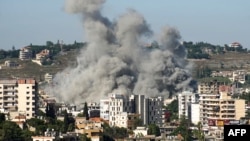
A wave of Israeli strikes that killed dozens of people in southern Lebanon this week has exposed a deepening rift inside Iran's political establishment, with hard-liners demanding that Tehran respond to what they call a blatant violation of the US-Iran memorandum of understanding (MOU).
The interim agreement was announced on June 15 after it was signed electronically following talks mediated by Pakistan. It was then signed, remotely, by US President Donald Trump and his Iranian counterpart, Masud Pezeshkian, on June 17.
The agreement's first clause calls for an end to the fighting "on all fronts, including Lebanon." Instead, Israeli air strikes killed at least 47 people, including a soldier, according to Lebanese health authorities, while Hezbollah said its fighters killed four Israeli soldiers in clashes near the Ali Taher hill, claiming to have destroyed three tanks.
Iran-backed Hezbollah, a militant group and political party that controls much of southern Lebanon, is considered a terrorist organization by the United States, while the European Union has blacklisted its armed wing but not its political branch.
Israel retaliated with strikes on the Bekaa Valley, with far-right National Security Minister Itamar Ben Gvir declaring that "all of Lebanon must burn."
The violence forced the postponement of a high-level Iran-US meeting in Switzerland on June 19 to begin talks on a permanent deal, and prompted France to publicly urge Washington to "exert all necessary pressure" on Israel to respect the agreement.

Hard-liners in Iran have been criticizing the agreement since it was announced and demanding tougher terms. Now, they feel the developments in Lebanon are giving them enough leverage to force the government to act.
Conservative parliamentarian Mahmud Nabavian warned that letting the violation slide would doom the rest of the deal.
"If you retreat on the [Lebanon] clause and ignore this blatant violation, and the enemy sees your weakness, then realizing the other clauses -- sanctions relief, unfreezing of funds and so on -- will certainly become impossible," he wrote on X.
Fellow MP Meysam Zohurian made a similar argument, tying Lebanon directly to Iran's other major point of leverage: the Strait of Hormuz.
"Any opening in the strait before a complete cease-fire is established in Lebanon -- and an Israeli withdrawal -- means Iran has accepted to prematurely implement the MOU," he wrote.
As part of the agreement, Iran is allowing toll-free transit of commercial ships through the strait, while the United States has lifted its blockade of Iranian ports.
One of the sharpest critiques came from commentator Nezamoddin Mousavi, who explicitly invoked Supreme Leader Mojtaba Khamenei's own reservations about the deal to pressure Iran's negotiators.
In a statement on June 18, Khamenei distanced himself from the agreement, saying he had authorized Pezeshkian's government to sign the MOU despite holding "a different opinion" himself and that Pezeshkian "explicitly accepted responsibility" for the outcome.
Seizing on that framing, Mousavi wrote: "Now the very first clause of the agreement -- 'end of war in Lebanon' -- is the first test of your commitment. This clause has been formally violated. What is your plan?"
It's a pointed line for Pezeshkian's government: Having staked its credibility on a deal that Khamenei was lukewarm about from the start, it now has to answer for that deal's first failure on his terms.
Not all of the criticism is coming from the hard-line camp typically associated with the Paydari Front, which has staged demonstrations against the MOU since it was first announced.
Cleric Jalil Mohebbi, who is close to chief Iranian negotiator Mohammad Baqer Qalibaf, offered a blunt assessment, writing in a short post on X, "Israel's renewed attacks on Lebanon won't leave any agreement intact."
Axios reported on June 20 that White House special envoy Steve Witkoff is traveling to Switzerland to meet Iranian Foreign Minister Abbas Araqchi, indicating the postponed talks might be back on track, albeit at a lower level than initially planned.
Still, the rumored meeting has its detractors. Tasnim news agency, an affiliate of the Islamic Revolutionary Guards Corps (IRGC), charged that there is "no justification" for meeting Witkoff given what's happening in Lebanon, and called on the authorities to again close the Strait of Hormuz.
"The negotiators must not only suspend all talks; they must also completely close the Strait of Hormuz before it is too late," Tasnim wrote. "While the enemy has failed to meet its commitments, relieving the pressure on them by keeping the strait open would be an irreparable strategic mistake."
- By Ray Furlong and
- Alex Raufoglu
Iran Deal Provides Economic Boost, But Hormuz Shipping Is Key
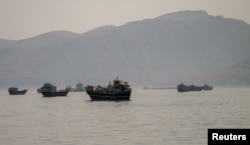
The Iran framework agreement gave an immediate boost to markets, with shares rising and oil prices dipping. But whether this translates into durable economic gains will largely depend on shipping in the Strait of Hormuz.
There were signs of traffic beginning to revive on June 18 in the hours immediately after the US and Iranian presidents signed a memorandum of understanding to end the war, according to Windward, a maritime intelligence company.
Speaking in an online briefing, Windward chief analyst Michelle Wiese Bockmann said 18 vessels had transited the strait between 6 p.m. on June 17 and 2 p.m. UTC on June 18, in what she described as "a sign of confidence in the agreement."
Specifically, she said these were a French-flagged liquid natural gas (LNG) tanker, two Hong Kong-flagged tankers, an Italian-flagged vehicles carrier, a Japanese-controlled oil tanker, and some Saudi-flagged tankers.
Ten of the vessels were outbound, having been stuck in the Persian Gulf for 109 days owing to the war that began with US and Israeli air strikes on Iran on February 28.
Prior to the war, some 20 percent of the world's oil supplies passed through the Strait of Hormuz, as well as large quantities of LNG, fertilizers, and other important products and commodities.
A 'Trickle' Of Ships
"It's going to start as a trickle, but certainly this is a very good sign, an early sign that there is confidence for outbound transits," Bockmann said.
"Transits averaged about seven vessels a day in the first two weeks of June until we had word of this agreement coming on [June 14]. And the total volume of transit so far in June already exceeds the 156 that we saw in May that we tracked. Certainly we see everything gathering force," she added.
Ben Cahill, a nonresident senior fellow at the Atlantic Council's Global Energy Center, indicated that this trickle needs to grow if the hope of an economic peace dividend is to be realized.
"It's all about tanker traffic. Agreements on paper don't matter much unless they really get oil moving again through the Strait of Hormuz, because that's what everyone will be monitoring -- the number of tankers exiting the strait to carry oil, gas, and other products to market," he told RFE/RL.
"But also, the entrance into the strait of tankers, because that's when normal loading operations will resume and when upstream oil and gas production throughout the Middle East can resume as well. You have to keep an eye on the two-way tanker traffic," he added.
This is a real test. Shipping companies must have confidence that if their vessels enter the Persian Gulf they will not get stuck there again by a renewed outbreak of hostilities. It's key to restarting loading of oil tankers from Iraqi, Kuwaiti, and Saudi port facilities, and to get Qatari LNG moving.
Under the deal, Washington has also issued a waiver of sanctions on Iranian oil, giving a further potential economic boost.
Windward also tracked Iranian vessels moving through the strait, as well as Iranian-controlled LNG and oil tankers heading west from southeast Asia through the Malacca Straits -- apparently confident of being able to load up in Iranian ports now that the US naval blockade of Iranian ports and waters has been lifted.
The First Test Is At Sea
But the bullish mood only lasts as long as the deal.
"There is an element of proof of concept in all of this," Naysan Rafati, Iran senior analyst at the International Crisis Group, told RFE/RL.
"The first test is at sea. Does traffic in Hormuz start to creep up? Do the Iranians still try to harass or fire drones at vessels? Does the US allow Iranian ships to go through the cordon?" he added.
Other key tests of the viability of the strait include insurance premiums, the presence of sea mines, and the question of tolls.
The text of the US-Iranian memorandum says: "The traffic of commercial vessels will immediately start and considering the need for removing the technical and military obstacles and demining by the Islamic Republic of Iran, will be instated within 30 days."
But at this stage, there are no details on when demining will begin and who will do it.
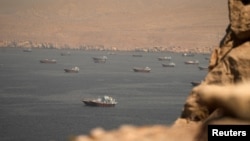
The deal also says Iran has agreed to toll-free transit through the Strait of Hormuz for 60 days, pending further talks with US negotiators.
Bockmann said the southern route through the strait is in Omani waters and that once this was demined the question of a toll became unimportant. Tehran has spoken of imposing "maritime service fees" in cooperation with Oman, but Bockmann said, "I really don't think that's going to fly."
On insurance, she told RFE/RL that it was "too early to say" whether costs would start to come down.
"We do know that additional premiums, which are part of war risks for going into what's called listed areas, are being recalculated daily. And they're a percentage of hull value. And before the war, they were less than 1 percent of hull value. And then we saw it sorted between 3 percent and 5 percent, sometimes as high as 10 percent," she said, adding that a return to lower premiums would be important for shipping to return to normal levels.

Cahill said he did not expect insurance costs to stabilize quickly, but that it was not the main problem.
"The problem was that vessel owners just didn't want to put their crews at risk. When they have that certainty, that safety, that feeling that it's OK to transit again, I think you'll see a pretty rapid result," he said.
The End Of Hormuz?
Iran blocked traffic through the strait in response to the US and Israel air strikes that began the war on February 28. The move sent global markets into turmoil, caused acute fuel shortages across swathes of Asia, and led Gulf oil and gas producers to start questioning whether they should prepare other routes to market.
Saudi Arabia boosted throughput on its East-West pipeline, pumping its crude to the Yanbu port on the Red Sea to bypass the strait. The United Arab Emirates found a similar solution, using its pipeline to the port of Fujairah, on the Gulf of Oman. Iran targeted both routes during the conflict, but neither was as vulnerable as the strait.
This has led some to suggest that the war has provided Iran with a future weapon that has even more leverage than a nuclear arsenal would -- namely, the prospect of switching off global trade flows whenever it pleases. Not everyone agrees, though.
"One of the lessons of this episode is that it's dangerous to be too dependent on a single chokepoint. And of course, the Strait of Hormuz is the world's single most critical oil chokepoint," said Cahill.
"Buyers in importing countries will reassess supply risk and transit risk through the Middle East in really significant ways," he added. "There's some skepticism that the Strait of Hormuz will ever again constitute such a wide share of global oil transit and exports. The bypass pipelines are under way. People will explore alternative infrastructure."
How Long Will It Take The World To Recalibrate After Hormuz Reopens?
While the US and Iran have reached a historic agreement to restore stability in the Strait of Hormuz, the path to a full global energy recovery is dangerously lopsided. As energy expert Ariel Cohen notes, the infrastructure damage is not uniform: "Oil supply is expected to be fully restored by the end of the year, but LNG supply restoration is projected to take much longer, possibly until 2028."
- By Ray Furlong
Trump's Iran Accord And The 2015 Nuclear Deal: What's Different This Time?
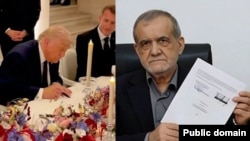
The US-Iranian deal to end their war and reopen the Strait of Hormuz is inevitably being compared with the 2015 Joint Comprehensive Plan of Action (JCPOA) agreed with Tehran by then US President Barack Obama.
That deal was fiercely criticized by his successor, Donald Trump, who pulled the United States out of JCPOA in 2018 during his first term of office. Trump has repeatedly said his deal would be better, although the text he signed in Versailles on June 17 is not the final one -- it leaves many issues to be negotiated over the next 60 (or more) days.

"If it were easy we would have resolved it, you know, two wars ago," Naysan Rafati, Iran Senior Analyst at the International Crisis Group, told RFE/RL, referring both to the 12-Day War in June last year and to this year's hostilities, that reignited with US and Israeli air strikes on February 28.
"The fundamentals of the Iranian nuclear program since last June have been different to what they were like under the JCPOA," he added.
What Was In The JCPOA?
One thing that is unchanged is that Iran has always denied wishing to develop nuclear weapons but possesses enriched uranium to grades beyond what is needed for civilian purposes.
This was a core problem then and remains so today.
Key elements of the JCPOA were for Iran to ship 98 percent of its enriched uranium stockpile out of the country, accept limits on future enrichment to well below weapons-grade levels, mothball some centrifuges that are used for enrichment, and allow all this to be checked by inspectors from the International Atomic Energy Agency (IAEA).
Wrapped in all this was a wealth of technical details, for example on exact levels of enrichment, quantities of enriched material, storage locations, and specific models of centrifuges. In addition, Iran pledged not to develop nuclear weapons.
In return, international sanctions related to the nuclear program (but not other issues such as Iran's support for armed proxy groups across the Middle East, its missile program, or its human rights abuses) would be lifted based on verification that Iran was complying.
Additionally, Iran was granted access to overseas frozen assets whose value was greatly disputed (and variously calculated), with claims and estimates varying between $50-$100 billion, as well as payments from the US government totaling $1.3 billion.
The deal had a dispute resolution mechanism and a 2030 sunset clause. It was approved by the UN Security Council.
The agreement faced political resistance in Congress from both sides of the aisle from lawmakers who criticized it for limiting Iran's nuclear program rather than dismantling it completely. Others pointed out that it failed to address the wider issues beyond the nuclear program that had also made Iran an international pariah.
Sanctions on Iran were lifted following IAEA verification in January 2016, with Washington certifying twice in 2017 that Iran was sticking to the deal.
The Road To War
In May 2018, President Trump withdrew from the agreement, which he described as "horrible, one-sided."
From 2020-2021, Iran began ramping up both its numbers of centrifuges and its uranium enrichment, according to IAEA reports. This led Britain, France, and Germany (known as the E3) to say Tehran was no longer complying with the JCPOA.
In June last year, Israel and the United States carried out air strikes on Iranian nuclear facilities, warning that Iran was close to developing nuclear weapons. The Pentagon later assessed that operation Midnight Hammer had put back the program by up to two years, though there were conflicting reports about the exact extent of the damage.
"There has been widespread damage both to its facilities and across many of its senior nuclear-related personnel. But we also have not had on-the-ground inspections at the damage sites. The IAEA has been able to go into a couple of facilities, but not the major enrichment facilities that were targeted under Midnight Hammer," said Rafati.
Iran began to restrict IAEA monitoring after the June conflict. Then, in September last year, another JCPOA provision, its so-called snapback clause, took effect.
This meant UN sanctions lifted under the terms of the deal were reimposed following Iranian noncompliance. The E3 initiated the move after Iran refused to meet their demands of full access for IAEA inspectors and transparency regarding enriched material stockpiles.
After the June 2025 conflict, Washington and Iran reengaged in nuclear talks. Those talks were abandoned when US and Israeli air strikes on Iran began on February 28.
What Now?
The memorandum of understanding (MOU) signed by Trump and Iranian President Masud Pezeshkian on June 17 provides for the immediate waiving of US oil sanctions on Iran, while tying the end of wider sanctions and the release of frozen assets to Iran implementing commitments, such as "down-blending" its stocks of highly enriched uranium under IAEA supervision.
"We're not in the trusting business," a senior US official said during a background call with journalists on June 17.
The issue of enrichment is also left to be dealt with in further negotiations, while Iran "reaffirms that it shall not procure or develop nuclear weapons."
As with the JCPOA, the MOU has been criticized, including with rumblings of discontent from Republican lawmakers who suggest Washington has given up too much for too little.
Max Meizlish, a senior analyst at the Foundation for Defense of Democracies, voiced concern over the oil sanction waivers.
"What we should be doing, if this is truly a performance-based deal, is tying any sanctions relief to actual conduct by the regime that goes beyond just participating in the negotiation, signing the memorandum of understanding, and opening up the strait," he told RFE/RL.
"The US Congress is not going to give up easily here, absent significant reforms by Iran. And we'll have to see. We'll have to see what the US ultimately pushes for," he added, referring to the talks yet to come.
Meizlish also criticized the lack of any reference to Iran's other "malign activities" such as its missile program and support for groups such as Hezbollah, which is designated a terrorist organization by Washington.
As noted, the JCPOA was criticized on the same grounds.
The situation now, following two wars that have devastated Iran's economy and damaged its nuclear facilities, is very different from 2015. Those conflicts have also substantially eroded trust, further complicating talks.
The JCPOA was not just a bilateral US-Iranian process: Russia, China, Britain, France, and Germany were all involved in negotiations lasting nearly two years. The MOU says negotiators will aim for a deal within 60 days but also that this time period can be extended.
Rafati said the talks will need to be more technical and complex than they have been so far in 2025-26.
"Even when they were in Oman or in Rome, they were this cumbersome process of indirect negotiations in fairly kind of short bursts of time, kind of between brunch and dinner," he said.
"Are they going to be accompanied by expert delegations that are actually going to get into the granularities of the nuclear nonproliferation side of things and the sanctions-relief side of things? Those technical delegations were present at some, but not all of the past negotiations…if there's any kind of aspiration for getting this wrapped up in 60 days, it would have to be a fairly regular and empowered and technically competent set of experts from both sides," he added.